AI Consultancy Options for Small Accounting Firms Without Enterprise Budgets
Small accounting firms can automate workflows affordably if they pick the right consultancy model.

A small firm automates its tax prep workflow, cuts turnaround by half, and the client notices nothing except that the invoice arrived on time. The gap between internal improvement and client-visible credit is driving the AI decision facing small accounting firms right now. The cost and infrastructure barriers that once made AI an enterprise-only tool have come down, so the constraint today is picking the right path, not scraping together the budget to get in the door.
Three pressures are converging at once. Clients expect faster turnaround than they did even three years ago, full stop on patience for a six-week response to a document request. The talent pipeline feeding the profession has thinned: the number of new CPA exam candidates has dropped meaningfully over the past decade, and three-quarters of today's licensed CPAs had already reached retirement eligibility by 2020. At the same time, non-CPA advisory firms are moving faster on automation and taking on work that used to sit squarely inside traditional accounting practices.
Put those three together, and waiting stops looking cautious. A firm that treats AI as a someday project is choosing to compete against firms that already automated the document intake, the reconciliation, the first draft of the advisory memo. The real question for a small firm in 2026 is how to tell a consultancy that will actually build something from one that will hand over a strategy document and an invoice.
What makes an AI consultancy engagement real
Before a firm evaluates any specific consultancy, it needs a way to separate three very different things that all get marketed as "AI consulting." A reseller configures someone else's software and hands over the login credentials. A builder writes a system from the firm's own data and workflows and leaves the firm owning it. A strategy consultant produces a document full of recommendations and departs once it's delivered. The fastest way to tell these apart is to ask two questions in the first conversation: who owns the code at handoff, and what does the 30-day deliverable actually look like? A strategy consultant will answer with a framework. A builder will answer with a working system running on the firm's own files.
Implementation depth is the second test, and it matters because partner demos lie. A slick demonstration for the managing partner proves that one person's browser has a working chatbot. It does not prove the firm's economics have changed. Phos AI Labs' evaluation criteria for accounting AI consultants lists team-wide adoption, under the heading of implementation depth, as one of five selection criteria, alongside professional standards fluency. The question to ask is whether every CPA and staff member on the team is actually using the system daily, with guardrails in place, or whether the whole engagement lives inside one partner's laptop.
Professional standards fluency is the third test, and for accounting-specific engagements it carries no flexibility. Any AI system that touches client financial data has to be deployed inside a governance framework that covers AICPA standards, IRS Circular 230, and client confidentiality from day one. A consultancy that plans to bolt governance on after deployment has already misunderstood the assignment, because client financial data carries regulatory exposure that generic business software does not.
Deadline awareness is the fourth test, and it's a cheap way to spot a consultancy that has never actually worked inside an accounting firm. Tax season, extension deadlines, year-end close are the calendar the entire firm runs on. A consultancy that proposes a generic 90-day engagement with no regard for when April 15th falls has likely never built anything for a firm like this before.
These four tests, ownership at handoff, team-wide adoption, standards fluency, and deadline awareness, form the lens for everything that follows. Any consultancy can claim to meet all four in a sales call. The next section applies the tests to the actual firms and models a small accounting firm will encounter in the market.
The four consultancy models available to small accounting firms
Four distinct engagement models exist in the market in 2026, each with a different price point, commitment level, and fit. Which one makes sense depends on the firm's revenue band, how clearly it understands its own bottleneck, and whether it wants a long-term partner or a scoped project with a defined end date.
The first model is the accounting-specific embedded partner. This fits firms with recurring, document-heavy workflows, a managing partner who wants AI running across the whole team rather than sitting in one browser tab, and monthly revenue sufficient to sustain an ongoing retainer. This model trades a higher recurring cost for deep familiarity with accounting-specific workflows from day one.
The second model is the fractional or embedded AI retainer, built for generalist firms with accounting capability. SANSA is a clear example of this model: it embeds an AI engineer directly inside the firm's operations, diagnoses the highest-leverage AI opportunity within two weeks, builds a production-ready system around that opportunity, and stays embedded as the results compound. Proof points from comparable service-firm engagements include substantial reductions in manual data entry for an insurance broker and more than a hundred hours a month saved for a freight company. SANSA is built for SMBs across accounting, insurance, logistics, and general services, and because the engineer works embedded, the firm's own staff shape the system as it's built and adopt it as a matter of course. This model fits firms where the bottleneck is clear but the internal capacity to scope, build, and maintain a system is not there, and where the goal is a capability that keeps compounding.
The third model is the sprint or project-based commissioned build. ColabContent, a Boston-based commissioning house, builds custom AI for mid-market firms on a fixed fee, with the firm owning the code at handoff and no ongoing seat license. The engagement runs in five steps: a diagnostic conversation, a working prototype built on the firm's own data within a short window and before any fee is owed, a written fixed-fee scope paid in two installments, the production build itself (roughly 4 to 5 weeks for one focused system, 6 to 8 weeks for an end-to-end workflow, 10 to 14 weeks for a multi-system platform), and finally training, post-launch tuning, and full source code handoff. ColabContent explicitly recommends buying a vetted platform first and only commissioning a custom build when no existing product addresses the actual constraint. This model fits firms with a well-defined, differentiating workflow that no off-the-shelf vendor covers, where owning the system outright over a 24-month horizon costs less than a subscription that compounds per seat.
The fourth model is the fractional Chief AI Officer or advisory retainer. This fits firms that want executive-level strategy without committing to implementation yet, and it works well as a diagnostic step before choosing among the other three models.
Matching a firm to one of these four models depends less on budget alone than on how clearly the bottleneck has already been identified, a question the next section turns into a decision framework.
The build-vs-buy decision for firms under 50 people
For accounting firms under 50 people, the default answer is to buy an existing product. The June 2026 CPA.com AI Build vs. Buy Decision Framework, co-authored with the innovation consultancy radical, is the most authoritative tool available for making that call at the partner level.
The framework rests on a three-condition test. Buy when the workflow is high-volume, low-differentiation, and already served by a mature vendor: accounts payable, bank reconciliation, document intake, categorization, and e-signature routing all qualify under this standard. Consider building only when the workflow is client-facing, reflects the firm's own unique method, and no vendor packages anything the firm would trust in front of a client, and even then, ask whether most of it can be bought and only the remainder configured. Commission a fully custom build only when the constraint is specific enough that no existing product addresses it, and require a working prototype on the firm's own data before any money changes hands.
The strongest objection to a buy-first approach is vendor lock-in. For a firm under 50 people without internal engineering capacity, though, the alternative, a custom system nobody on staff can maintain once the consultancy leaves, carries more operational risk than a subscription dependency does.
The practical sequencing follows from the framework directly. Start with one high-volume, repetitive workflow. Run a 30-day pilot with an off-the-shelf vendor whose demo the firm can reproduce on its own data, not just watch on a sales call. Measure hours per item before and after. Then decide whether to expand the pilot, switch vendors, or bring in a consultancy to build what the product can't handle.
Most 30-day pilots that underperform do so because of one overlooked step: a data quality audit before the pilot starts. Firms that skip this step routinely miss the headline metrics the vendor demoed because the firm's own data wasn't clean enough to feed it. Any credible consultancy should surface this in a readiness assessment before the pilot even begins.
Michael Cerami of CPA.com put the underlying discipline directly: "The firms that will differentiate in the AI era are not necessarily the ones moving the fastest, they're the ones moving most intentionally. That discipline, buy first, test on real data, build only where nothing else works, is what separates the firms in the next section that got the decision right.
Three small-firm implementations that show what happens when the decision is made correctly
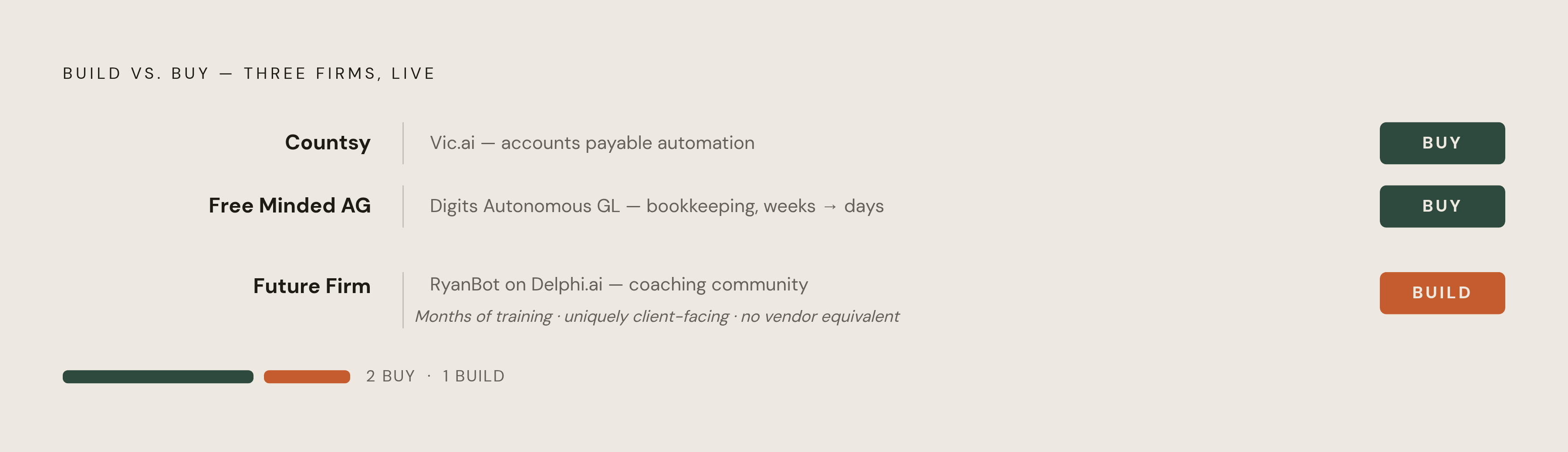
Three well-documented small-firm implementations show this framework in practice. The pattern across them is two buys and one build, and the build was justified only because of a uniquely differentiating, client-facing product that no vendor offered.
Countsy, which provides outsourced accounting and fractional CFO services to venture-backed startups, bought Vic.ai for accounts payable. The workflow fit the buy criteria exactly: high-volume, rules-based, already served by a mature vendor, and not the kind of client-facing differentiator that required Countsy's own unique method to execute.
The Free Minded Accounting Group bought Digits' Autonomous General Ledger for bookkeeping. Annual cleanups that used to take weeks now take days. The build verdict here is buy: the workflow is high-volume and largely rules-based, and the firm's competitive advantage lives somewhere else. The case illustrates how often the highest-return move in this space is unglamorous: purchasing a product that already does the job, rather than commissioning something custom to do the same thing more expensively.
Future Firm built RyanBot on Delphi.ai for its coaching community, a custom AI trained on Future Firm Accelerate content. The launch generated substantial early engagement and required months of iterative training to get right. The build verdict is build, but only on a low-code platform, and only because the underlying workflow was uniquely client-facing, tied directly to Future Firm's own content and voice, with no vendor positioned to deliver anything comparable.
The exception here proves the rule it breaks. The only justified custom build among the three cases was the one with a genuinely differentiating, client-facing product, and even that build ran on a low-code platform. Two buys, one build. The build was the exception to the rule, not a template for how most firms should approach the decision.
Embedding AI in the right bottleneck
The real payoff of a correctly scoped AI engagement for a small accounting firm has nothing to do with working the same hours more efficiently. It's the removal of a ceiling. Firms that get this decision right stop turning away clients during busy season, stop delaying advisory work because the compliance backlog eats every available hour, and stop hiring reflexively just to keep pace with volume that a properly built system could absorb instead.
That distinction separates an efficiency gain from a capacity gain. Buying Vic.ai or Digits' Autonomous General Ledger frees up hours that used to go into data entry and reconciliation. Those hours don't just disappear into slack time. They become capacity for advisory work, for the kind of client relationship that produces recurring revenue. The embedded models, whether that's SANSA working inside day-to-day operations or ColabContent commissioning a system around a specific constraint, aim at the same outcome from a different entry point: find the actual bottleneck, build or buy directly into it, and let the freed capacity become something the firm can sell.
A firm that treats this as a one-time efficiency project will get a one-time efficiency result. A firm that identifies its real bottleneck, correctly chooses to buy where a mature vendor already exists and build only where the constraint is specific enough to demand it, and sticks with a partner who stays embedded as outcomes compound, ends up with something structurally different: a practice that can take on more clients without proportionally more staff, and a team that spends its hours on the work only accountants can do.