Automation's Role in Accounting Firm Client Capacity Gains
Automating back-office work, not billable tasks, lets firms serve more clients without hiring.

Accounting firms are hitting a ceiling on how many clients they can serve, and the ceiling has nothing to do with demand. Work is plentiful. What's scarce is the staff time to take more of it on, and that scarcity, being structural, isn't a seasonal squeeze that eases once hiring catches up. The administrative load that used to sit with junior staff has climbed up the ladder to senior accountants, and there's no hiring pipeline deep enough to push it back down.
Finance leaders report it routinely takes two months or more to fill an open accounting role, and plenty of positions stay vacant far longer than that. Even firms with the budget to hire can't fill seats fast enough to relieve the pressure. At the same time, clients want more from every engagement than they used to. Real-time advisory has replaced annual compliance delivery as the baseline expectation, so the same client now takes more hours to serve properly, not fewer. Hiring alone can't raise the ceiling fast enough to keep up. The real question for most firms is whether they can grow at all without automating.
Where the hidden capacity goes
The constraint is that a large share of staff hours never reach professional work in the first place, not that professional work takes too long. Those hours go to coordination: chasing down documents, re-entering data that already exists somewhere else, confirming receipt of a file for the third time. None of that is accounting. All of it eats the time that accounting would otherwise fill.
Picture a senior accountant spending eight hours a week sending reminder emails and following up on missing bank statements. That person's salary doesn't change because of those eight hours, so the invisible cost is what those eight hours could have billed at a senior accountant's rate across a full year, a far larger number than the hours themselves suggest. As junior headcount has shrunk across the profession, that coordination work hasn't disappeared. It's moved up to the people who cost the most to keep doing it.
This is where the whole argument turns. Automating billable work faster produces efficiency: the same client gets served in less time. Automating the coordination layer that blocks billable work produces something different: capacity. More clients get served, not the same clients served quicker. Firms that optimize for speed on existing engagements are solving the wrong problem. The hours worth reclaiming are the ones spent getting to the point where the accounting can start, not the ones spent doing the accounting.
What the capacity gains from automation look like in practice
Firms that have automated the right workflows, specifically the administrative bottlenecks rather than everything at once, report gains visible as more engagements per staff member, not just faster turnaround on the clients they already have.
The CPA.com 2025 AI in Accounting Report documents vendor-reported time savings between 30 and 70 percent on bank reconciliations, transaction coding, and month-end close. Firms capturing those gains have largely used the freed time to reallocate capacity toward advisory work and new client intake, not to cut hours or shrink teams. The time didn't vanish into efficiency. It got redirected into growth.
Scale that down to a five-person firm, the size where this matters most directly. Recapturing even a modest, meaningful block of weekly hours by automating administrative work can translate into room for several additional clients without adding a single hire. At typical per-client revenue for a firm that size, that arithmetic matters even at a small scale. It's the difference between a firm that turns away prospective clients every tax season and one that takes them on. No single named analysis ranks one driver above the rest, but the direction is consistent: the time comes back, and firms redirect it toward growth.
The workflows worth automating first, ranked by how fast they free capacity
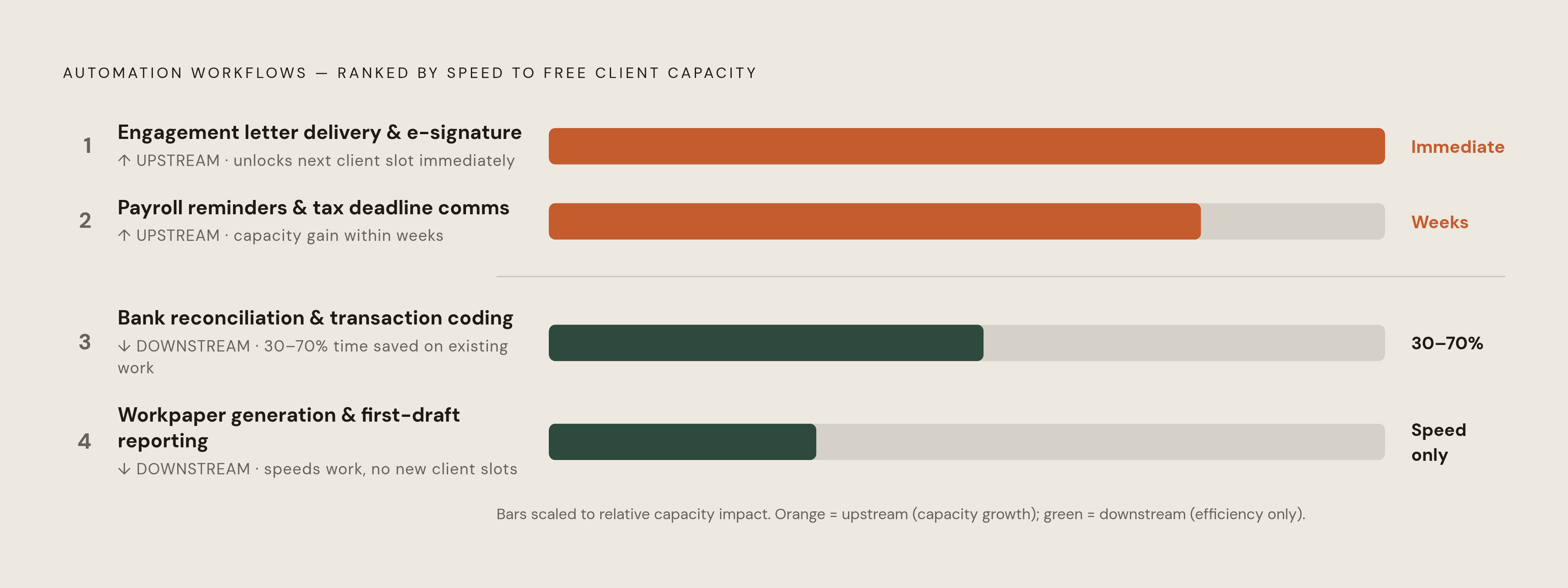
Not every automatable task contributes equally to how many clients a firm can serve. The workflows that remove coordination between the firm and the client unlock the most new engagements per hour reclaimed, and they tend to pay for themselves the fastest.
Engagement letter delivery and e-signature routing sit at the top of that list. Manual back-and-forth on getting a letter signed delays the start of an engagement and creates bottlenecks right when a firm has the least slack, during season peaks. Automating that step doesn't just save time. It opens the slot for the next client sooner.
Payroll reminder sequences and tax deadline communications follow close behind. These typically pay back within weeks, because the labor cost of manually staging and sending deadline reminders across an entire client base adds up fast, and the automation itself is simple to configure. There's little complexity standing between a firm and this gain.
Bank reconciliation and transaction coding rank next. The CPA.com 2025 AI in Accounting Report documents agentic AI adoption for reconciliation as one of the fastest-growing use cases in the profession, with vendors reporting time savings between 30 and 70 percent across these workflow tasks. The automation flags exceptions for a human to review rather than replacing judgment on anything complicated, so the gain comes from removing repetitive matching work, not from removing oversight.
Workpaper generation and first-draft reporting round out the list. The time savings documented sit downstream of the coordination bottleneck. Automating them helps a firm move faster on work it already has. It doesn't expand how many clients that firm can take on the way upstream automation does.
The sequencing logic follows directly from that ranking: start wherever work is stuck before it can even begin, whether that's a document that hasn't arrived or an engagement that hasn't started. Those are the points where an hour reclaimed becomes a new client slot, not just a quicker close on a client already on the books.
Where a realistic first deployment stalls
Firms that capture capacity gains quickly share one pattern: they pick a single, bounded workflow, configure it fully, and measure the result before touching anything else. Firms that try to automate several things at once, partially, tend to end up with several things half-working.
Practitioner accounts of how this actually plays out describe a four-week structure. The first week is spent mapping the current process exactly as it exists, capturing every spreadsheet, every email chain, every manual export, and every informal approval that lives in someone's head. Only after that mapping does a firm pick one pilot: document collection, invoice preparation, reconciliation, or client deadline communications. Not a mix. One.
Timelines vary a lot depending on what a firm is working with. Firms using the AI already built into platforms like QuickBooks or Xero can move quickly, because the integration work is already done. Firms on mid-market platforms that need to connect with separate practice management software should expect longer timelines, and the delay comes almost entirely from data quality and integration work, not from the automation logic itself.
The most common place firms stall is underinvesting in implementation support. The common mistake is underbuying the support needed to run the platform well while overpaying for features nobody on the team ends up using.
A second stall point appears even in firms that get the implementation right: skipping the baseline measurement. A firm that doesn't measure how long the old process took can't prove the new one is faster, and without that proof, there's nothing to point to when making the case to automate the next workflow. Momentum inside a firm depends on being able to show a number, not just a feeling that things got easier.
Document collection makes a strong starting pilot for firms weighing where to begin. It carries the highest total hour-savings potential of the candidates listed above, the automation logic is simple enough to test cleanly, and the payback arrives fast enough to build a case for what comes next.
Why the right framing is capacity expansion, not headcount replacement
Firms that have automated broadly are serving more clients with the same team, a very different outcome than the job-loss story that dominates most conversations about automation in professional services.
The CPA.com 2025 AI in Accounting Report states the point directly: AI isn't replacing practitioners, it's amplifying what they can do. Firms investing in automation are putting the freed capacity toward advisory and analytics work, not cutting staff. That's the clearest signal available on where this is actually headed at the firm level.
There's a less comfortable truth sitting next to that reassurance, and it deserves honest treatment. Automation changes who a firm needs to hire, not whether it needs to hire at all. As the simpler, repetitive tasks get automated, the human work that remains demands more judgment, stronger client relationship skill, and comfort working alongside automated systems. Firms may find themselves competing harder for that kind of talent, even as they need fewer total people.
The staffing pyramid itself is shifting as a result of that change. The old model depended on a steady supply of junior staff to process volume. That supply has been thinning for years regardless of what any individual firm does about automation. What's replacing it is a leaner team of more experienced practitioners, supported by automated systems doing the volume work juniors used to handle. That's less a choice firms are making and more the shape the profession is settling into, given who's actually available to hire.
For a small firm, the capacity argument lands more directly than any of the macro trends. A five-person team that automates its coordination layer removes the ceiling that was forcing that team to turn down engagements or push work past tax season because there simply weren't enough hours to go around.
How automation compounds from the first workflow into new service capability
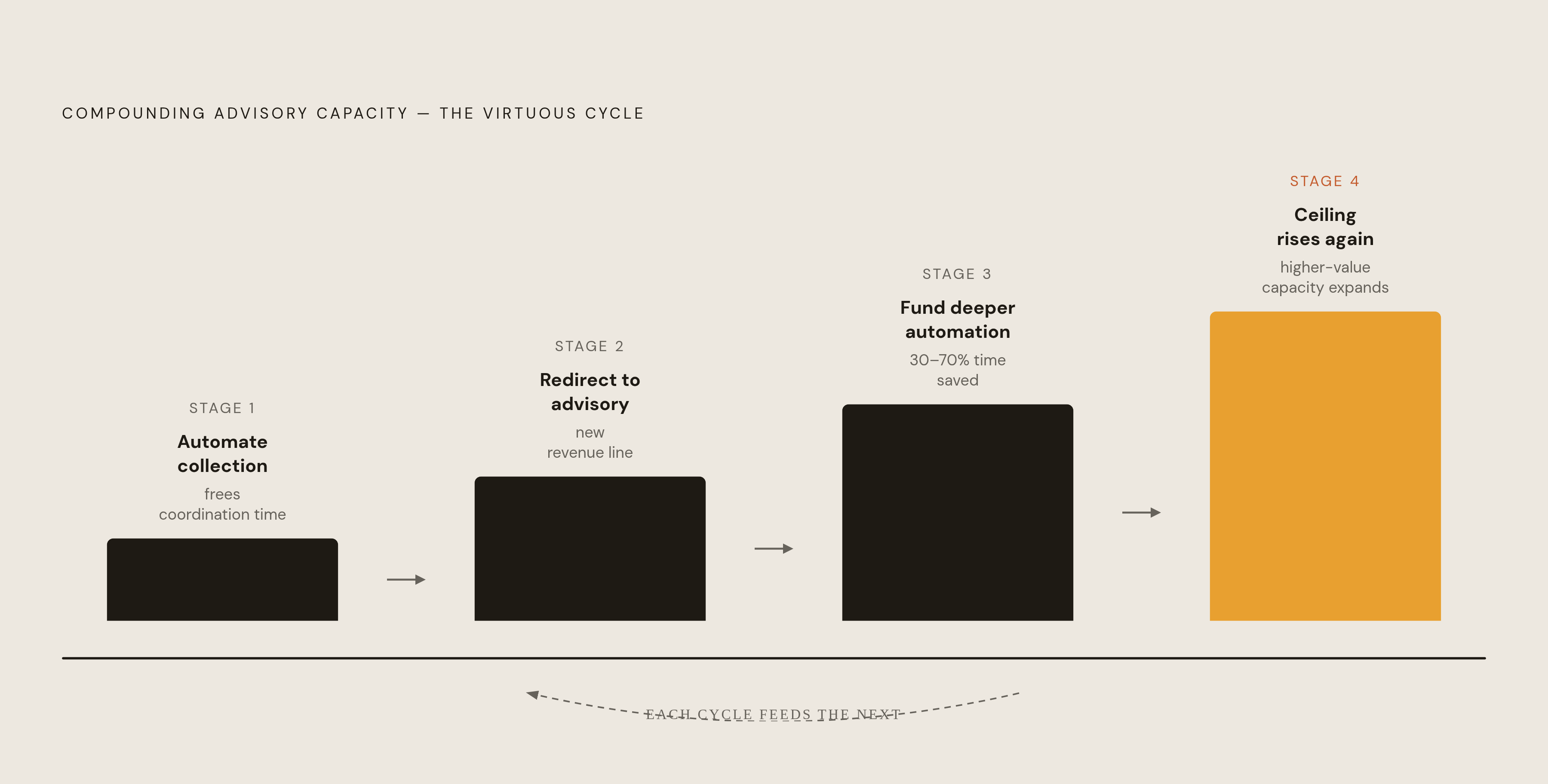
The firms gaining the most from automation are the ones that took the capacity freed by the first workflow and used it to fund the next layer, compounding past that first win into services they couldn't have staffed before.
The CPA.com 2025 AI in Accounting Report frames this as a central strategic theme for the profession: time saved through workflow automation is being reallocated toward higher-value advisory work, giving the firm a different offering than it had before. The Intuit QuickBooks Accountant Technology Survey backs this up from a different angle, finding that a strong majority of respondents already use AI to support strategic advisory work for clients, with a somewhat smaller share expecting advisory services to grow over the next year. Put together with the 30 to 70 percent time savings the CPA.com report documents on compliance tasks like reconciliation and transaction coding, the pattern is consistent: automating compliance work is the mechanism, and advisory expansion is where that freed time ends up.
The compounding runs in a clear sequence. Automating document collection frees a senior accountant from coordination work. That time gets redirected into advisory, which opens a new revenue line. Revenue from that line funds deeper automation of reconciliation and reporting, which frees still more time for higher-value work. The ceiling keeps rising with each cycle.
For a small firm that has treated a fixed client count as just how things are, the constraint was never a shortage of talent or ambition on the team. It was the administrative ceiling on how much the existing people could actually process in a week. Remove that ceiling, and the same team can take on meaningfully more work, and different work than before.
This is the gap an embedded approach to automation is built to close. The work starts by finding the single highest-leverage bottleneck in a firm, usually a coordination or data-entry workflow, and builds a working system around that one problem first. From there, the system stays in place as the firm grows, compounding into faster decisions, new service lines, and capacity that used to require hiring another person to get. For a five-person firm that assumed transformation like this was only within reach for much larger firms, that's the actual starting point: one bottleneck, fixed properly, with everything after built on top of it.