Time Recapture Patterns in Accounting Firms Under 50 Staff
Four automation steps can cut small accounting firms' monthly close time in half.
Small accounting firms don't get their hours back evenly. Document intake, transaction coding, reconciliation, and month-end close concentrate almost all of the recoverable time into four specific chokepoints. Firms that understand this sequence know exactly where to point their first dollar of automation spend, and the ones that don't tend to scatter their effort across a dozen tools, then wonder why adoption numbers look good on paper while nothing actually changes on the ground. That gap between claimed adoption and real, embedded use is the whole story of where the accounting industry stands right now.
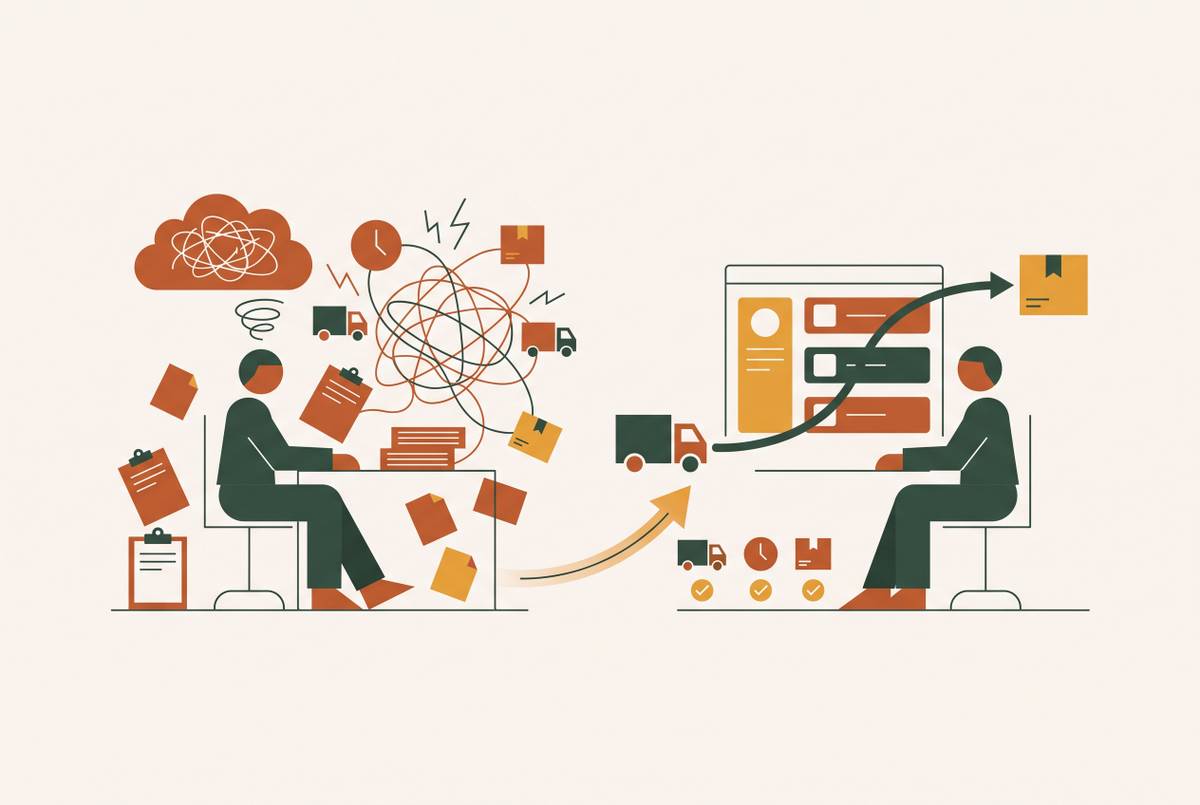
Most of what firms burn hours on hasn't shifted in a decade: transaction coding, bank and credit-card reconciliation, AP and AR processing. Routine tasks like these historically eat somewhere between 70% and 80% of staff hours at a small firm. That's the real capacity crisis, and it hides behind adoption surveys that make the industry sound further along than it actually is.
How time recapture distributes across firm workflows
A field study out of Stanford and MIT, run across 79 small and midsize firms, found AI use associated with 8.5% of accountant time shifting away from routine data entry, alongside a 7.5-day reduction in monthly close time. Alone, 8.5% sounds like a rounding error. Translate it into hours at a five-person firm, though, and it stops sounding modest, because that time comes almost entirely out of a handful of repetitive tasks rather than getting spread thin across everything a firm does.
The breakdown by role backs this up from a different angle. Business.com's Small Business AI Outlook Report finds the average SMB employee saves 5.6 hours a week using AI tools. Managers save more: 7.2 hours. Individual contributors save less: 3.4 hours. That gap matters, because it means time comes back first at the points where judgment gates volume, not simply where volume happens to sit lowest. Managers spend their days reviewing, approving, and unblocking work stuck behind a decision. Automate the decision, or pre-filter it before it reaches a human, and a manager's calendar opens up fast.
So the pattern isn't random. Savings cluster at handoff points, the moments where work passes from one person or system to the next, and at high-volume processing steps. They don't cluster in complex judgment work: technical research, client strategy calls, the stuff that actually fills the rest of a firm's calendar. That work stays human, and it should stay human.
Document intake and invoice processing as the first place hours return
Every firm advising on where to start converges on the same answer: accounts payable. It's the highest-volume workflow in most small firms, the judgment calls are repetitive rather than complex, and the accuracy of what gets entered here determines how clean everything downstream turns out. Get intake wrong, and the error doesn't stay contained. It compounds through coding, through reconciliation, straight into close.
Modern AI invoice tools now hit accuracy rates between 95% and 99%, combining computer vision and language models to read documents that used to require a human eye. These tools match invoices against purchase orders automatically, code expenses based on vendor history, and route anything unusual to a human instead of guessing at it. That routing decision is the whole design principle at work: the system aims to know what it doesn't know, and hand off the rest. It's trying to know what it doesn't know, and hand off the rest.
Automating AP cuts processing time directly: firms report reductions of 70% to 80% in time spent on invoices, and data from Auxis puts the figure closer to 75%. The quieter win is duplicate payment elimination, an effect measured in dollars stopped rather than hours logged, so it never appears on an hours-saved chart. That's money leaving the building, caught before it's gone, and it matters more to a firm billing fixed fees than any hours metric ever will.
Transaction coding and bank reconciliation as the second concentration of recoverable hours
Coding and reconciliation share a structural trait that makes them ideal targets for automation: high repetition, decisions governed by clear rules, and almost zero tolerance for error. AI tools now automate bank reconciliations and transaction coding directly, freeing accountants for the advisory work that actually needs a human brain in the room.
The order in which these workflows are implemented determines how much time and accuracy each subsequent step gains, since clean AP data speeds coding, accurate coding speeds reconciliation, and each stage's output becomes the next stage's input. Clean AP data makes coding faster, since the system already knows the vendor and the likely account. Accurate coding, in turn, makes reconciliation faster, because there's less to question and less to fix. Automate reconciliation without cleaning up intake first, and the gains shrink fast: the chain has a broken link at the front of it, and no amount of automation downstream fixes an upstream mess.
A professional services firm with a three-person accounting team makes the case cleanly. Before AI, roughly 60% of the team's time went to operational tasks, invoice processing, bank reconciliation, and expense management chief among them. Ninety days after implementation, that number dropped to 35%. The firm didn't spend the freed-up time relaxing. It took on 40% more clients without hiring a single additional person.
Month-end close as the most visible and measurable time recapture event
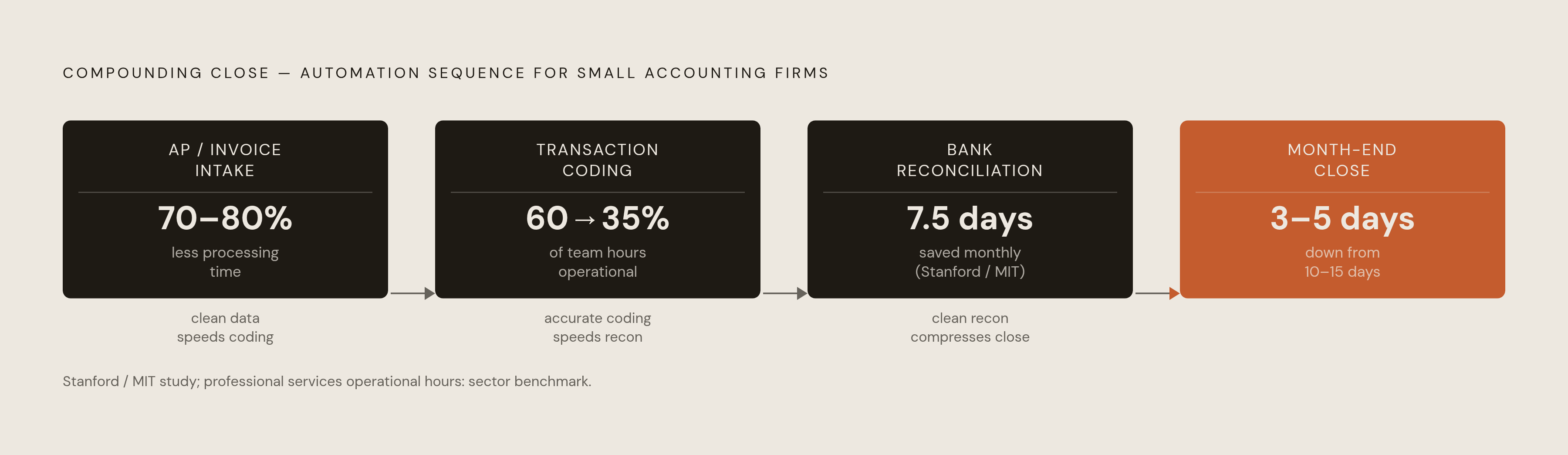
Close is where the recapture becomes impossible to miss, because everyone in the firm feels it directly. The old baseline for a small firm running close manually runs 10 to 15 business days. Firms that have automated intake, coding, and reconciliation report closing in 3 to 5 business days instead. That's the first week of every month handed back to the firm, to spend on billable advisory work instead of chasing down mismatched entries.
The Stanford/MIT figure from earlier, the 7.5-day reduction in monthly close time, is this pattern's payoff stated at a single point on the calendar. That week of freed capacity is what an 8.5% shift in time allocation looks like once it accumulates at one visible event.
The tool landscape here moves fast enough that anything written about it risks going stale within months, and firms should plan around that instability rather than pretend it isn't there. Ramp's Accounting Agent launched in February 2026, reporting auto-coding accuracy above 90% and a close that runs several times faster than the old manual process. Ramp followed in June 2026 with Ramp Stack, an "AI OS" built for accounting firms specifically. Wesley launched in the US in July 2026, promising to compress month-end close from weeks down to roughly 24 hours. Accrual raised a large funding round to build AI-native workflows for firms from scratch (the exact figure hasn't been confirmed in available reporting).
Five product launches in five months make this a land grab, not a settled category. Whatever exists in this space by the end of 2026 will look different from what launched at the start of the year, and any firm picking a tool now should expect to revisit that choice within twelve months.
Tax preparation and research as a separate but parallel recapture channel
Tax work runs its own recapture curve, moving alongside the operational workflows rather than feeding into them. A report cited by the Journal of Accountancy finds some firms have automated more than 80% of individual tax return preparation using AI-assisted tools. Others have cut document analysis time in audit and advisory work roughly in half.
That 80% figure needs a second look before anyone gets too excited about it. Automating 80% of prep doesn't mean 80% of total engagement time disappears with it. Research, planning conversations, and client communication stay human-intensive no matter how good the drafting automation gets. The number describes one stage of the work.
Research use is climbing fast, regardless. A CPA.com and Blue J survey found weekly AI use for tax research nearly doubled year over year, climbing from about a third of respondents in 2025 to roughly 60% in 2026. One Stop CPA, a Fort Lauderdale firm with four accountants and three nonaccountants, shows what that looks like on the ground. Founder Brian Davis uses Blue J to research complex, layered transactions, real estate deals involving multiple entities and tangled ownership structures. His workflow runs a clear sequence: identify the problem, run AI-assisted research, apply professional-level interpretation, build the client strategy, then bank the prompt into a reusable library for next time. Davis keeps final judgment squarely in human hands. The AI narrows the research. It doesn't make the call, and that distinction is the whole point of running tax work this way.
What the pattern means for firms deciding where to start
Every source on this lines up the same way: intake, then coding, then reconciliation, then close. Savings concentrate in that order, and they only compound when a firm deploys automation in that order too. Automate close before intake runs clean, and there's less signal to work with at exactly the stage that needs the most precision. That's the mistake most firms make, jumping to the flashiest, most visible workflow instead of the one upstream of everything else.
The right sequence starts with AP, because it's high-volume, the return is obvious, and the scope stays contained. Reconciliation comes second, since it builds directly on the clean data AP now produces. Anomaly detection comes third. The restraint that produces this outcome is the rule not to expand scope mid-pilot. Firms that try to automate everything at once lose the ability to tell which change caused which result, and end up with a mess of overlapping tools instead of a working system.
Thirty days in, "good" has a specific shape. Exception rates on a standard mix of documents should sit under 5%. Cycle time should show a measurable drop. And the team shouldn't spend more time babysitting the tool than it used to spend doing the work by hand, because that's not automation. That's a supervisory job stacked on top of the old one.
Most small businesses see 3x to 5x ROI on AI accounting tools within the first year, driven by gains that include fewer bookkeeping hours, fewer billing errors, and faster invoice collection. Specialized point tools, aimed at one workflow rather than the whole stack, often show visible ROI within 2 to 6 months. Starting narrow beats starting broad, every time this gets tested.
How an embedded AI approach turns one workflow win into a compounding capacity gain
The real constraint at a five-person firm was never ambition. It was arithmetic: when 60% of the day is locked into processing, there's no room left to chase a new service line or absorb a seasonal spike without hiring somebody new. Dropping operational time from the majority of the day to a much smaller share changes the math completely. The same headcount can quote faster, take on work it couldn't staff before, and get through a busy season without a temp.
A PwC survey found that among firms that adopted AI, 62% reported significant cost savings alongside increased productivity. More telling is a second figure from the same survey: 50% said AI let them offer new kinds of services, predictive financial insights among them, that they simply couldn't offer before. That second number is the real prize here. The first is an efficiency gain. The second is a capability the firm didn't have a year earlier, and capability compounds in a way that hours saved never quite does on its own.
Firms further along on the technology curve consistently outperform peers by a meaningful margin, a gap wide enough that it stops looking like noise and starts looking like a strategy decision. Most firms deploy AI on a single workflow, see the win, and stop there. That instinct produces every firm using AI "situationally" instead of running on it as a default. They capture the first-order saving, the hours back on one task, and never reach the compounding gain that comes from stringing intake, coding, reconciliation, and close into one system that reinforces itself.
The firms pulling ahead are the ones that finished the sequence. They're the ones that finished the sequence.
Sources
- Journal of Accountancy • August 2026 • Real-life ways small firms use AI
- AI in Accounting: Use Cases, Tools & Risks (2026 Guide)
- Accounting Firms Using AI in 2026: Tools and Examples - ACCWire.com
- AI & Automation in Accounting Stats 2026. Updated monthly.
- Best AI Tools for Accounting & CPA Firms in 2026: A Comprehensive Comparison
- tommasomariaricci.com
- journalofaccountancy.com
- cpa.com