Automation's Effect on SMB Hiring Thresholds
Small businesses that automate can absorb more routine work before hiring becomes necessary.
Automation is raising the bar for when a hire actually pays off. Small teams can absorb more work than they used to before adding a person becomes the right call. Headlines about AI replacing jobs have made that shift hard to see clearly, and it's the one thing small business owners need to sit with before their next staffing decision.
The speed of SMBs' shift from experimenting with AI to depending on it
The adoption numbers move in one direction, and they move fast. Business.com surveyed 1,009 workers at companies under 250 employees and found SMB investment in AI climbed sharply from 2023 through 2025. The State of Small Business Survey backs that up, with nearly 39% of SMBs now leveraging AI technologies.
What matters more is how fast the gap between small and large companies closed. The SBA Office of Advocacy found large businesses using AI at nearly twice the rate of small ones (11.1% versus 6.3%) in an earlier reading. By August 2025, small business usage had climbed to 8.8% while large business adoption actually dipped to 10.5%. A gap that size closing in under two years means small businesses moved the moment the tools got good enough to trust, not the moment it became fashionable to say so.
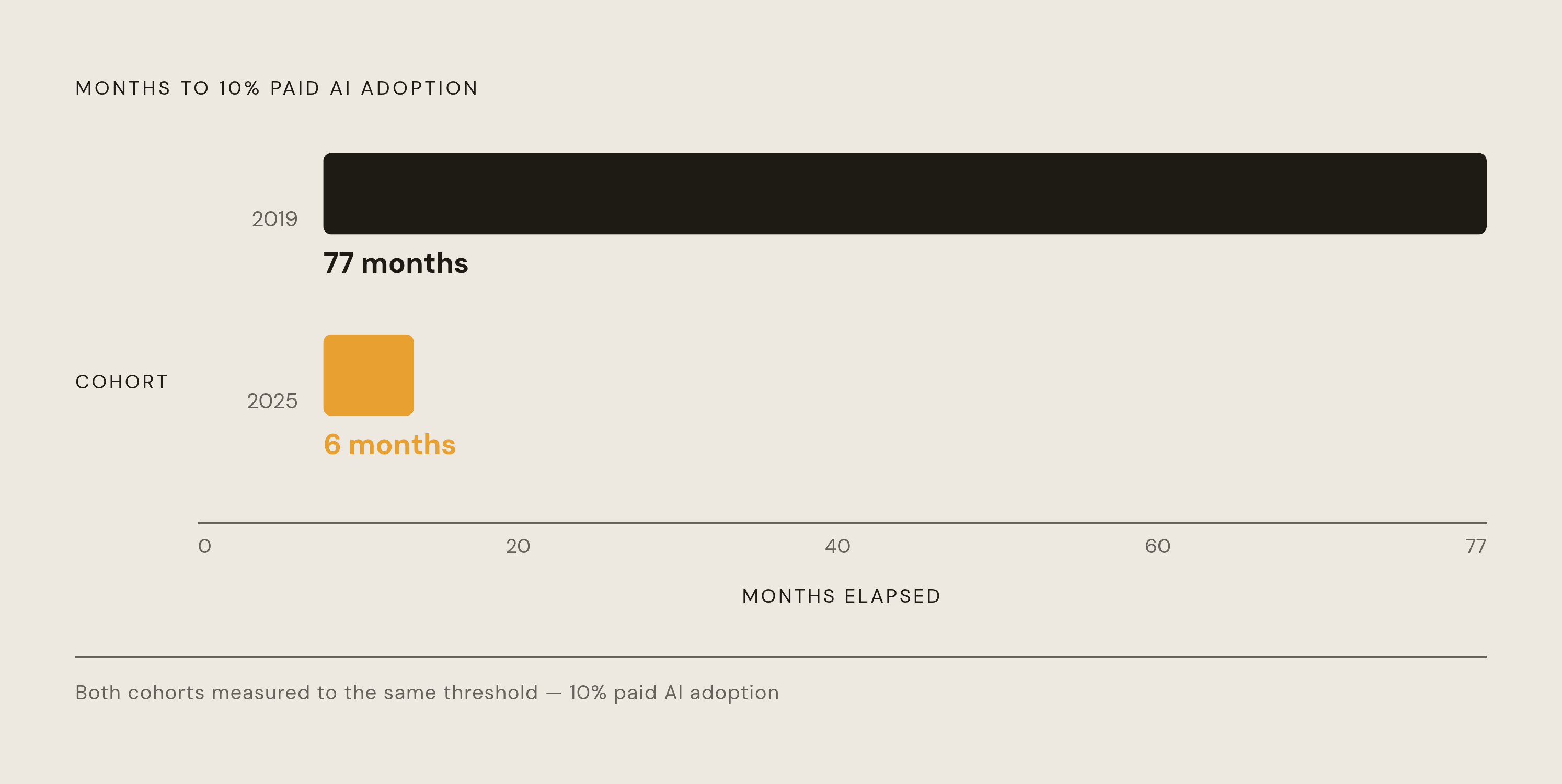
Newer companies are moving faster still. Research from the JPMorgan Chase Institute found the 2025 startup cohort hit 10% paid AI adoption in just six months. The 2019 cohort took 77 months to reach that same mark. AI is part of the foundation these founders build the business on. It's part of the foundation they build the business on, which makes the question of when to hire an immediate, practical one. It's sitting on someone's desk right now.
What the data shows about AI's effect on SMB headcount
A Gusto study of 1,593 SMB AI adopters against 669 AI-aware non-adopters found businesses using AI hired 7% more in their first year than businesses that didn't. That gap widened over time too, from around 4.5% early on to 6.8% by the end of Q4.
The smallest firms saw the biggest lift. Businesses with fewer than 10 employees grew their teams about 10% faster than similar-sized companies that skipped AI. Goldman Sachs research backs this up from a different angle: 87% of businesses using AI said it adds to what employees do rather than replacing them.
Gartner reported that 22% of surveyed CHROs said at least one business leader at their company had stopped hiring for entry-level roles specifically because of AI automation. That counter-signal shows up as pauses on entry-level roles, not the broad hiring freeze the aggregate numbers might suggest. McKinsey's 2026 data shows the gap between fear and outcome even more starkly: 32% of respondents expected AI to cut headcount, but a year later only 14% reported it actually happened. Expectation runs way ahead of reality here, and most of the anxiety in that gap comes from people who never checked back.
Both things are true at once because they're not describing the same layer of the business. Net hiring is up. What businesses hire for is shifting, because automation is absorbing routine tasks while demand grows for hands-on and judgment-based work. Gusto's data shows new roles skewing toward teachers, technicians, cooks, front-desk and admin support, with therapists and care providers showing up separately in healthcare. Entry-level administrative work and repetitive tasks face the most pressure. More hiring overall and a higher bar for certain hires are the same trend, described from two different seats at the table.
Why AI expands capacity before it shifts what kind of help a business needs
Get the order of operations wrong here and the rest of this doesn't make sense. Automation absorbs volume first, the same volume that used to trigger a hire on its own. Only once that capacity gets soaked up does the type of help a business needs start to change.
The old pattern went like this: an owner notices that quoting, intake, scheduling, or follow-up work has grown to the point where it eats a full person's time, and that becomes the moment a hire happens. Automation steps into that exact gap and either absorbs the task completely or shrinks it down to nothing worth staffing. The threshold just moves further out, to a higher volume of work than it used to take to justify a person. It just moves further out, to a higher volume of work than it used to take to justify a person.
By the time the hire actually happens, it's usually for a different reason entirely: capacity to grow, a new service line, judgment work a machine can't fake. Not administrative relief anymore.
Salesforce research shows how much is actually on the table here: companies with 10 to 50 employees can lose a substantial amount annually to manual workflow overhead. That's the pool automation recaptures before a business ever needs to post a job listing.
This isn't only happening to existing businesses adjusting course, either. Gusto's data found that nearly two-thirds of businesses started in the prior year used AI to get the doors open. Founders are building automation into the business from day one instead of bolting it on after hitting a wall, so the eventual hire is more likely to grow revenue than mop up overhead that never should have existed.
The roles automation doesn't defer
Automation doesn't touch every role equally. Not even close, and treating all hiring decisions as equally exposed to AI is the mistake that gets owners into trouble.
Entry-level administrative work, repetitive data processing, first-pass HR screening: these sit under real pressure, and that's exactly where Gartner's 22% of CHROs are seeing hiring pause. Gusto's data shows that roles requiring someone physically present, a real relationship, clinical judgment, or a licensed skill are holding steady or growing among AI adopters. SHRM puts a finer point on it: 15% of employment nationally is already at least half automated, and 12.6% of roles are at high or very high risk of further automation. That exposure concentrates in specific functions. It doesn't spread evenly across every job type, and pretending otherwise is how an owner freezes hiring for a role that was never at risk to begin with.
For small businesses, the roles that stay necessary tend to be the hardest ones to fill: technical roles, customer-facing roles, licensed roles. Automation defers the easy hire, the one that would've been simple to post and fill. The hard hire, the one that already took months to fill before AI showed up, stays exactly as urgent as it was. Map the actual roles on the team, or the ones under consideration, against function type before assuming automation moved the hiring threshold. Some thresholds move a lot. Others don't move an inch, and confusing the two is expensive.
The cost of getting AI capability itself
Getting AI into a small business means picking one of three paths: hire someone in-house to run it, bring in a consultant, or lean on AI-powered tools with the team already in place.
The in-house path costs more than most owners expect, and most people at this size should be talked out of it. A fully loaded, U.S.-based embedded AI engineer runs $160,000 to $200,000 a year, and senior candidates take three to six months to fill, according to LinkedIn Talent Insights and the Hired State of Software Engineers report. That delay alone eats into the very capacity gain the hire was supposed to deliver. McKinsey's research found 46% of business leaders name skill gaps as a major obstacle to adopting AI. The in-house route runs slow and expensive for a simple reason: the people who know how to do it well are scarce, and they know it.
Industry data shows organizations that embed ML engineers directly inside a business unit, reporting to that unit's leadership instead of a central tech function, ship working models three to four times faster and see better adoption. A six-month embedded engagement runs $180,000 to $220,000, well under the cost of a 12 to 18 month centralized build-out. Speed isn't even the main reason it works, either. Engineers on these embedded arrangements spend a substantial portion of their time on things that aren't technical at all: talking to stakeholders, wiring up data pipelines, refining the business case as they go. That's what gets a tool actually used by a five-person team instead of gathering dust on a shared drive somewhere.
Get this decision wrong, and automation ends up creating an expensive full-time hire the business wasn't ready to support.
What ROI from automation looks like before the threshold moves
Payback timelines vary by function. Administrative automation saves a significant share of the time spent, typically paying back within a few months. Customer service automation cuts support handling time substantially, with payback following shortly after. Sales and lead qualification tools can meaningfully boost qualified lead conversion, though they tend to take longer to pay back. Content and marketing automation often delivers the fastest return of the group, cutting production time significantly, and it's usually the cheapest of the four to set up.
That payback window is the threshold in action. Capacity gets recaptured in real time while the system runs. A hire made before the system pays for itself is a hire made too early, plain and simple.
Not every automation project gets there. Many companies have struggled to see AI projects through to completion, and a large share say they struggle to even set up ROI metrics for the ones they keep. Those failures don't just waste budget. They send owners straight back to the old hiring reflex, having spent time and money with nothing to show for it. What separates the wins from the failures usually comes down to one habit: building the measurement case before deploying anything, knowing what gets tracked and over what window, instead of hoping the tool figures it out on its own.
Diagnose the actual bottleneck first, build a system around that specific problem, then support it as results compound. That sequence is what makes the payback numbers real instead of aspirational. One insurance broker cut data entry time by 80%. One freight company saved more than 160 hours a month. Numbers like that make the threshold visible instead of theoretical.
How to read your own business for where the hiring threshold has moved
Ask this before posting a job: is this hire relieving a real capacity constraint, or filling a gap automation hasn't reached yet? Whether the right move is headcount or a system depends on the answer.
A hire is genuinely warranted when the bottleneck sits in judgment, relationship-building, or physical presence. It's warranted, too, when automation is already running in that exact workflow and the constraint persists anyway, or when the new person would generate revenue or add service capacity rather than absorb overhead that shouldn't exist.
Automation should come first, and the threshold hasn't moved yet, when the role would mostly involve repetitive, data-driven, or rule-based work. Same goes for a function no automation has touched at all: the real capacity ceiling there is still unknown, so hiring into it is a guess dressed up as a decision. For most small businesses under a certain revenue range, a dedicated in-house AI hire isn't justified yet, either. An embedded path makes more sense at that size than adding a full-time role built around a single skill set.
Automation applied to the first real bottleneck frees up capacity, and that capacity funds whatever comes next: a new service line, a revenue-generating hire, another system worth building. Each layer moves the threshold again, further out than the last one.
The ceiling on what a small business can do was never about talent or ambition. It was about access to the systems that remove the ceiling. Knowing where the hiring threshold actually sits is how an owner stops running into it in the dark.