AI Adoption and SMB Revenue per Employee Ratios
Smaller teams hitting revenue-per-employee ratios that rival AI-native companies.
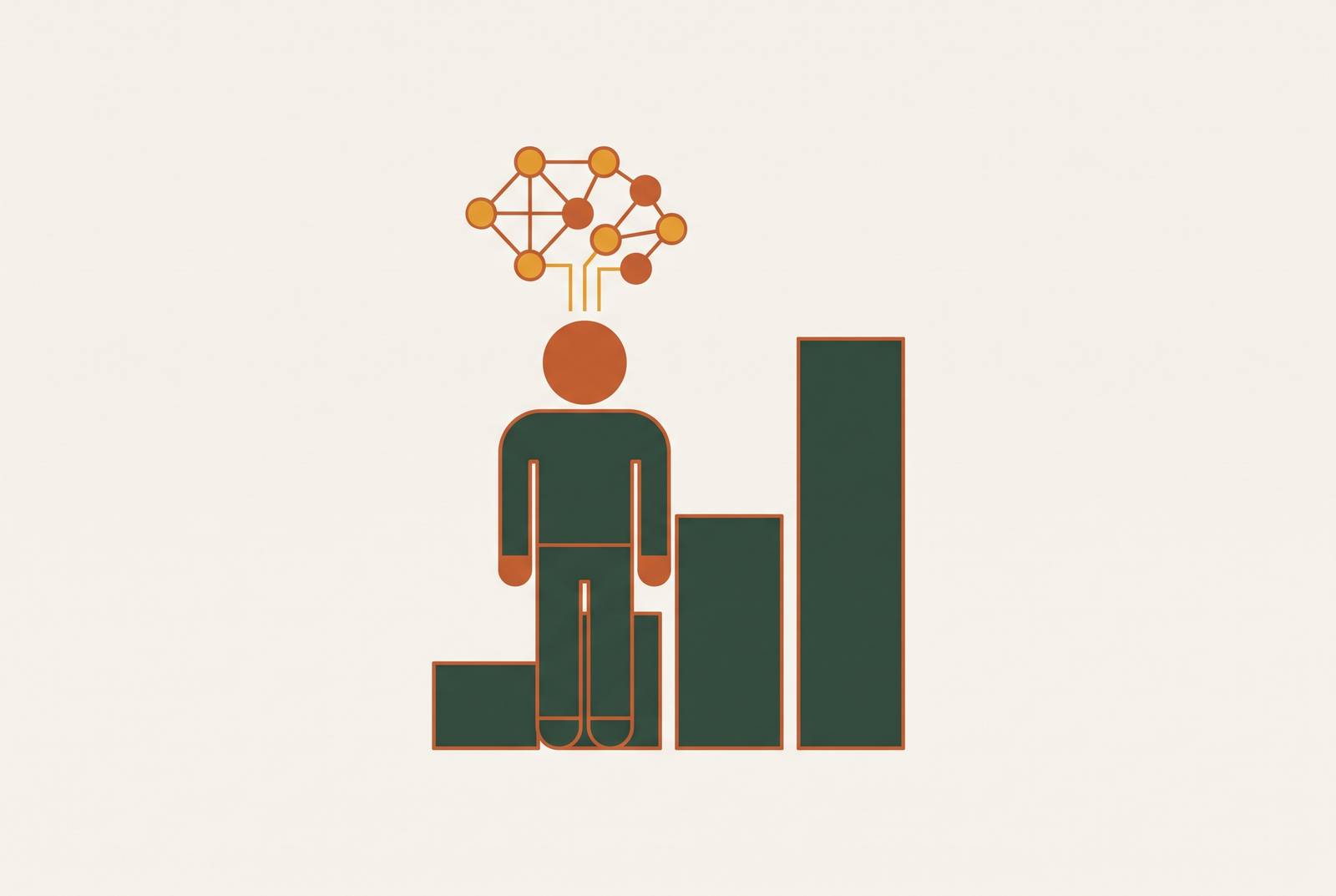
Revenue per employee, not cost per hour, explains why some small businesses are pulling away from their peers this year. AI adoption at SMBs tracks with higher output per person, and the mechanism is capacity expansion beyond what a fixed headcount could otherwise produce. A five-person team is no longer capped at five people's worth of output. Most of the debate about "AI adoption" misses it by arguing over who's using a chatbot instead of asking who's rebuilt a workflow around one.
How far SMB AI adoption has come, and why the numbers look so different depending on who you ask
How many small businesses use AI depends on who's counting: the answer ranges from a small minority to a clear majority. Neither side is wrong. They're measuring different things, and most of the confusion here comes from people quoting one number as though it settles an argument the other number isn't even having.
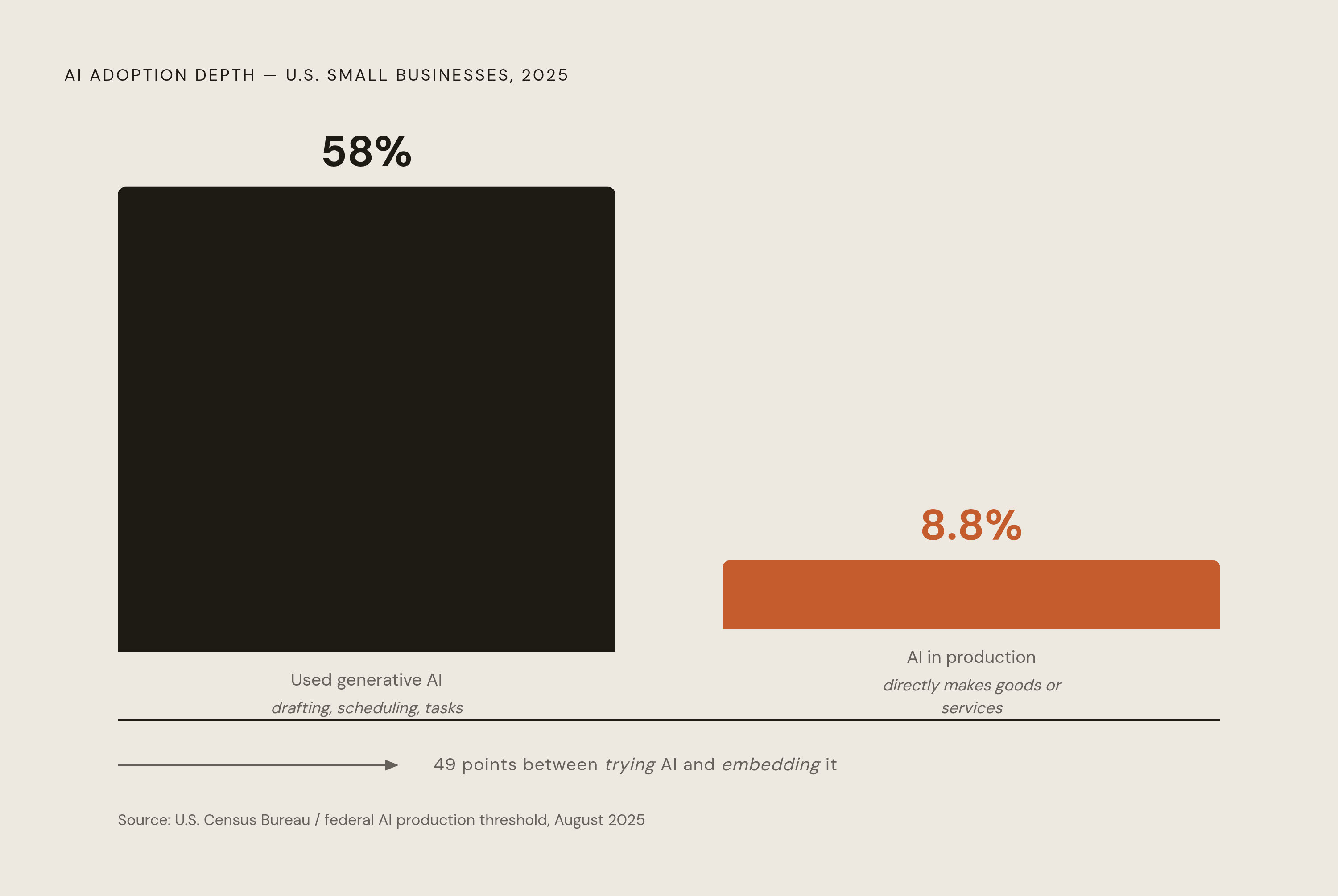
A federal statistical agency's business conditions survey sets a strict bar: AI has to show up directly in producing the goods or services a business sells, not just exist somewhere in the building. By that standard, 8.8% of small businesses under 250 employees met the threshold as of August 2025, up from 6.3% six months earlier. That's close to 40% growth in half a year, real movement, but still a small slice of the market.
That 8.8% figure also misses a lot on purpose. A business running AI features baked into its accounting platform or scheduling software doesn't count, because the AI arrived through a vendor rather than as a tool the business deliberately chose. So the true rate of AI exposure across small business operations sits above 8.8%, likely well above it.
A national business federation measures something looser: any use of generative AI at all, drafting an email, scheduling a post, answering a customer question. Under that definition, 58% of small businesses used generative AI in 2025, up from 40% the year before, a remarkably rapid adoption curve by any measure.
Both numbers hold up. The gap between them is the actual story. Adoption of AI as a tool people poke at is already mainstream. Adoption of AI as an input woven into production, the kind that touches revenue-generating work, is still early. Everything that follows lives in that gap.
The baseline for revenue
Public SaaS companies post a median revenue per employee that's climbed from $327,000 a few years back to a notably higher figure now, a 21% gain over three years. That's the benchmark for a well-run, software-enabled business still running on a traditional headcount model.
Private SaaS companies tell the same story at smaller scale. Firms doing a few million to a few tens of millions in ARR post a median revenue per employee in the low six figures. At the top end of ARR, that median roughly doubles. Scale helps. But even at the top end, these figures describe the ceiling of what a conventional org chart can produce, not a different category of output.
AI-native companies operate without that ceiling. Midjourney runs on roughly 40 employees and pulled in $192 million in revenue, about $4.8 million per employee. OpenAI generates around $2.8 million per employee. Anthropic reaches approximately $2.5 million per employee. Lovable, the Stockholm-based AI coding platform, hit $400 million in annual recurring revenue in early 2026 with 146 full-time employees, adding roughly 1,500 paying customers per day, and lands on a per-employee figure well below OpenAI's or Anthropic's but still nowhere near a normal SaaS company's range.
None of these numbers belong in the same conversation as $144,000 to $300,000. When AI isn't bolted onto a business but built into how the business actually produces its product, the old ceiling on revenue per employee doesn't creep up. It stops applying.
The mechanism: why embedding AI in real bottlenecks raises output
Most conversations about AI at small businesses default to a cost story: AI saves hours, saved hours lower the labor bill, the business does the same revenue on a leaner cost structure. That's true enough, and worth having as a conversation. But it describes a smaller version of the same business, not a bigger one, and treating it as the whole payoff undersells what's actually on the table.
The real story is about ceilings, not costs. Every small team has a bottleneck: some task that eats the hours that would otherwise go toward taking on more clients, quoting faster, or launching a service line the team can't currently staff. Embed AI directly into that bottleneck, instead of layering it on top, and the constraint doesn't just get lighter. It gets removed.
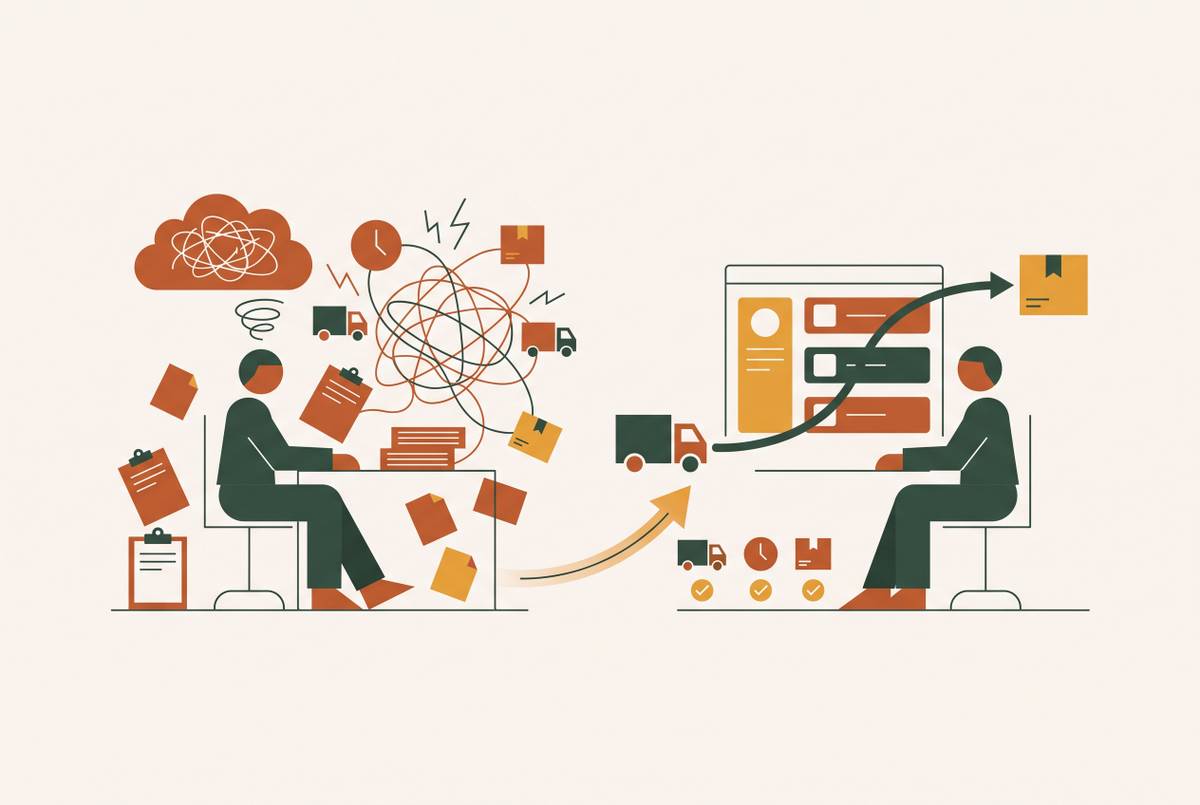
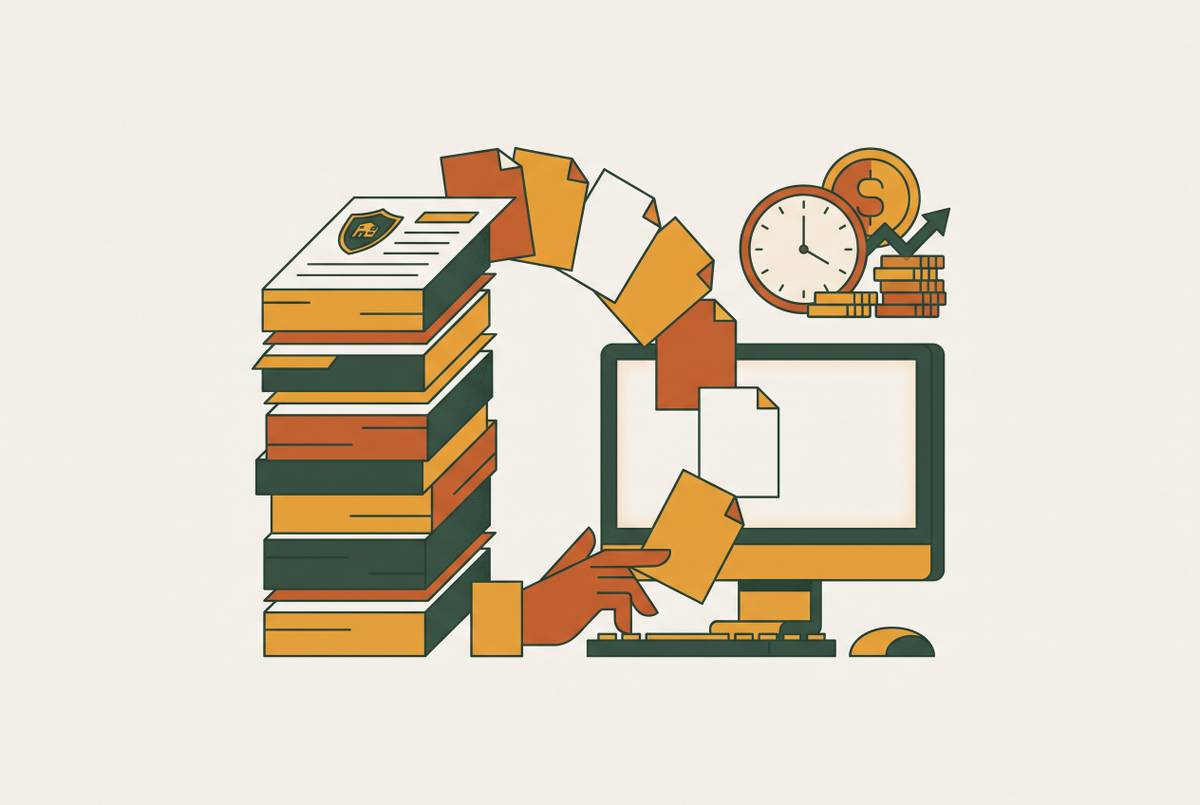
Take a five-person insurance brokerage that manually processes submissions. Data entry eats hours that could go to underwriting judgment, client calls, or new business. When AI is put into that specific choke point, the same five people process more submissions, quote faster, and possibly stand up a service line they couldn't have staffed under the old workflow. That's more revenue moving through the same five desks, without a sixth hire.
One insurance broker saw an 80% reduction in data entry time once AI got embedded into that workflow. The hours that frees up don't vanish into savings; they get redeployed toward higher-value client work. A freight company recovered more than 160 hours a month the same way. At that volume, the conversation is no longer about what got saved; it's about what the business can now do that it physically couldn't before.
A tool bolted onto an unchanged workflow nudges productivity at the margin, shaving a few minutes here and there. A system built around the actual bottleneck removes the constraint that was capping growth without new hires. Those are different categories of intervention, even though both get filed under "AI adoption," and confusing the two is how a business ends up disappointed with a low-cost monthly subscription that was never going to move revenue.
What the ROI data shows when AI reaches operations, and where the numbers still fall short
When AI reaches real operational work instead of sitting on the surface, revenue moves, and the effect is visible in the data. 91% of small businesses using AI report measurable revenue increases, and average ROI on AI tool investment among small businesses runs 3.7x.
Time savings work as a rough proxy for how much capacity actually gets freed up. AI saves small business owners an average of 6.8 hours a week, 17% of a standard 40-hour week, or roughly the equivalent of adding 0.85 of a full-time employee without hiring anyone.
Marketing automation offers a clean case. Across a survey of 2,400 small businesses, automated marketing tools produced an average annual revenue increase of $47,000. The top quartile saw increases north of $120,000, and that spread is the real finding. It tracks to whether AI actually reached a load-bearing constraint in the business, or just got bolted on as a surface-level add-on that never touched anything that mattered.
Payback timelines confirm the pattern. Content and marketing automation tends to pay back fastest, followed by administrative automation, then customer service automation, which typically takes the longest to recoup, though precise timelines vary by business and implementation. The sequencing logic writes itself, and most SMBs skip it anyway: start where payback is fastest, prove the model with real numbers, then move to the slower, deeper wins.
Why most SMBs haven't embedded AI at the bottleneck: the access problem, not the ambition problem
If the upside is this well documented, why isn't every small business doing it? Not ambition. It's access, and access splits into two separate problems: cost and expertise.
On cost, a substantial share of SMBs name cost as the main barrier to going deeper with AI adoption. But actual AI spend, once it reaches a real bottleneck, pays for itself in months, not years. The perceived cost barrier and the real cost barrier are drifting apart, and that gap is doing damage to businesses that could afford this and don't realize it.
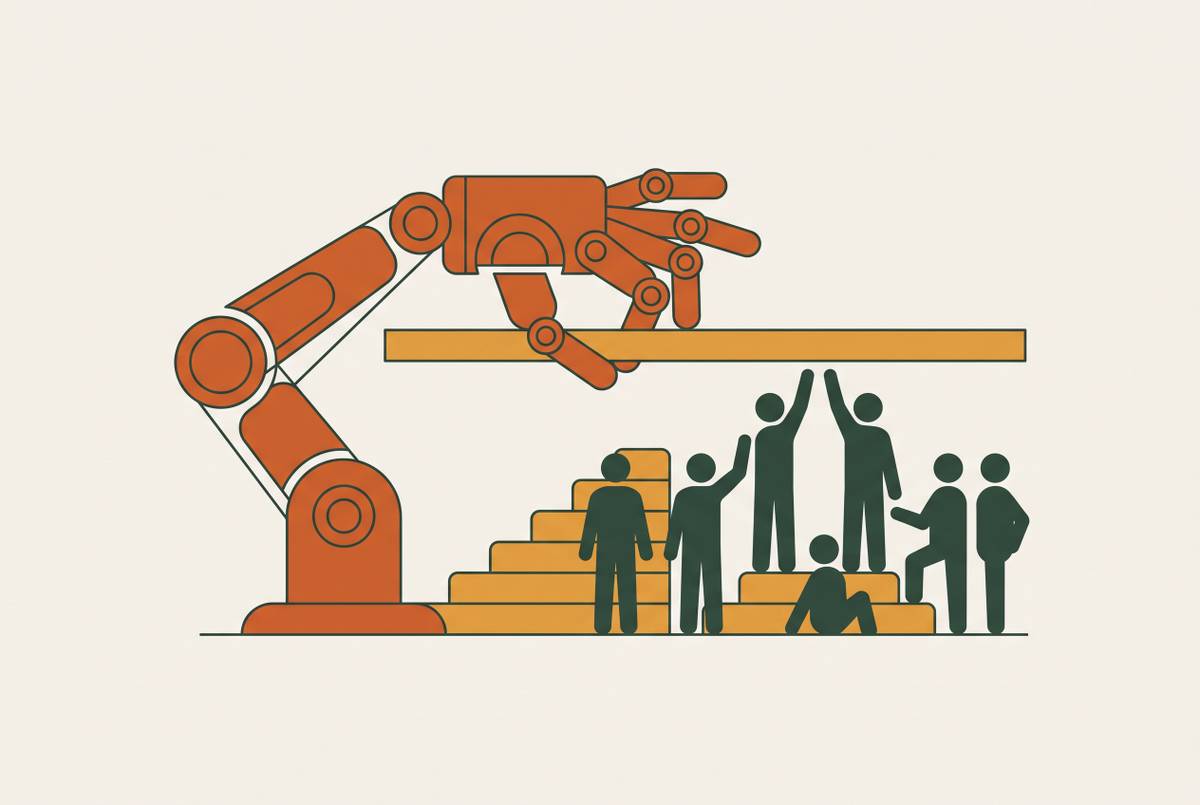
Expertise is the harder problem, and it's the one that actually explains the gap. Embedding AI into an operational bottleneck isn't picking a tool off a shelf. It takes someone who understands the business process well enough to locate the real constraint, plus the technical skill to build something that removes it. That combination is rare, and hiring for it is expensive.
A fully loaded embedded AI engineer commands a significant annual cost once benefits, payroll taxes, equipment, and overhead are factored in. Senior roles in this category are notoriously slow to fill. That's half a year of recruiting before a single workflow goes live. Across the forward deployed engineer category broadly, median total compensation runs $173,816, and at the leading AI labs, mid-senior bands clear meaningfully more. That's not a hire a 15-person company makes casually, and most don't.
The setup that actually works looks nothing like a centralized AI lab tucked away from daily operations. Adoption succeeds when engineers sit inside business units with direct P&L accountability, close enough to the work to see the bottleneck without a slide deck explaining it to them. That embedded, business-unit model also runs at a lower cost than centralized engagements chasing comparable output. Better and cheaper at the same time is rare: this is the version that should be the default, not the exception.
The implementation path built for SMB economics rather than enterprise playbooks
The enterprise AI playbook doesn't fit down-market, and pretending otherwise wastes everyone's time. Large consulting engagements, multi-month centralized rollouts, forward deployed engineers pulled from major AI labs into regulated whale accounts like banks, government agencies, and hospital systems: none of that is reachable for a 30-person freight company or a 12-person insurance broker. That playbook was built for a different customer, and no amount of scaling down the pitch deck changes who it was designed for.
The appetite at the small end of the market is real and growing anyway. 93% of SMBs currently using AI plan to keep investing, and 62% expect to increase AI spending over the next 12 months. Demand isn't the constraint. Matching that demand with an implementation model that actually fits SMB economics is.
A model built for that reality looks different at every step. It starts by diagnosing the single highest-leverage bottleneck: the one constraint currently forcing a hire, a wait, or a client turned away. From there, a production-ready system gets built around that specific bottleneck on a timeline measured in weeks, because speed to a working system compounds faster than chasing a perfect architecture nobody gets to use for months. Staying embedded once that first system is live lets the win compound: freed-up capacity opens a new service line or a faster turnaround, which exposes the next constraint to solve.
Diagnose fast, build fast, stay embedded. That's enterprise-grade AI implementation reshaped for firms with 5 to 500 employees across accounting, insurance, logistics, and general services, delivering the embedded, business-unit pattern that actually works, at a cost structure small businesses can carry. No six-figure retainer, no freelancer who vanishes after the invoice clears, no six-month hiring search before anything ships.