Manual Data Entry Costs in Insurance Brokerage Operations
Agencies lose 15 to 20 percent of margin to manual data entry that never appears in budgets.

Manual data entry in insurance brokerages is a structural cost. It eats margin quietly, drives good people out the door, and sits behind more E&O exposure than most principals want to admit. Getstrada's 2025 research put a number on the daily toll: agents spend up to 2.5 hours a day on manual desk work, roughly 30% of a working day that never touches a client. Most brokerage owners feel this drag. Almost none of them have seen it measured, and that lack of measurement is how it survives.
The aggregate picture is worse than any single agent's day suggests. Across a typical independent agency, wasted time adds up to about 34 hours a week, spread across data entry, certificate issuance, renewal follow-up, and claims status checks. A single insurance submission eats 45 to 90 minutes of manual re-keying. One brokerage operations manager clocked 18 minutes of data entry per policy touch, spread across three separate systems, a cost that compounds with every renewal. That is not a staffing gap. That is a second job nobody hired anyone for.
Applied Systems' Digital Adoption Report, cited by Agiliux, found something close to a contradiction. Nearly 60% of brokers said integrated processes and productivity were the main benefit technology could offer them. About half said they either do not know whether they are using automated workflows, or are not using them. The gap between what brokers say they want and what they have actually deployed is most of what this piece is about.
Data comes in through email, PDF, or phone call, and it almost never lands in a format anyone downstream can use. So someone re-types it, reformats it, or reconciles it by hand before it reaches a carrier portal, an agency management system, or a compliance file. That cycle repeats at onboarding, at quoting, at policy administration, at renewal, and again at bordereaux processing. Same problem, five different doors.
The P&L line that does not exist: how manual entry erodes margin without appearing in the accounts
Administrative drag is a margin problem wearing a workload costume. It never appears as its own line item in the budget, and that absence from budget tracking is why it survives inside a business that otherwise runs tight. The research brief puts the damage at 15 to 20% of a firm's total net margin, a number most principals have never seen attributed to workflow rather than soft rates or market conditions.
The transaction math backs this up. CAQH data pegs the cost of processing a single manual invoice at roughly $15.97. A claim inquiry runs $12 to $16. Neither number looks dangerous sitting alone on a spreadsheet, but multiply either one by monthly volume and they stop being rounding errors. They become a second payroll nobody budgeted for.
Commission leakage runs on a parallel track. Agencies pulling in substantial commission revenue burn 20 to 25 hours a week per accountant just matching carrier statements by hand. Research on commission reconciliation found that automation catches an average of 3.2% in underpaid or missing commission that manual review misses. On a sizable book, that is real premium sitting unclaimed every year, because nobody has time to check that closely.
Insurance Business Magazine, cited by Agiliux, found that manual processes cause the errors that consume 14% of operational budgets to correct. None of this appears on a P&L labeled "manual entry cost." It gets absorbed into salaries, into rework hours, into a general sense that margin runs leaner than it should. That absence is the whole reason the cost never gets fixed.
Error rates, E&O exposure, and the compliance debt that accumulates silently
Infrrd's 2025 analysis found that manual data entry in insurance operations carries an error rate of 1 to 4% per transaction. That range sounds narrow until it meets real volume. At 1%, a brokerage processing 5,000 transactions a month generates 50 errors, and each one needs someone to spot it, investigate it, fix it, and re-enter it. At the higher end, one documented brokerage case study found a 4.5% weighted error rate that produced enough downstream cleanup to consume real staff hours, until automation cut policy processing errors by 94% (a 2026 US Tech Automations case study documented the fix).
On the compliance side, manual process turns the risk from an efficiency question into a liability question. Documentation gaps, missing endorsements, unrecorded client instructions, and incomplete renewal files sit at the top of the list of what causes E&O claims in commercial broking. A process built on email threads and spreadsheets cannot produce a reliable audit trail on demand, only reconstruct one after the fact, and reconstruction after the fact is a far riskier thing to lean on than a clean record kept as you go. The exposure is not just the underlying error. It is the inability to prove, cleanly and fast, what happened and when.
Bordereaux processing deserves its own mention, because it scales the problem in a way nothing else does. Cedants send data in whatever format works for them, and normalizing that data into internal templates happens by hand, inside the brokerage, every month, no matter how many cedant relationships are on the book. The 1 to 4% error rate is the documented baseline for what happens when humans re-key data across systems, over and over, at volume, and fixing it calls for better process design.
What data entry is doing to producers and account managers who were hired for something else
A senior commercial lines underwriter might spend 60 to 70% of the day pulling information out of documents. Only 30 to 40% goes toward the underwriting judgment that took years to build, the thing the agency is actually paying for. That ratio should bother anyone running a book of business, and most principals have never sat down and done that math on their own team.
Sonant's research found that 40% of field agents who left their jobs pointed to excessive desk work as part of the reason. Losing a producer is never just an empty seat. Client relationships walk out with them, and it typically takes six to nine months before a replacement hits full productivity. Agiliux's reporting notes this cost almost never gets traced back to workflow design. It gets filed under turnover instead, next to a cause it never had.
The retention data connects directly to renewal quality. Overloaded teams managing renewals manually leave less time for proactive outreach, and that gap shows up in client attrition. Overloaded staff produce weaker renewal follow-through, and weaker follow-through produces churn. Overloaded staff produce weaker renewal follow-through, and weaker follow-through produces churn.
Agiliux's May 2026 reporting sketched a composite scene: a Monday morning quote that takes 45 minutes across three separate carrier portals, two people handing in notice that same quarter, and a renewal that lands three days too late to save. None of those three things looks connected on a staffing report. Put side by side, the connection is obvious. Attrition driven by administrative overload carries a real price tag, and that cost gets absorbed into turnover and hiring budgets instead of getting filed under data entry, where it belongs. It is the most expensive consequence of leaving the manual process in place, and the one principals notice last.
Once the true cost across margin, risk, and talent sits on the table, the next question turns practical. Where does the time actually go? That is a workflow question.
Where the hours go: the five workflows that generate the most drag
Agiliux's May 2026 framing gets the diagnostic order right: before picking a platform, figure out which processes generate the most drag, and what that drag costs in dollars and hours. Five workflows keep proving to be the worst offenders, and onboarding is the one most agencies underestimate.
Client onboarding brings risk information in by email or PDF, which gets entered into the broker management system, then re-entered into carrier portals. If the risk profile changes before inception, and it often does, the whole cycle runs a second time from scratch.
Quote generation and ACORD intake takes a single submission through 45 to 90 minutes of manual re-keying across carrier portals that share no common field structure. At 200 active accounts, that time becomes a real ceiling on how many accounts a team can serve.
Policy administration involves issuance and endorsements processed by hand, checked against templates. Every touch is a chance for a discrepancy to slip through, often unnoticed until a claim reveals it, at which point it is far too late to fix cheaply.
Renewal management tracks dates in spreadsheets, pulls prior terms manually, and depends entirely on someone remembering to kick the process off on time. Once an agency handles several hundred renewals a year, the spreadsheet becomes the bottleneck, not the brokers working it.
Bordereaux processing means cedants send data in whatever format suits them, and normalizing it to internal templates happens inside the brokerage, by hand, every month, regardless of how many cedant relationships exist.
A practical way to size this up: map every handoff where a person moves data between formats or systems, measure the actual time including rework, attach it to the salary of the person doing it, and count corrections over a representative month. Agiliux's May 2026 reporting shows this produces a ranked list, by cost, of exactly which workflow is most expensive to leave manual.
Manual reporting deserves a mention too, since it really is an extension of the same problem. The US Tech Automations reporting guide estimates manual reporting eats 6 to 10 hours per producer per week at mid-size independent agencies. The root cause never changes: data scattered across the AMS, carrier portals, and accounting tools, with no automated bridge connecting any of them.
What automation changes at the workflow level, and by how much
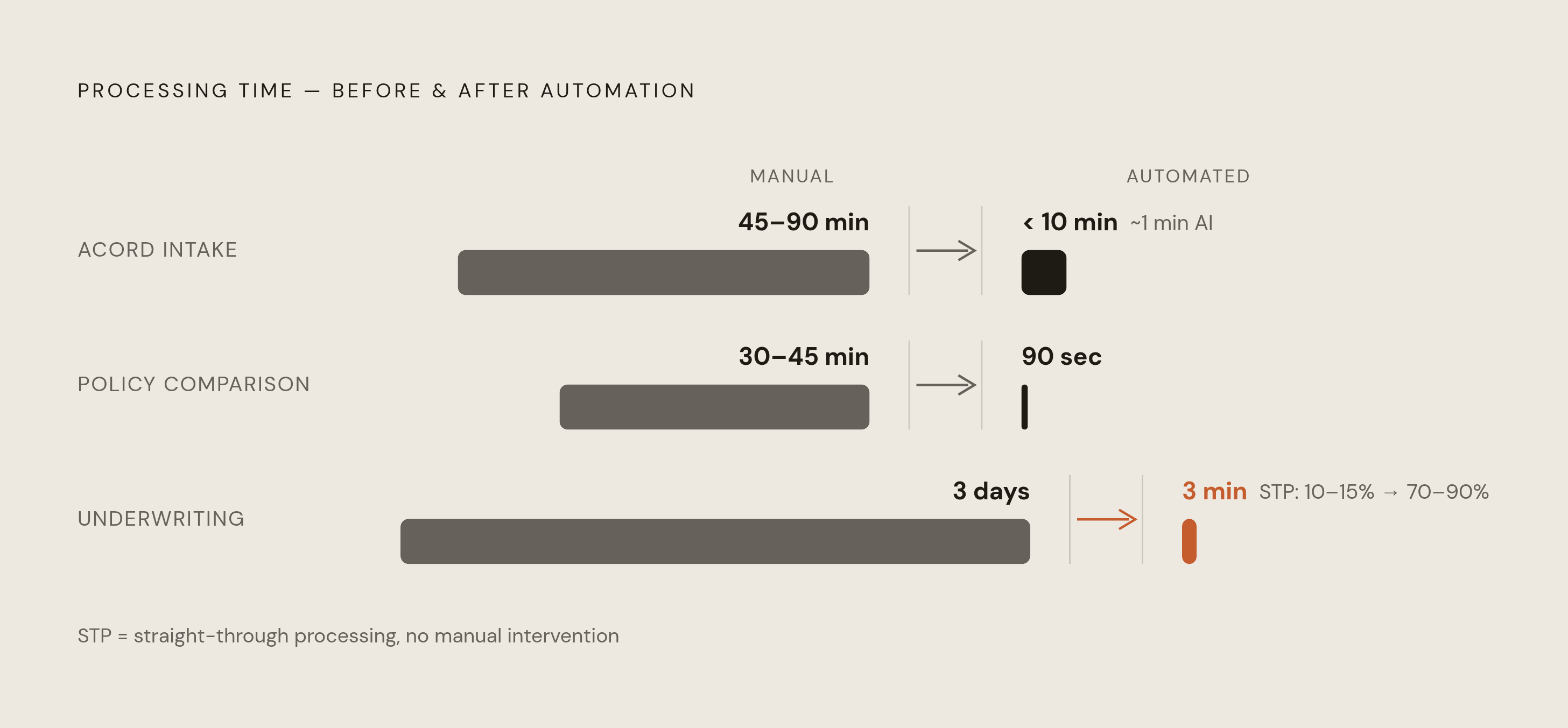
ACORD intake is the cleanest example of what changes when automation replaces re-keying. The time from a completed application to a carrier-ready submission drops from 45 to 90 minutes of manual work to under 10 minutes of reviewed, automated extraction. Smbscaler's data goes further, showing AI-assisted intake bringing that down to about a minute, which removes the administrative ceiling that keeps small teams out of competing for complex accounts.
Policy comparison shows a similar jump. A side-by-side comparison that used to take 30 to 45 minutes now runs in about 90 seconds with AI doing the heavy lifting.
Renewals change shape. Instead of a reactive scramble in the final 30 days, automated systems flag expiring policies 90 days out, surface rate changes and coverage gaps on their own, and draft outreach specific to the client. For agencies that make the shift, the reactive scramble gives way to a planned sequence built around earlier visibility and drafted outreach.
Applied Systems estimates AI could save brokerages 40 to 50% of their time by automating most manual tasks, and that automated task validation could cut operational errors by up to 90% in account reconciliation, data extraction, and submissions work. A mid-size brokerage running 8 to 12 automations at once reports 30 to 50 hours a week handed back to producers and CSRs. At the underwriting level, benchmarks in the research brief show timelines collapsing from 3 days to 3 minutes, with straight-through processing rates climbing from 10 to 15% up to 70 to 90%.
None of this happens automatically, and the tool's suitability for the specific task affects extraction accuracy and downstream error rates more than which category it belongs to. Tool specificity determines extraction accuracy far more than tool category does. A generic solution built for no particular industry loses to a narrow one built for this exact problem, every time, and any brokerage still shopping by category instead of by fit is going to relearn that the hard way.
The real cost of doing nothing: what a full accounting looks like when you add margin, errors, talent, and missed renewals together
Putting the pieces from the last four sections side by side changes the shape of the problem. A mid-size independent agency is losing money in four places at once, and none of them alone looks like an emergency.
There is 15 to 20% of net margin gone to administrative bloat. Research on commission reconciliation shows a substantial share of annual recoverable commission sitting unclaimed on a sizable book. Client retention loss from weaker renewal follow-through translates to real premium attrition for a mid-size agency, with the dollar impact scaling directly with book size. And producers and CSRs keep walking out the door partly because a large share of their day goes to data entry instead of the work they were trained and hired to do.
None of these four costs is catastrophic by itself. That is precisely the problem: they never get added together. The P&L shows a margin that runs a bit leaner than it should. HR shows turnover that looks roughly normal for the industry. Compliance shows no recent E&O claim, so nobody worries. Looked at separately, each one is tolerable. Added up, they form a structural ceiling on what the business can grow into.
Here is where most principals get the diagnosis wrong. A brokerage whose producers are maxed out on data entry looks, from the outside, exactly like a brokerage that needs more headcount. Hiring struggles, capacity struggles, growth that has stalled, the symptoms are identical. But a workflow-constrained business and an understaffed one call for opposite fixes, and hiring more producers into a broken workflow does not solve anything. It just buys more expensive data entry.
How brokerages are beginning to address this: the deployment patterns and costs that are working
The pattern that works is not complicated, and the brokerages skipping it are the ones still struggling two years later. Start small. Brokerages that implement a single high-priority use case first reach positive ROI roughly four months faster than those that try to deploy every capability at once. Certificate of insurance automation keeps turning up as the practical first step: low risk, high volume, easy to measure against a clear before-and-after.
Cost ranges vary by scope. A single ACORD-intake automation can run as low as $2,500. A full-brokerage stack covering intake, quoting, renewals, and claims routing can run up to $30,000. Most agencies in the 10-to-30-person range reach ROI within 60 to 90 days of going live.
One documented case, from US Tech Automations in 2026, spent $7,440 a year on automation platform costs and hit breakeven in 1.8 months, well ahead of the Salesforce 2025 benchmark median payback of 4.2 months. That gap matters, because it suggests the brokerages moving fastest are not spending more than everyone else. They are picking sharper first targets and measuring them honestly.
Integration with existing agency management systems is where people get tripped up. Applied Epic and AMS360 are enterprise platforms with complex API structures, and getting automation to talk to them cleanly typically runs $1,500 to $4,000 in configuration work. That is not a rounding error, but set against recoverable commission that automated reconciliation would otherwise surface, or 30 to 50 hours a week handed back to staff, it is a cost most agencies recover within a single quarter. The ones waiting for a perfect integration plan before starting are the ones still doing this by hand a year from now.
Sources
- Manual Insurance Broker Workflows: The Hidden Cost | Agiliux
- Where Should Insurance Agencies Start With Automation?
- Eliminate 80% of Manual Data Entry Through Automation
- How Voice AI Eliminates Manual Data Entry in Insurance in 2026 - Strada
- infrrd.ai
- How to Cut Manual Reporting in Insurance 2026 (Step-by-Step)?
- salesforce.com
- sonant.ai