Freight Dispatcher Productivity Before and After Workflow Tools
Automation cuts dispatcher admin time by 60%, freeing capacity for higher-margin freight booking.

A dispatcher's day is a time budget, and most of it burns before a single profitable load gets booked. Scanning load boards, calling brokers, fielding check calls, sending status updates, chasing paperwork: none of that books freight, and all of it eats hours. Numeo.ai puts the number at 60% to 70% of a dispatcher's day gone to repetitive broker calls, check calls, and email follow-up instead of actual load selection.
Multiplying that by fleet size makes the math turn ugly fast. A dispatcher running 15 to 20 trucks repeats this same drain across every load, every day, all week. Broker communication is the single biggest piece: outbound prospecting, rate negotiation, inbound check calls, confirmation follow-ups. That's most of a shift, gone before lunch.
Email piles on top of that. A composite brokerage profile from Debales AI put operations teams at roughly 35% of the day just reading, sorting, and answering inbound email: rate requests, status questions, POD requests. None of this is dramatic on its own. It's just constant, and it's the baseline every dispatcher on the floor already knows without needing a study to confirm it.
What the manual workload costs a 20-truck carrier in a year
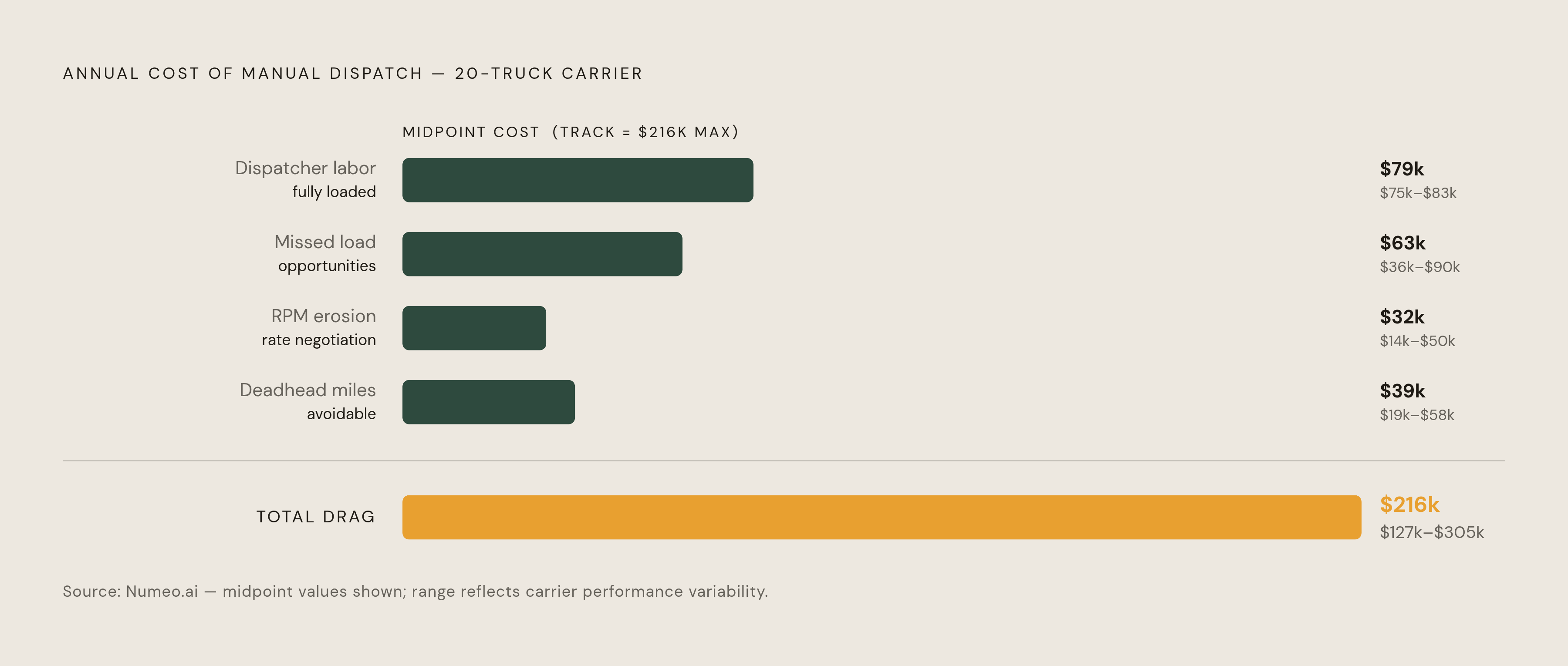
Putting a number on that lost time makes the picture uncomfortable fast. Numeo.ai breaks the annual cost for a 20-truck carrier into four lines: dispatcher labor fully loaded ($75,000 to $83,000 per dispatcher), missed load opportunities from capacity that sat unfilled ($36,000 to $90,000), RPM erosion from rate negotiations done under time pressure ($14,400 to $50,400), and avoidable deadhead miles priced at the industry-standard empty-mile rate ($19,440 to $58,320). Adding it up, a 20-truck carrier is looking at $127,000 to $305,000 a year tied directly to manual workflow drag.
Most people wave off the rate erosion line as rounding error. That's the wrong call. Numeo.ai's example: a dispatcher under time pressure accepts $2.10 a mile. A dispatcher with market data in front of them negotiates $2.25. On a single 1,000-mile haul, that's $150. Across hundreds of loads a year, that gap stops looking like rounding error and starts looking like a second salary.
None of this is happening in a market with room to spare. Industry data puts average truckload operating margin at negative 2.3% in 2024, down from 3% in 2023 and 8% in 2022. On margins that thin, manual workflow drag isn't a line item sitting next to the margin. It is the margin.
Changes to check calls, load board scanning, and email triage when workflow tools absorb them
Break the workload into its three biggest pieces, check calls, load board and broker communication, email triage, and the before-and-after gets concrete fast.
Check calls first. A dispatcher running 15 to 20 loads a day, at 3 to 5 check calls per load, makes dozens of calls daily, then logs and relays every update by hand. NAD Logistics, cited via trychain.com, deployed AI that participated in 95.8% of chat-eligible loads and delivered 98.8% of ETA updates without a human touching the phone. NAD's Tyler estimates each dispatcher gets back roughly 45 to 60 minutes a day once automated status capture takes over, time that goes to booking freight instead of holding the line for a status update.
Load board scanning follows the same pattern, just slower to fix. Manually, a dispatcher reacts to what's on the board, calls brokers for details, and negotiates without much data to lean on. The shift involves automated broker outreach surfacing profitable loads before a truck even goes empty, with rate negotiation backed by real-time market data instead of gut feel. Speed changes the most: Numeo.ai's research shows automated quote turnaround running around 32 seconds, against 17 to 20 minutes the manual way. That gap alone explains why brokers who automate quoting win more of the loads they bid on.
Email follows the same arc, and the fix comes faster than most dispatchers expect. Before automation, that 35% of the day spent sorting inbound messages meant a standard quote request could take 45 minutes to turn around. Debales AI's brokerage profile found email classification accuracy hitting 90% or higher within the first two weeks of deployment, with standard quote responses landing in under 60 seconds. Research cited via ustechautomations.com found mid-market logistics companies that automate shipment communication cut inbound status-inquiry calls by an average of 58%. "Where is my delivery" calls run 25% to 40% of logistics customer service volume, so automated ETA and delivery-confirmation messages knock out a real chunk of that queue on their own.
None of this is a small tweak to the same old process. Each one is time that used to be structurally unavailable for judgment or relationship work, now sitting open on the calendar.
The load capacity per dispatcher that recaptured time translates to
Recaptured time only matters if it turns into more freight handled per person, and the data says it does. Ustechautomations.com reports an average 41% increase in loads-per-dispatcher within 90 days of full automation rollout. USTA's broader range puts the gain from automated check-calls and shipper notifications at 40% to 60% more per-dispatcher capacity, with no extra headcount.
SemiCab's disclosure, via Debales AI, shows the outer bound: individual operators on its platform managing over 2,000 loads a year, four times the traditional benchmark of 500 loads per broker. Echo Global Logistics found productivity gains up to 70% when teams rebuilt their workflows around AI instead of just bolting automation onto the old process. Redesigning the work, not merely installing new software, is what determines the size of the gain, which affects how much productivity a company actually captures. Redesigning the work, not merely installing new software, is what determines the size of the gain.
A dispatcher who topped out at 15 to 20 trucks manually can cover meaningfully more freight without burning out once check calls and quote turnaround stop eating the day. The ceiling that used to trigger a hiring decision moves. The resulting shift is dispatcher-as-operator becoming dispatcher-as-strategist: less time on repetitive calls, more on broker relationships, lane coverage, and exceptions.
The math on automation cost versus hiring another dispatcher
Salary data for dispatchers varies by source but is a consistent band as of early 2026: ZipRecruiter puts the average at $45,823, with other major salary aggregators landing somewhat higher depending on region and experience. When benefits, onboarding, and management overhead are added to any of those figures, the fully-loaded cost is $75,000 to $83,000, the range cited above.
Volume doesn't scale for free. A carrier adding trucks beyond what one dispatcher can handle manually faces a binary choice: hire, or automate. USTA's automation playbook puts total monthly technology cost for a mid-market broker handling 80 to 200 loads a week in the $1,500 to $5,500 range, a fraction of one or two additional dispatcher salaries. Hiring is the default move most carriers reach for first, and at that price gap, it's usually the wrong one.
Payback moves fast, too. Debales AI's brokerage profile suggests payback comes relatively quickly for brokers integrating automation into an existing TMS, with standalone parallel deployments taking somewhat longer to recover costs. USTA's playbook identifies automated carrier outreach and customer status notifications as the fastest-paying workflows, typically recovering $15,000 to $40,000 in dispatcher time annually within the first 60 to 90 days.
None of this eliminates the need for an experienced dispatcher. It changes what one dispatcher can cover, and it pushes the hiring decision toward growth and relationship work instead of raw volume coverage. The real bottleneck for a smaller carrier without an IT department comes down to whether anyone on staff actually gets the system built and running. Most of these projects stall before they produce a number worth reporting.
What a realistic rollout looks like
Implementation timelines vary depending on how tangled the existing workflow is, though most deployments move from setup to early results within a matter of weeks. The advice that holds up across sources stays consistent: start with whatever task eats the most time, then expand from there. A staged pattern is common in brokerage practice: individual workflow installs go live quickly, with additional automations layering in over subsequent months. The first workflow is a starting point that carriers expand from over time.
Timing affects adoption speed and operational stability. Across implementation accounts, companies that deploy AI during lower-volume periods tend to see higher adoption rates and fewer operational disruptions than those who roll out during peak season. Rolling out new dispatch tools in the middle of produce season or holiday freight is asking for a rocky launch.
Debales AI's brokerage profile found email classification accuracy above 90% within two weeks of deployment, a fast, measurable proof point well before the bigger capacity gains have time to compound. A useful test for a smaller carrier: if dispatch automation saves one dispatcher day a month, or knocks out a handful of failed deliveries a week, it pays for itself at list price. Most well-run pilots clear that bar inside 30 days.
The bigger gains go to whoever redesigns the workflow instead of layering automation on top of the old one unchanged, and this is where most carriers leave money on the table. Echo Global's 70% productivity gain came from rebuilding the process. A 30-day model built around diagnosing the single highest-leverage bottleneck, usually check calls or email triage, and building a working system around it first, matches this pattern closely. Well-run deployments that expand past the first workflow tend to compound their time savings significantly as each additional automation builds on the last.
The dispatcher role after the manual work is absorbed
The dispatcher role is moving away from reactive phone volume and toward broker relationships, lane strategy, exception handling, and driver support. Loadconnect.io calls this the shift from operator to strategist: predictive load matching, rate negotiation backed by data, KPI visibility across lanes and brokers. That's work that needs human judgment, and it compounds in value the longer someone does it well.
At the carrier level, this changes what a small dispatch team can actually do. A five-person team that used to hit a hard ceiling on truck count because of manual overhead can take on more freight, add a service line, or improve margin on lanes it already runs, without waiting on a new hire or running the existing team into the ground.
Most of the industry hasn't gotten there yet, and that gap is the opportunity. Research via ustechautomations.com found only 24% of freight brokers below a certain annual revenue threshold have reached Level 3 automation maturity. The rest are at Level 2, where a TMS handles load entry but carrier communication still runs through phone calls and manual email.
The market isn't waiting around for stragglers to catch up. Gartner forecasts supply chain software with agentic AI capabilities growing from under $2 billion in spend in 2025 to $53 billion by 2030. The distance between carriers that have automated and carriers still running everything by hand is only going to widen from here.
The ceiling on what a ten-truck dispatch operation can handle was never about talent or ambition. It came down to access to systems that absorb the manual load, and that access no longer belongs only to enterprise fleets with IT departments behind them.