AI Adoption Timelines in Logistics vs. Professional Services SMBs
Professional services adopt AI fast, logistics adopt slow—but for opposite reasons.
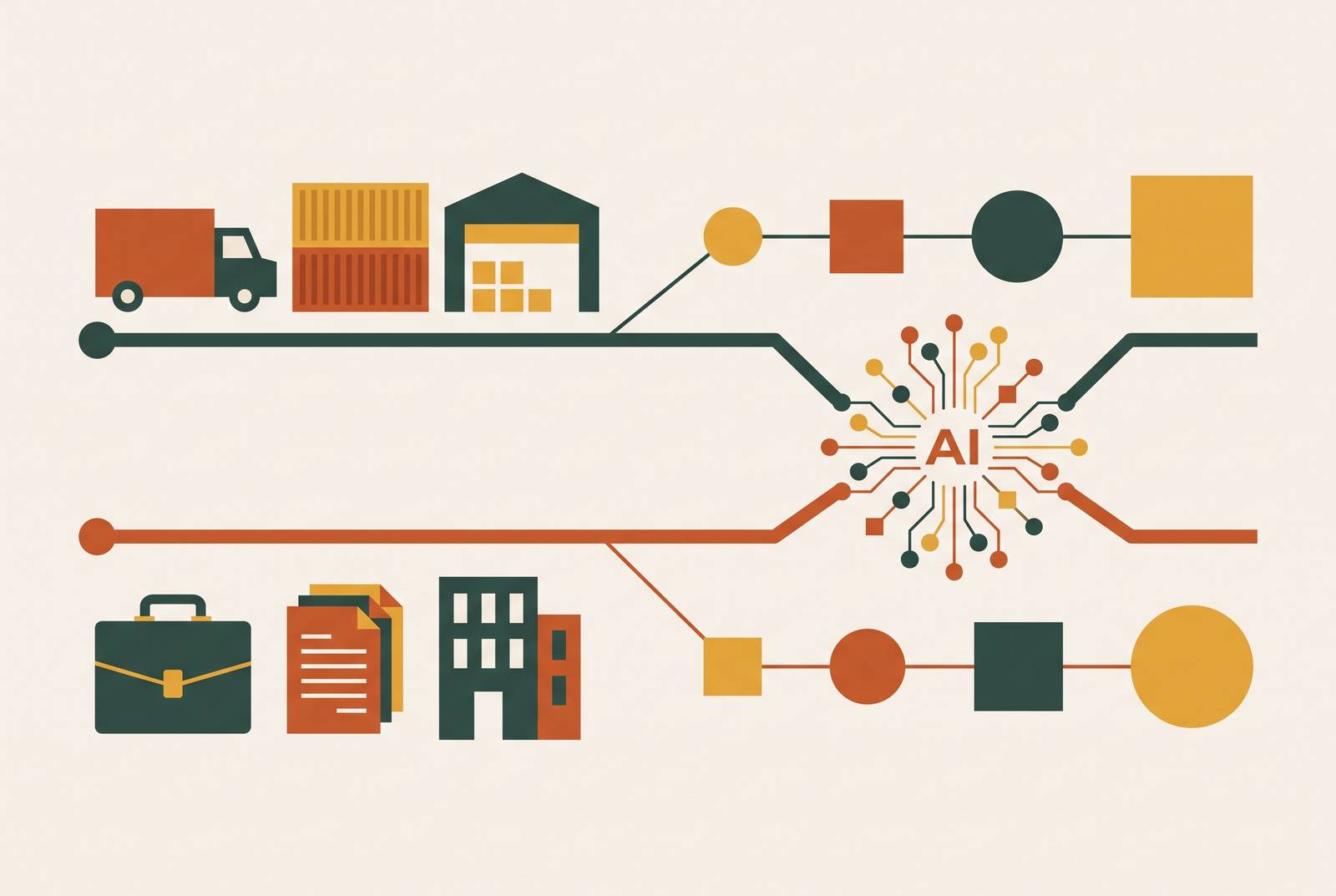
Picture two 50-person companies in the same city: a freight brokerage and an accounting firm. Same headcount, same local labor market, same general appetite for new tools. Yet the accounting firm can have a working AI system running in a matter of weeks, while the freight brokerage is still untangling its data months later. The gap is not about willingness, budget, or ambition. It comes down to a structural fact: professional services work already fits the shape of what today's AI tools do well, while logistics work sits on top of legacy systems that have to be connected, cleaned, and synchronized before any AI model can act on them.
That gap sits inside a much bigger wave of change. The U.S. Chamber of Commerce has called small business AI adoption the fastest technology uptake it has tracked since the rise of social media. But that headline number hides a lot. The U.S. Census Bureau measures AI adoption by whether a business uses it to produce goods or services, and that's a strict, narrow bar. The Chamber asks a looser question, about whether owners use generative tools like ChatGPT. Platform surveys, including Salesforce's, sample a different population still, tilted toward growing companies. The same business can appear as an AI adopter in one survey and a non-adopter in another, depending on which question got asked.
What all three agree on is the direction of travel. Adoption keeps climbing, the use cases keep expanding past simple chatbot queries, and the businesses with AI workflows that actually run day to day are pulling further ahead of the ones still stuck choosing a vendor. The sector-by-sector story behind that average is where the real planning information lives, where logistics and professional services look like two different problems.
Why professional services work is naturally AI-compatible
Professional services firms move faster because their core product is text: reading it, analyzing it, drafting it, and advising on it. That happens to be the task class current AI models handle best. A law firm's work is contracts, filings, and client correspondence. An accounting firm's work is workpapers, ledgers, and audit trails. None of that requires a new sensor, a new piece of hardware, or a new data feed. It requires a language model pointed at documents that already exist.
The results appear in practice: Zarwin Baum, a law firm, reported efficiency gains and stronger client relationships after adopting Thomson Reuters' CoCounsel Legal, describing generative AI as simply the next step in the natural evolution of legal work. The Mercadien Group's accounting practice saw similar gains, since it transformed its audit process with Thomson Reuters' Cloud Audit Suite. Neither firm had to build new infrastructure first. They pointed AI at the work they already had sitting in their files.
That's the deployment advantage in plain terms: a professional services firm with organized document storage can have a working AI system running in weeks, not months. The documents exist. They're human-readable. The AI can reason over them directly, without a middleware layer translating between systems that were never built to talk to each other. Because that data infrastructure is already in place, these firms can skip the integration work that slows other sectors down; a custom AI automation built around existing document workflows can move from diagnosis to a production-ready deployment in weeks, collapsing what would otherwise take months in a sector with messier data. Sansatech's work with accounting and insurance clients follows this same pattern, a detail the next section unpacks in more depth.
The hidden catch in professional services AI: the billable-hour conflict
Fast adoption is not the same as fast return. Professional services firms run into a problem baked into their own business model: AI can compress a multi-hour task down to a fraction of that time, and under hourly billing, that compression eats directly into revenue. A task that used to take six billable hours and now takes 40 minutes doesn't automatically make a firm more profitable. It can make the firm earn less per engagement, or invite a client to start questioning every invoice that comes in.
So speed of adoption and speed of return pull in opposite directions unless a firm changes how it charges for its work. The firms getting ahead of this are shifting to fixed fees, value-based pricing, or hybrid arrangements that tie compensation to outcomes instead of hours logged. That shift is a business-model change, not a software rollout, and it almost always takes longer than standing up the AI tool itself.
There's a second constraint layered on top. Many enterprise clients contractually restrict how their vendors can use third-party AI on their data. Consultants and law firms serving those clients often have to run a separate, more limited AI workflow for proprietary engagements, which slows the productivity gain precisely where the work is most valuable. Professional services firms adopt quickly on the surface, but turning that adoption into margin is a slower, harder problem, one that sets up a useful comparison with what logistics firms are up against.
Why logistics SMBs face a fundamentally different starting problem
Logistics SMBs run into friction before they ever get to question whether AI works. Their bottleneck is the cost and complexity of connecting an AI tool to the legacy systems that hold the data the tool actually needs, not model quality or a lack of interest in the technology.
Take a mid-sized 3PL operator trying to plug a route optimization model into its transportation management system (TMS). That connection requires middleware development to translate between formats, data transformation to make fields match up, and bidirectional synchronization so that changes made in one system show up correctly in the other. Each of those steps adds real engineering time, and together they can double the implementation timeline an operator originally expected. The AI model itself might be ready to go on day one. The data plumbing, not the model, determines when the system can actually run.
This is the structural asymmetry at the center of the whole comparison. Professional services firms work with data that's already in a form AI can use directly. Logistics firms work with data scattered across systems built years ago for entirely different purposes, and someone has to do the unglamorous work of connecting them before the AI layer means anything. Standardizing how shipment, rate, and exception data flows across those legacy systems has to happen before the AI model can operate on top of it. That sequencing, not the AI itself, sets the realistic timeline, and knowing where the data work ends and the AI deployment begins is the key to setting expectations that hold up.
The four forces making logistics AI adoption urgent despite the friction
None of that friction makes logistics AI optional. Four pressures are converging on logistics SMBs at once, and together they mean waiting for integration to get easier isn't a real strategy.
Margin survival is the first and most immediate. AI-driven optimization in logistics has moved from a nice-to-have efficiency play to a condition for staying competitive on price. Operators who aren't using AI to optimize routes, loads, and labor forecasting are increasingly priced out by competitors who are.
Compliance is the second. As emissions reporting requirements expand, you can't calculate emissions by hand across a multi-tier supply chain at any real scale. AI-assisted calculation is becoming less of an efficiency upgrade and more of a baseline requirement for meeting reporting obligations.
Customer expectations are the third force, shaped by how much visibility shippers and retail partners now expect into shipment status, exceptions, and delivery timing, expectations set by the consumer-facing tracking experience that has become standard elsewhere.
Resilience rounds out the fourth. In the years since the pandemic, boards and investors increasingly expect AI-powered supply chain risk monitoring as a standard part of operational resilience planning. That shifts AI from a discretionary investment to something closer to a governance requirement, decided well above the operations team.
Where AI is working in logistics SMBs right now
Given all that pressure, the practical question for a logistics operator is where AI already works without a full systems overhaul. The applications producing consistent results through 2025 and scaling into 2026 share three traits: narrow scope, measurable outcomes, and no requirement to replace legacy systems wholesale. That combination is what makes them realistic for an SMB to deploy.
Demand forecasting improved by folding in outside signals, weather, local event calendars, promotions, and social sentiment, layered onto existing forecasting models. The gains weren't dramatic, but they were consistent and repeatable. Routing and load matching saw real traction too: AI tools generated alternate routing scenarios during disruptions faster than a human planner could work through manually, while planners kept final decision authority. The time needed to compare options dropped sharply even though the human stayed in the loop. Exception handling tightened as well, with predictive ETA models and anomaly detection cutting down alert noise while surfacing the exceptions that actually mattered: fewer alerts overall, but a higher share of them worth acting on.
Heading into 2026, the shift is toward building AI directly into the tools operators already use, routing engines, slotting modules, replenishment planners, labor forecasting tools, and exception dashboards, rather than bolting a separate AI copilot on top. That approach cuts down the change-management burden, since the AI decision appears inside a screen the team already opens every day instead of a new tool they have to learn.
Some things aren't there yet: fully autonomous forecasting still needs a human checking its output. AI-driven carrier rate negotiation at scale is still an early-stage capability. And genuinely novel disruptions, a port strike, a sudden border closure, tend to generalize poorly, because the AI model has nothing in its training data that resembles the situation. Narrow, well-defined problems are where logistics AI delivers today. Broad, open-ended automation is still a few years out.
What realistic deployment timelines look like in each sector
A professional services SMB can expect a first working AI system in weeks. A logistics SMB should plan for months. The gap between those two numbers comes almost entirely from data readiness, not from which tool gets picked or how eager the team is to use it.
For professional services, the inputs, documents, workpapers, client correspondence, already sit in readable form. There's no pipeline to build before an AI assistant can start reasoning over them. A knowledge assistant trained on internal precedent, a draft generator for engagement letters, or a summarization tool for case files can run directly on existing document storage, without touching billing systems, CRM platforms, or the firm's core ERP. Sansatech's engagements with accounting and insurance clients have moved from kickoff to a first deployed AI system in a matter of weeks, consistent with that document-native starting point.
Logistics timelines stretch out, but they shrink considerably when the project scope narrows. Document intelligence applied to freight paperwork, or exception alerting layered onto data the company already has visibility into, can move faster than a full route optimization or demand forecasting build, simply because fewer legacy systems are involved. Mid-market logistics operators have matched the integration results of much larger 3PLs by focusing on three to five key data sources instead of attempting a comprehensive system replacement.
Across both sectors, the deployments that actually deliver measurable returns share the same three ingredients: a narrow starting scope, success metrics defined before the project begins, and team training built into the rollout from day one, not bolted on after launch.
How the embedded model changes the timeline math
The single factor that compresses deployment timelines most consistently in both sectors is having an engineer embedded inside the day-to-day operations of the business, not brought in for a scoping call and then gone.
The most common failure mode in SMB AI adoption is treating deployment as a one-time project: a tool gets picked, installed without real integration into how the team works, and quietly abandoned the first time it causes friction. In the bolt-on pattern, the tool gets installed without changing how work happens, and the underlying bottleneck stays exactly where it was before the tool arrived.
An embedded approach works differently. An engineer maps how the work actually gets done, builds around the data sources that actually exist, however messy they are, trains the people who will use the system every day, and stays long enough for adoption to hold and for the system to improve over time. Logistics SMBs need this more than most, because connecting legacy systems and cleaning the data can't be solved in one handoff. It takes iteration as data quality issues surface, integration edge cases appear, and the team's actual working patterns become clear. Professional services firms face a different version of the same risk: deployment itself is fast, but the pricing and workflow changes needed to turn time savings into real margin are exactly where firms stall without continued support.
Sansatech structures its engagement model around that compounding logic directly: a two-week diagnosis phase to identify where AI can actually help, a build phase that produces a production-ready system, and an embedded phase where the team trains on the system and the engineer stays involved. The first deployment is the foundation the business builds its next capability on, one it likely couldn't have staffed or afforded on its own before that first system was in place.
Where each sector should focus first, given everything above
The timeline gap points to two different starting moves. Professional services firms should start with the document workflows already sitting in their file systems, the engagement letters, the workpapers, the case files, since that's where a first AI deployment can go live fastest with the least friction. At the same time, they need to start the pricing conversation in parallel, because the fixed-fee or value-based models that let AI compression turn into actual margin take longer to work out than the technology itself.
Logistics firms should start by getting honest about data readiness before they pick a tool. Trying to overhaul every legacy system at once is the surest way to stall for months. Choosing three to five key data sources and one narrow, measurable use case, exception alerting, a single routing scenario, document intelligence on a specific document type, gets a working system in front of the team faster and builds the foundation to expand from there.
Both paths lead to the same underlying lesson: narrow scope, clear metrics defined up front, and a team trained to actually use what gets built are what separate a 30-day AI deployment that sticks from a tool that gets installed once and quietly ignored.