SMB Technology Adoption Barriers Beyond Upfront Cost
Most SMBs already own AI tools—they're struggling with expertise, data, and security instead.

Most SMB owners have already bought the tool. That's the part the standard story about AI adoption keeps missing. Adoption among companies with 10–100 employees jumped sharply in a single year, with the share of SMBs with no plans to adopt falling from roughly a third to under a fifth. A large majority of SMB owners are already using or actively testing AI tools right now. Yet most of that same group report hitting at least one barrier the moment they try to go deeper than a first experiment. Adoption climbed while the barriers held their ground, and the obstacles left standing are structural: they involve expertise, data readiness, and organizational capacity, not price.
Cost used to be the reasonable explanation. Business software has a long history of pricing small operators out, and it made sense to assume AI would follow the same pattern. Tool prices dropped to subscription-level pricing years ago, and the capital argument that once kept SMBs on the sidelines of earlier software waves largely dissolved. What's left is a harder set of questions: whether anyone inside the business can run the tool, whether the data feeding it is usable, whether the security implications are understood, whether the bill will stay predictable, and whether the business is even organized in a way that lets AI change how work gets done. Those five questions are what the rest of this piece traces.
The expertise gap that no subscription price can close
Affordability is no longer the operative question for an SMB considering a tool. Whether anyone inside the business can make that tool actually work in their specific environment is. That distinction explains why adoption numbers and deployment numbers have pulled so far apart.
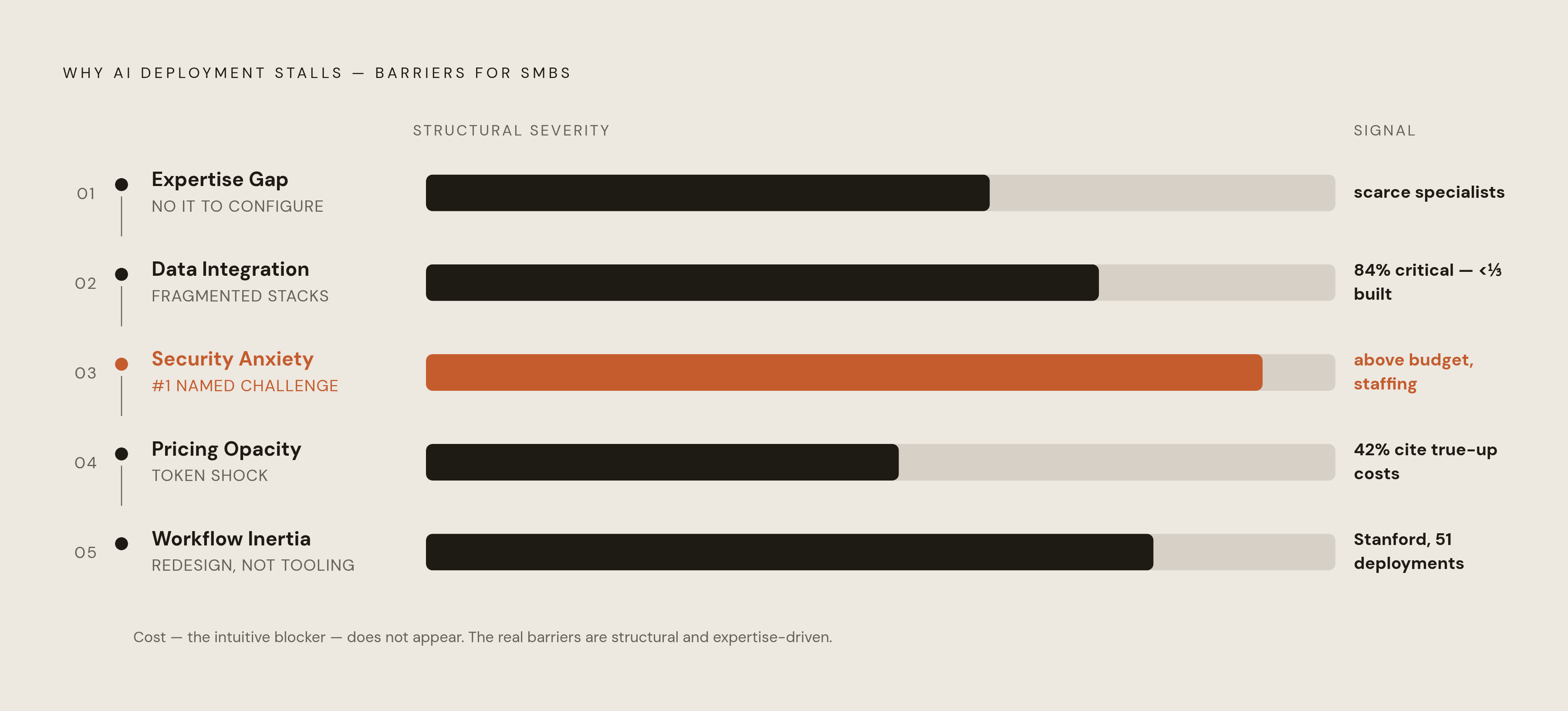
Start with staffing. A significant share of the SMBs IDC surveyed have no full-time IT employee at all, and that number has held steady even as SMB technology budgets have grown. A business can increase what it spends on software every year and still have zero people on payroll whose job is to configure it, secure it, or troubleshoot it when it breaks. A substantial share of SMBs cite AI skills gaps as a real barrier, and small businesses report feeling this more acutely than medium-sized ones. Among non-adopters, 62% say they don't understand what AI can actually do for their business, and a similarly large share point to a lack of in-house technical resources as the thing stopping them.
Forward deployed engineers illustrate the scale of this problem: AI labs themselves rely on senior engineers embedded inside customer environments to make enterprise deployment work. Large AI companies employ forward deployed engineers: senior engineers who get embedded directly inside a customer's operating environment to wire a model into that company's actual authentication systems, actual data pipelines, and actual compliance requirements. That role exists because AI models don't deploy themselves into a messy, real-world operating system. Someone has to do that work by hand, account by account, integration by integration. The compensation for that kind of senior engineering talent places it structurally beyond what any SMB can hire for, making this an organizational capability gap rather than a price gap.
Enterprise AI vendors built their deployment playbook for organizations that can afford a dedicated implementation team. They won't, not without someone doing the wiring. And that's an organizational capability problem. A business can't fix it by finding a cheaper version of the same tool, because no price change supplies the missing expertise and organizational capacity.
Data quality and integration complexity block the move from experiment to production
Getting past the expertise gap doesn't guarantee anything. Connecting an AI tool to what a business actually runs on, its own data, is the next wall a business hits. Whether that data exists in usable form, whether it's clean, and whether any tool can even reach it determines what happens next.
More than half of SMBs report being held back by data problems, with data quality and integration complexity ranking as top barriers right alongside cybersecurity. Strengthening data governance for AI now ranks as the number one cloud initiative among SMBs, ahead of AI integration itself. That ordering matters. It means most SMBs have recognized that the plumbing has to get fixed before the AI can run on top of it, not after.
The gap between recognizing that and doing something about it is wide. 84% of SMBs see an integrated technology stack as critical to their operations, but fewer than a third have actually built one. A lot of that fragmentation isn't the product of any single bad decision. It accumulates. NIST's AI Risk Management Framework flags a related danger: training data can shift over time in ways that affect how an AI system performs and how much it can be trusted, and that risk compounds as a business pulls from more data sources. More tools means more places for that drift to happen, and fewer people watching for it.
This barrier doesn't hit every SMB the same way. Medium-sized businesses feel integration complexity more acutely than skills gaps, while smaller businesses feel the opposite, struggling more with skills than with stitching systems together. The typical SMB today runs about five separate AI tools. Each one operates on its own slice of the business's data, with no shared context between them, no unified governance covering all five, and nobody whose job it is to keep them coherent as a set. Five tools that each work fine in isolation can still leave a business with no coherent picture of what's actually happening across its operations.
Security anxiety keeps growing even as trust in AI improves
Security concern about AI is getting stronger as SMBs get more comfortable using it, precisely because AI gets embedded deeper into daily operations.
Implementing new technology securely now ranks as the single biggest challenge SMBs name when asked what stands between them and their business priorities, ahead of lack of budget, ahead of user adoption, ahead of lack of IT staff. Data security and privacy concerns rose sharply year over year as the top barrier businesses report, climbing rather than settling down as familiarity with the tools increased.
That anxiety isn't irrational. It tracks a real gap in understanding. 78% of SMB owners say they don't fully trust AI to handle low-level tasks without human oversight, even though those are exactly the tasks that would free up the most time if the trust were there. Distrust of AI accuracy and anxiety about security feed each other, and the more AI gets woven into daily operations, the less owners report understanding what the tools are actually doing with their business data. The opacity grows as adoption deepens, not before it does. A business running a cloud AI tool at scale often genuinely cannot answer a basic question: where does the data go, and who can see it once it's there.
That uncertainty is shaping which architecture businesses choose. A large majority of SMBs now prefer private or hybrid AI setups, drawn by more predictable, fixed infrastructure costs and less exposure to volatile API pricing. Security preference and cost predictability are pulling businesses toward the same architectural choice at the same time. And this isn't purely a matter of individual gut feeling. The dominant framing, that SMBs aren't adopting AI because they can't afford it, is no longer supported by the evidence: adoption has accelerated sharply even as the structural barriers remain. Above that threshold, a CISO holds effective veto power over what gets deployed. Security anxiety has become an organizational governance dynamic that decides what technology a business is allowed to run, not just a private worry an owner carries around.
Unpredictable AI pricing became a barrier after adoption
The newest barrier in this list doesn't stop anyone from trying AI. The pricing barrier appears after a business has already committed to a tool, and it breaks the trust that adoption was supposed to build.
Unpredictable pricing is now named by IDC as the first barrier still needing solving: when an SMB implements an AI capability, sees it working, and then watches its bill jump after crossing an invisible usage tier, trust breaks down fast. Trust breaks down fast once that happens, because the business made its decision assuming one cost structure and got billed under a completely different one. Separate research from Techaisle found 42% of SMBs name inflexible pricing models and unexpected true-up costs as their top frustration with AI vendors, a pattern the industry has started calling "token shock".
The way the tools were sold set this pattern in motion. The 2025 wave of "all-you-can-eat" AI subscriptions set an expectation of flat, predictable costs. Plenty of SMBs adopted on that basis, then discovered usage-based billing kicking in once their usage actually scaled up. The tool didn't get worse. Its cost stopped being something the business could predict at the moment it started mattering most.
That shift is changing what SMBs are spending their attention on in 2026. A lot of businesses are pivoting toward optimizing the AI spend they already have instead of chasing new adoption, because the financial model underneath it became unpredictable once it was actually working. IDC expects FinOps, the discipline of managing and forecasting cloud and AI costs, to become more important for SMBs going forward, and it's a discipline that most SMBs currently have no internal capacity to run. It's the most legible one: credit-based models, freemium tiers that allow for real experimentation before commitment, and clear communication about what crossing each usage threshold will actually cost.
The workflow inertia that keeps AI at the surface of operations
A business can clear every hurdle above (staff up on expertise, clean up its data, settle its security posture, get its pricing under control) and still get stuck. The most common failure at this stage is using AI to do old work the same way rather than rethinking how the work should be done.
Real value comes from redesigning a workflow around what AI can do, rather than bolting AI onto a process that was built around human limitations. Saving an hour on a broken process is a different achievement than removing the bottleneck that made the process broken to begin with. Most SMBs are still doing the former.
Where AI gets used inside the business accounts for part of the reason. In 2024, most SMBs ran separate, standalone AI products. By 2026, 45% of AI usage inside SMBs comes from features already embedded in platforms they subscribe to for other reasons, tools like HubSpot or QuickBooks, which cuts down the friction of adding "one more tool" to the stack. It cuts down the friction of adding "one more tool" to the stack. It also reinforces a habit of adopting AI at the edges of the business rather than at its core. Casual AI use, someone drafting an email or summarizing a document, is now everywhere. Embedded AI operations, where AI takes autonomous action inside a real business process without a person driving every step, remain the exception.
A growing share of medium-sized businesses have started exploring agentic AI, tools built to execute complex workflows on their own rather than waiting for a person to direct each step. That marks the move from the assistant era of AI into the execution era. Most smaller SMBs haven't made that move yet. Stanford's review of 51 successful AI deployments found that organizational readiness, not which model or technology a company picked, determined whether the deployment actually worked. How the business is structured around the tool decides the outcome more than the tool itself does.
None of this is a mindset problem that a pep talk fixes. A business without IT staff, with messy data, and with unpredictable bills is rationally reluctant to redesign workflows around tools it doesn't fully control. The reluctance is rational.
That reluctance is visible in how SMBs measure success. Most track AI success through general productivity and efficiency gains rather than hard cost savings. Without a specific, measurable outcome tied to a specific workflow, even real productivity gains stay invisible inside the business, and nobody inside the company can build the internal case for going deeper.
The Measurement Gap and Real AI Deployment
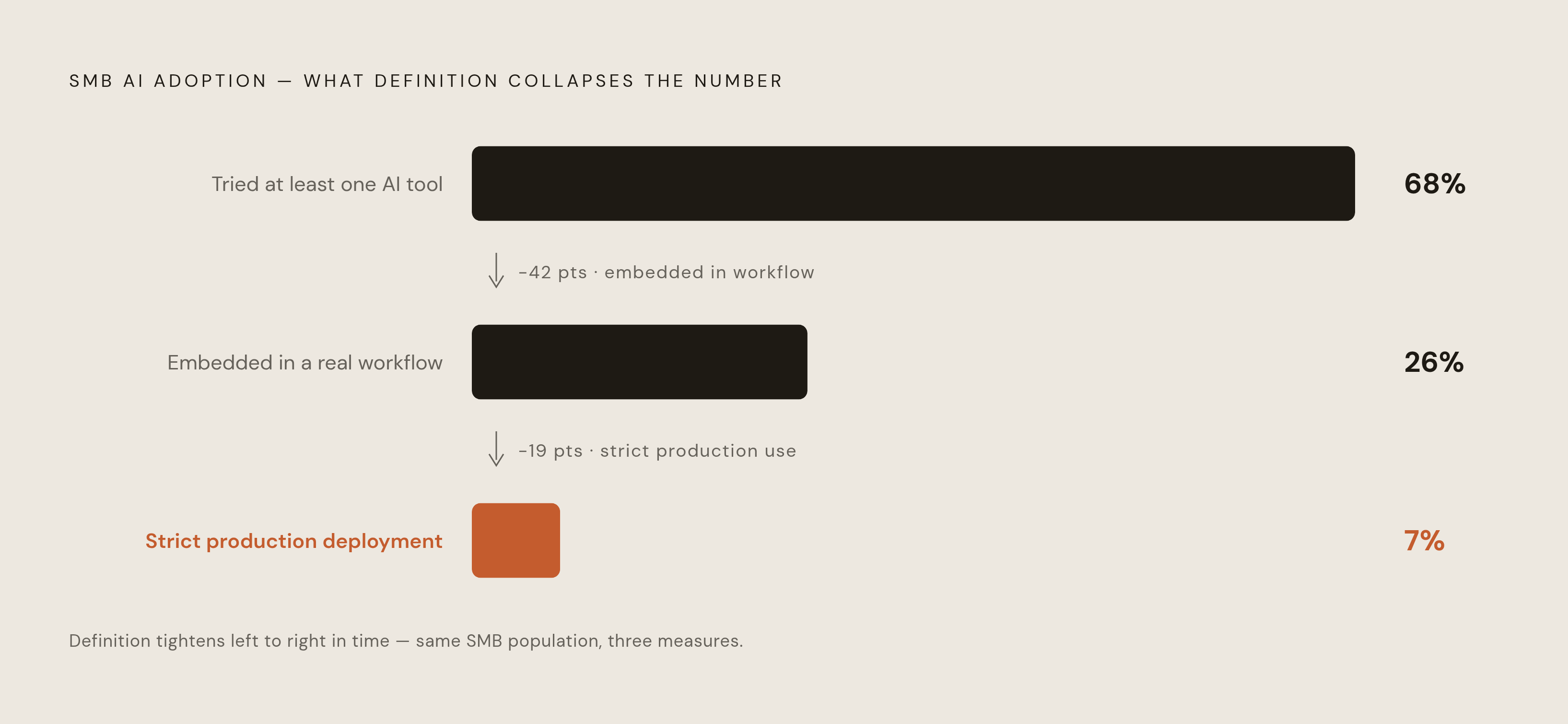
The adoption numbers most SMB owners have seen overstate, by a wide margin, how many businesses are actually running AI inside their real workflows. The gap is a direct product of the barriers this piece has traced.
The size of the gap depends entirely on what "use" gets measured. Figures built on "has tried at least one AI tool" run into the high sixties as a percentage of SMBs. Figures built on "has AI embedded in a real business workflow" land far lower. Applying a strict production-use definition drops meaningful SMB AI deployment to a small fraction of the headline adoption number. The distance between trying a tool once and running the business on it is exactly where expertise gaps, data problems, security concerns, pricing shocks, and workflow inertia all pile up.
What's emerged is a divide inside the adopter group itself, sometimes called the "Great AI Divide". A minority of SMBs run multiple AI tools daily as a genuine part of how they operate. A larger share has experimented inconsistently, picking a tool up and putting it down without ever settling into a routine. A substantial share hasn't started at all. Among the non-adopters, most say they see no use case that applies to their business, and that's a relevance failure rather than a technology failure.
The OECD's discussion paper for the G7 found that AI adoption by SMEs remains relatively low compared to other digital technologies and to larger firms, despite recent advances.
Sources
- AI Adoption Statistics for Small Businesses: 2026 Report
- 2026 Small Business AI Trends Report
- IDC - SMB AI Adoption 2026: From Wait-and-See to All-In
- SMBs race into AI despite data barriers - TechInformed
- AI adoption by small and medium-sized enterprises (EN)
- Top 10 SMB & Mid-Market Predictions for 2026 and Beyond: The Autonomous Business - Techaisle Analyst Insights - Techaisle - Global SMB, Midmarket and Channel Partner Analyst Firm