Predictors of Successful AI Implementation in SMB Professional Services
Firms with dedicated capacity and clean data reach production faster than those picking tools first.

Predictors of Successful AI Implementation in SMB Professional Services.
Why SMB Professional Services AI Projects Stall
The split that matters in AI adoption isn't between firms that use it and firms that don't. It's between firms that get one deployment working and build on it, and firms that get stuck running pilots that never quite make it to production. That distinction explains a strange gap in the data. Self-reported adoption among small businesses is around 68%, but U.S. Census Bureau figures, backed by JP Morgan Chase Institute transaction research, put actual production use at 17 to 20%. Most of what gets counted as "adoption" is a free trial, a demo, or an experiment that never became part of daily operations.
The pattern appears industry-wide too. Generative AI pilots fail to reach production 95% of the time, according to MIT Sloan research, and the tools aren't the reason. It's the conditions in place before deployment even started. Yet only 8% of businesses overall reach what counts as advanced AI adoption. Usage went up. Depth didn't follow at the same rate.
None of this is random. A specific, identifiable set of conditions separates firms that compound results from firms stuck in pilot limbo, and those conditions can be checked before a firm signs a contract or picks a vendor. The rest of this piece walks through them one at a time, not as a pitch for any particular tool, but as a self-assessment an operator can run before committing budget and goodwill to a project.
Revenue band and internal capacity as predictors of outcomes before tool choice
Revenue band turns out to be the single strongest predictor of AI adoption rate among SMBs, ahead of industry, geography, or how long the company has been around. That's a counterintuitive finding on its face. Tool access isn't the variable, since the same software is available to a five-person shop and a two-hundred-person firm at more or less the same price. What differs by revenue band is internal capacity: time to actually evaluate options, ability to train staff on a new workflow, and the organizational maturity to define what success even looks like before flipping the switch.
There's a real inflection point in the data. That points to a real inflection point in the data. It's a signal that someone inside the company now owns the outcome, instead of the responsibility sitting diffused across five people who each have a full-time job already.
Which raises the real question for an operator sizing up a project: not "can we afford the software," but "does someone here have the bandwidth to make this work." If no one on the team has at least 40% of their time free to own implementation, the project stalls regardless of which platform gets chosen Thomson Reuters Small Business AI Adoption Statistics 2025. Internal capacity is the precondition for the next stage. It's the precondition for the next stage: the unglamorous data work that determines whether that tool has anything usable to act on. The inflection point: companies that make their first AI hire (even part-time) at the $10M–$20M revenue mark consistently outperform peers in adoption success (AIOpsNav, 2026).
Data foundation work before tool selection as the factor separating lasting implementations
Data quality determines output quality, and 85% of IT professionals will say so Small Business AI Adoption Statistics 2025. A survey found that 74% of growing SMBs are increasing investment in data management, compared to just 47% of SMBs whose revenue is shrinking Small Business AI Adoption Statistics 2025. That gap between growing and declining firms isn't a coincidence either. It reflects two very different mental models of what AI implementation actually requires.
Firms succeeding in 2026 treat AI as infrastructure, something that demands structured data and organizational alignment before it goes live, not a tool you install and hope for the best. Practically, that means asking a few blunt questions before any vendor conversation starts. Are client records, documents, and workflows the AI will touch sitting in a consistent, accessible format, or scattered across inboxes and someone's personal folder structure? Are there defined fields and process steps, or does the institutional knowledge live entirely in people's heads?
The common failure mode runs in exactly the wrong order: pick the tool first, then discover the data feeding it is too messy to use. No dramatic statistic is needed to explain why. Bad data in produces unreliable output out, the team stops trusting the system within a few uses, and the project quietly dies. Before evaluating any tool, an operator should be able to state in one sentence exactly what data the AI will act on and where that data currently lives. If that sentence is hard to write, the tool selection is premature. Common failure mode: firms select the tool first, then discover their data is too messy to feed it, and this is the sequence that produces the 80% project failure rate (Baytech, 2026) and the 51% of B2B organizations that implement without hitting expected financial outcomes (SMB AI Adoption Guide: Use Cases, Costs, Roadmap).
The billable-hour paradox that blocks professional services firms from moving from pilot to production
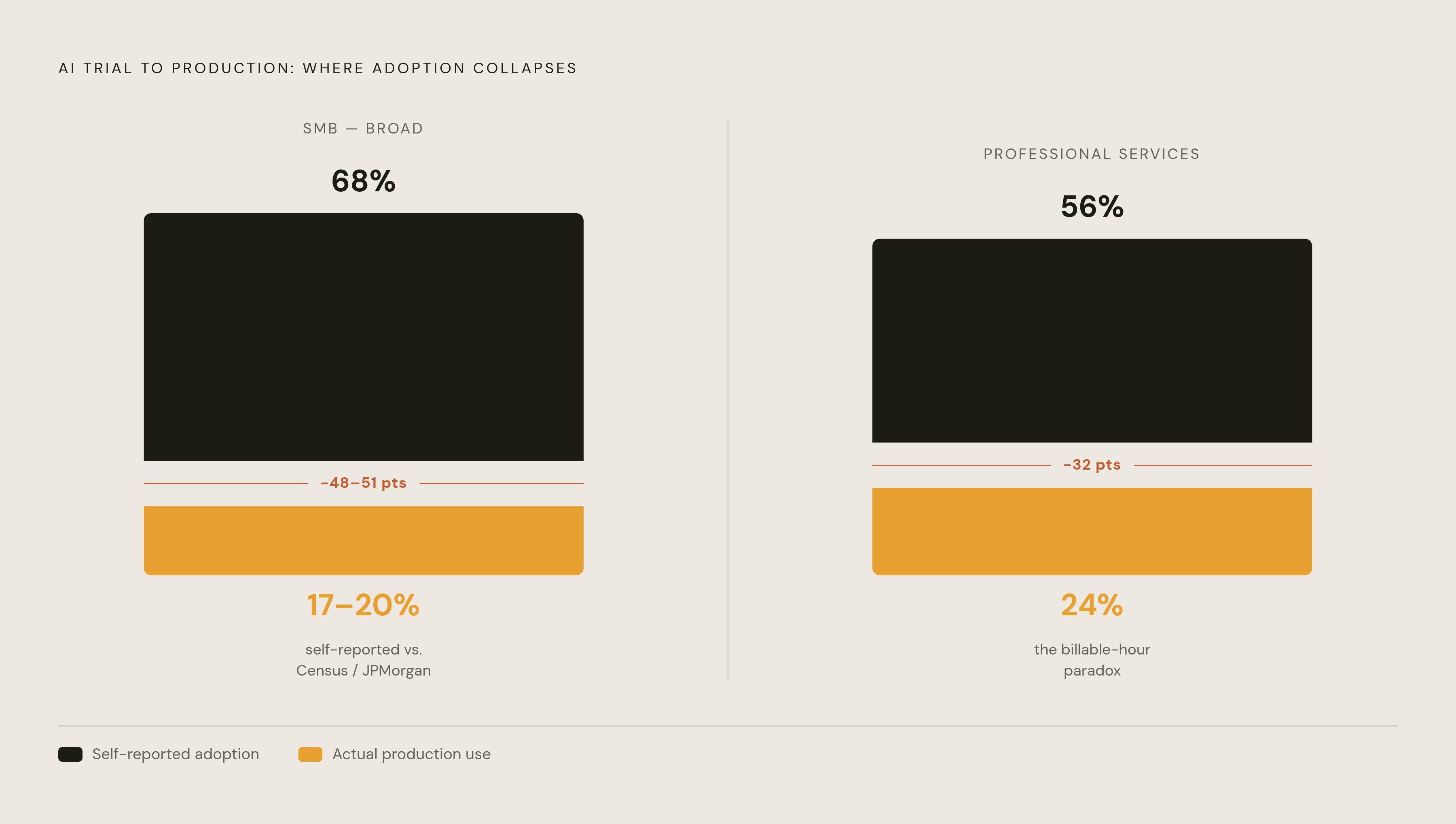
Professional services should have an easier time with AI than most industries. The core work, research, document analysis, client communication, maps cleanly onto what current AI systems actually do well. And yet the sector's own numbers show a steep drop-off: 56% adoption shrinks to just 24% reaching actual production deployment. That gap between trying and sustaining is too large to explain by technology limits alone.
The real explanation is structural. When pricing depends on billable hours, AI that makes the work faster threatens the revenue model that pays for it. Call it the billable-hour paradox: the same efficiency gain that should be a selling point becomes a threat to the invoice. This isn't a problem AI vendors can fix with a better model.
The firms that cross from 56% to 24% share one specific move: they find a workflow where speed opens up new client capacity or a new service line entirely, instead of a workflow where speed just compresses an existing invoice down to fewer hours AI in Professional Services — Complete 2026 Guide Upwork. Document summarization, research acceleration, and client communication drafting show up consistently as the highest-ROI use cases across legal, accounting, consulting, and marketing firms alike. Before adopting any candidate use case, an operator should ask whether it frees up capacity that can be sold to a client, or whether it simply shrinks a billable line item on an invoice nobody will notice went smaller. The gap is a business model problem, and firms that solve it reframe AI savings as capacity for new work, not as a route to the same revenue in fewer hours.
Targeting the actual bottleneck instead of the obvious task
IDC's research on SMB AI adoption found something simple but easy to skip past: the businesses moving fastest all looked hard at their own operations before they looked at a single vendor. That ordering matters more than it sounds. Firms that flip it, starting with a vendor demo and working backward to find a use for it, tend to land on the easiest, most visible task rather than the one that actually limits growth. Email drafting and calendar scheduling get automated because they're simple to demo, not because they're where the company is bleeding time.
A better test starts with one question: what's the single step in the workflow that, if it ran twice as fast, would let the firm take on more work or serve existing clients better? Then a follow-up: is that step slow because of repetitive volume, or because it genuinely requires human judgment? If the answer is repetitive volume, that's a bottleneck AI can actually break.
Two concrete cases make the shape of this clear. An insurance broker found the bottleneck sitting in manual data entry across submissions, and removing it produced an 80% reduction in that specific work SMB AI Adoption Guide: Use Cases, Costs, Roadmap. Neither result came from automating the flashiest task available. It came from diagnosing the actual constraint first. Bottleneck targeting isn't automating a process because it happens to look amenable to AI, or because a vendor's demo made it look impressive on stage. Getting the target right is only half the job, though. A correctly targeted system that the team refuses to use still fails, which is where the next predictor comes in. Freight company: the bottleneck is hours spent on manual coordination and documentation, and removing it freed 160+ hours a month (SANSA proof point).
Team involvement during the build as a predictor of post-build adoption
PwC's 2026 AI predictions show that crowdsourcing AI efforts across an organization produces impressive-looking adoption numbers but rarely produces meaningful business outcomes. Leadership needs to pick where the effort goes. But the team that actually does the work needs to shape how it gets built, not just receive it once it's finished.
A structural finding explains this: the team doing the work every day knows where the edge cases live, where the underlying data gets inconsistent, and where a proposed automation is going to quietly break. The reason isn't mysterious. The team doing the work every day knows where the edge cases live, where the underlying data gets inconsistent, and where a proposed automation is going to quietly break in practice. Ignore that knowledge, and the result is a system that performs beautifully in a demo and falls apart the first week it touches real client work.
This is also why embedded engineers need 40 to 60% of their time on stakeholder alignment, data pipeline work, monitoring, and iterating on the business case, not just building the model itself. Purely technical deployments, ones that skip this, tend to underperform for exactly this reason. The people who will use the system should help define what success looks like, review early outputs, and flag failures while the thing is still being built, not after go-live. If an implementation plan doesn't include a defined feedback loop from actual end-users before launch, adoption risk stays high no matter how good the underlying technology is. Team involvement does double duty here too: it's also the mechanism by which ROI actually gets defined and measured, which matters given that only 18% of professional services organizations report knowing whether their firm tracks AI ROI at all Thomson Reuters Small business AI adoption statistics for 2026. The embedded BU model finding: organizations with ML engineers reporting to business unit leadership (not to a centralized CTO function) ship models 3–4 times faster and maintain higher adoption (TheNeuralBase, 2024–2025 data).
Speed to a working production system over longer planning cycles
SMBs have a real structural edge over larger organizations here. Cloud-based agent platforms can go live in days or weeks, while larger organizations often need months just to navigate integration and governance approval. Smaller firms move faster because they have fewer layers to get through, not because the technology treats them differently.
Thirty days is a realistic horizon for a scoped, single-workflow deployment, and most of the actual refinement happens in the first 30 to 60 days as the system gets tuned against real data. That refinement can't happen on paper. Learning from a live system compounds faster than learning from a plan, because edge cases, data quality problems, and adoption friction only become visible once real work is running through it.
The failure mode on the other side of this is familiar: ambitious pilots that try to solve multiple workflows simultaneously, which drain budget and stall out in proof-of-concept purgatory, consistent with that same 95% pilot failure rate cited earlier. Upwork's State of AI in SMBs 2026 data shows what actually crosses over from pilot to real scaling, and the pattern is telling: data analytics at 27%, content generation at 26%, inventory management at 24% AI in Professional Services — Complete 2026 Guide. These are narrow, measurable functions, not sweeping transformation bets. The self-assessment follows directly: can the firm define a single workflow, with a clear before-and-after metric, that could realistically be in production within 30 days? If not, the scope under consideration is too wide. And speed only compounds into something larger if there's a way to measure what's actually happening once the system is live.
The ROI tracking gap that stalls compounding after the first win
Only 18% of professional services organizations say they know their firm is tracking AI ROI in any real way, according to the Thomson Reuters Future of Professionals report. That single number explains a lot about why so many firms get one good result and never get a second. Without a measurement baseline, there's no evidence to justify the next investment, so the second deployment never gets approved, or it gets approved on faith alone and fails for lack of a track record to build on.
There's a telling split in how growing versus struggling SMBs evaluate AI tools in the first place. Growing firms rank capability evaluation as extremely important 40% of the time, while struggling firms lean on price first, with only 23% prioritizing capability Thomson Reuters Small Business AI Adoption Statistics 2025. Capability-first buyers are forced to define what they actually need before they buy, which builds measurement thinking into the process from day one Thomson Reuters Small Business AI Adoption Statistics 2025.
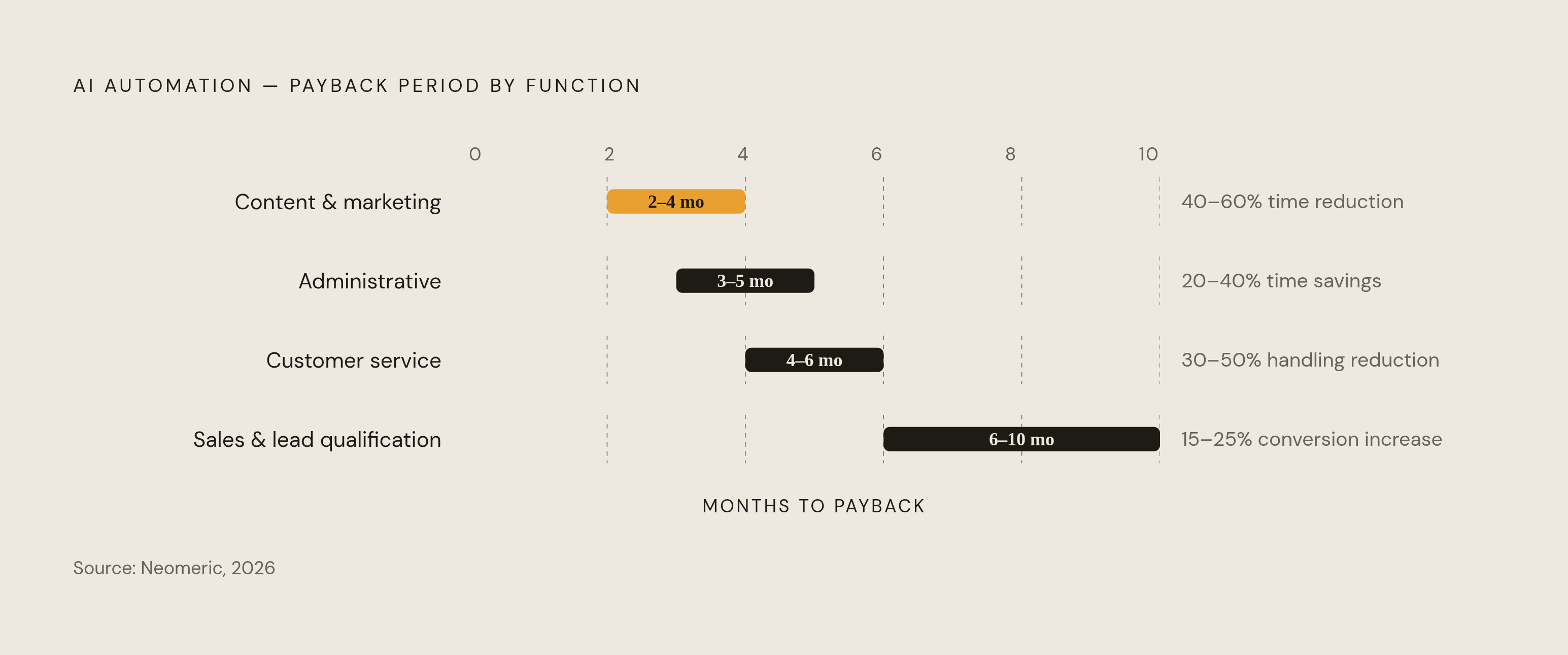
Practically, tracking doesn't need to be complicated. It means a clear before-and-after measure of the specific task the AI touches, whether that's hours saved, error rate, or turnaround time. It means checking in at 30 days and 60 days, not waiting for an annual review to see what happened. A measured first win builds the internal evidence a firm needs to justify the second deployment. Skip the measurement, and every future proposal starts the political argument over again from zero. What tracking looks like in practice for a professional services SMB:. Function-specific payback benchmarks from Neomeric (2026) give firms a calibration point:. Administrative automation (scheduling, invoicing, data entry): 20–40% time savings, 3–5 month payback. Customer service automation: 30–50% reduction in support handling time, 4–6 month payback. Content and marketing automation: 40–60% reduction in content production time, 2–4 month payback (lowest cost to implement). Sales and lead qualification: 15–25% increase in qualified lead conversion, 6–10 month payback.
The Access Gap to Embedded AI Expertise for SMBs
There's a role in the AI industry built specifically around solving this whole set of problems at once, usually called the forward-deployed or embedded AI engineer: a senior engineer who sits inside a client's actual environment and writes production code against the client's real data, authentication systems, and legacy infrastructure, rather than showing up to advise from the sidelines. That's exactly the kind of role that could execute bottleneck targeting, team involvement, and ROI tracking all at once Thomson Reuters Small business AI adoption statistics for 2026. The problem is access.
Roughly 76% of lab-dispatched embedded engineers concentrate in regulated, high-stakes accounts, banks, government agencies, hospital systems, large insurers, according to research from Utsubo Forward Deployed Engineer Studio: The SMB Gap (2026). SMBs aren't where the supply goes. Cost compounds the access gap.
There's a middle path that changes the math. The demand is squarely at the SMB end. The supply hasn't caught up.
What that means practically is that the predictor framework laid out across this piece, bottleneck targeting, team involvement, speed to production, ROI tracking, needs someone who can execute all four, not just advise on them from a slide deck. That person has to be embedded in the actual work, not parachuting in for a two-hour discovery session and disappearing until the invoice is due. An embedded partner that stays through the first deployment is also positioned to design the second one, which is the actual mechanism by which the ceiling on a firm's AI capability rises instead of resetting to zero every time. The cost barrier: median total compensation for the role is approximately $173,816; senior bands at major AI labs clear $350K–$550K+, prohibitive as a full-time hire for a 10–500 person firm (Forward Deployed Engineer Studio: The SMB Gap (2026)). The embedded BU engagement model offers a different cost structure: roughly $180–220K for a six-month embedded engagement vs. $400K+ for a 12–18 month centralized deployment (TheNeuralBase), and the former ships faster and maintains higher adoption. Demand signal confirming the gap: FDE job postings grew 1,165% year-over-year in 2025 (Bloomberry, January–October 2025), with 58% of postings at 11–200 employee companies, showing that the demand is there, but supply concentrates at the enterprise end (Small business AI adoption statistics for 2026, SMB AI Adoption Guide: Use Cases, Costs, Roadmap). SANSA's model addresses this directly: a three-stage engagement (diagnose the highest-leverage bottleneck in two weeks, build a production-ready system, stay embedded to ensure adoption sticks), structured to deliver the embedded expertise the predictors require without the full-time hire cost or the six-month consulting runway.
A self-assessment checklist SMB operators can use before committing to an implementation
Before signing anything, an operator should be able to answer a short set of questions honestly. Can the specific data the AI will touch, and where it currently lives, be described in a single sentence? Is there a named workflow where speed creates sellable capacity, rather than one that just shrinks an invoice line? Can that workflow realistically be in production within 30 days, with a clear before-and-after metric attached to it?
If most of those questions have solid answers already, the firm is closer to ready than most. If they don't, that's not a reason to abandon AI. It's a reason to fix the gap before a vendor contract gets signed, because the gap doesn't close on its own once the tool shows up.
Sources
- The State of AI Within SMBs in 2026 - Upwork
- 2026 AI Business Predictions: PwC
- SMB AI Adoption Guide: Use Cases, Costs, Roadmap
- Small Business AI Adoption Statistics 2025
- Small business AI adoption statistics for 2026
- AI in Professional Services — Complete 2026 Guide
- 2026 AI in Professional Services Report | Thomson Reuters
- Forward Deployed Engineer Studio: The SMB Gap (2026)