Competitive Displacement of Non-Adopting SMBs in Saturated Local Markets
Slow-moving competitors lose market share permanently when AI-adopters respond to customers faster.
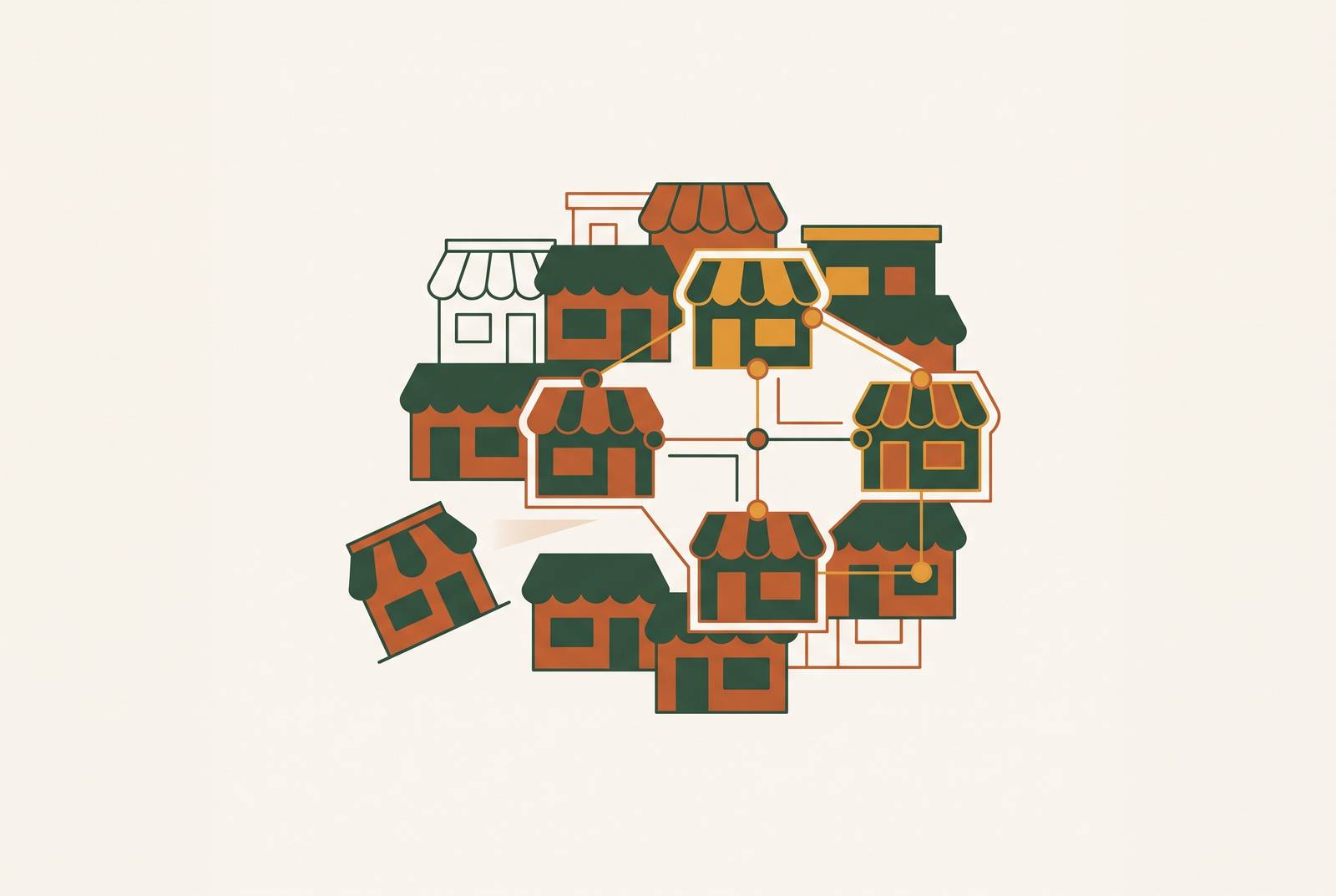
A homeowner with a broken water heater calls three plumbers before lunch. The first one to call back with a quote usually gets the job because speed reads as reliability. That single interaction is the whole story of what AI adoption means in a saturated local market: the customer pool is fixed, the competitors are many, and the business that responds fastest wins the job the others never had a chance at.
Why Saturation Changes What AI Adoption Means
A saturated local market is one where several providers sell the same service in the same geography, and new customers do not appear fast enough to go around. Construction, skilled trades, home services, local accounting and insurance, freight and local logistics all share this condition: geography caps how many customers exist, and every job one company wins is a job a competitor did not get. In a market like that, AI adoption stops functioning as a cost-saving upgrade and starts functioning as a tool for capturing a larger share of a pool that is not growing. Businesses that can serve more customers, faster, do not win occasionally. They win structurally, job after job, because the math of a fixed market rewards whoever moves first. A plumber who quotes in two hours while a competitor takes two days does not just win that one water heater job. That plumber builds a reputation for being the one who calls back fast, and that reputation compounds into the next call, and the one after that, until the slower competitor is competing for whatever work is left over.
How a throughput gap opens between adopters and non-adopters in the same market
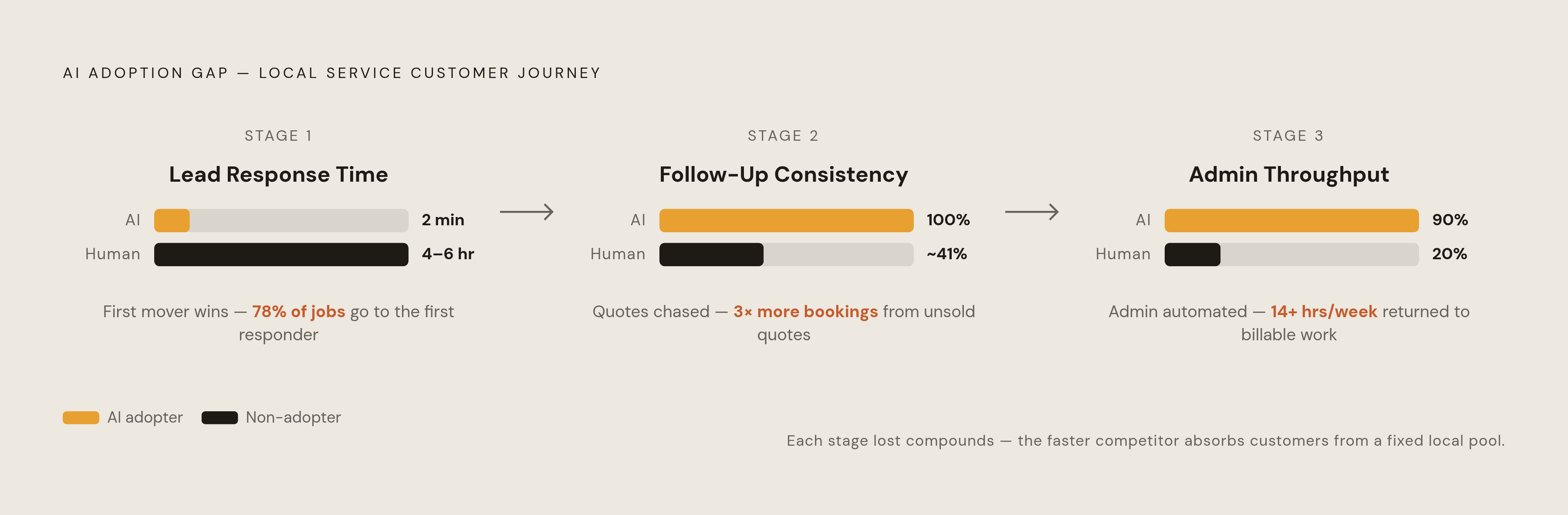
The gap between adopters and non-adopters has nothing to do with which company has the better product. It comes down to pace: how quickly a business can quote, follow up, schedule, and respond, at a volume a non-adopting competitor cannot match without hiring more people. That gap opens at three specific points in the customer journey common to almost every local service business. The first is lead response time, the window between when a customer reaches out and when they get a quote or callback. Data from the JPMorgan Chase Institute shows a growing share of small businesses are now paying for AI services, with adoption accelerating and small businesses spreading that spending across a wider range of AI tools, not just one. The second chokepoint is follow-up consistency. Human teams drop follow-ups when they get busy, but AI agents do not, and in local markets where most jobs need two or three touches before a customer commits, that difference alone changes how many quotes turn into booked jobs. The third is administrative throughput. IDC's Katie Evans points to invoice processing, data entry, and moving figures from PDFs into spreadsheets as the high-volume, repetitive tasks AI takes over, freeing the same staff to spend their hours on billable work. A business that handles more inquiries, closes a higher share of them, and turns jobs around faster fills its calendar before its competitors do, leaving less work available in the same zip code. This is already happening, not approaching. The US Census Bureau's Business Trends and Outlook Survey found AI use holding at roughly a fifth of all US businesses through early 2026. In most local markets, one in five competitors has already built AI into how they operate, while four in five have not.
Which local SMBs are most exposed
The businesses most exposed to displacement are the ones most convinced none of this applies to them: construction, skilled trades, food service, and local professional services. The SBA Office of Advocacy found that nearly four out of five businesses with fewer than five employees gave "not applicable to my business" as their reason for not planning to use AI, ahead of cost concerns and ahead of privacy concerns by a wide margin. That belief does not hold up against what is actually displacing these businesses. The use cases pulling customers away are automated phone answering, lead follow-up, scheduling, estimate generation, and review requests, workflow automation that any local operator could understand in five minutes if someone showed it to them. There is a particular irony in how commoditized local markets work: the more interchangeable the service looks from the outside (every plumber does the same work, every freight broker moves the same loads), the more that operational speed and responsiveness become the only thing separating one company from the next, and speed is precisely what AI compounds fastest. A second group of exposed businesses is in the "experimenting" tier: companies that have tried an AI tool or two without ever building it into daily operations. That tier offers no real protection. Trying a tool occasionally produces no throughput advantage, because the gap that matters runs between embedded AI and non-embedded AI, not between businesses that have touched the technology and businesses that haven't. IDC's 2026 research backs this up directly: standalone AI point solutions are losing out to embedded ones, and the SMBs seeing real results are integrating AI into their CRM, their ERP, and their actual operational workflows, not bolting on a separate app and hoping it helps.
The Adopter's Operational Model
The businesses pulling ahead are redrawing who does what inside the company, handing AI agents the high-volume handoff steps and keeping human staff focused on judgment calls and relationship work that actually need a person. In practice, that means routine customer inquiries, lead qualification, scheduling, and follow-up sequences run without someone manually pushing them along. It means job status, invoice records, and customer history move between systems automatically instead of being retyped by hand, which eliminates the coordination overhead that used to eat up administrative hours. And it means human staff shift from coordinating paperwork to generating capacity: more quotes going out, more jobs closed, more follow-through on the accounts that matter most. One documented case makes this concrete. A home services company automated phone answering, lead follow-up, scheduling, and review requests, eliminated two administrative positions, and reinvested the savings into a field technician who generated substantially more in annual revenue than those two positions had cost, producing a significant net annual gain against a modest monthly AI spend. A second case involves a mid-sized accounting firm that sharply cut the time staff spent on administrative tasks after putting AI into client onboarding, scheduling, and routine inquiries, which contributed to a measurable rise in client retention within four months. IDC describes the configuration behind both cases as a 2026 shift toward what it calls "AI Integrators," partners who define how human employees hand off work to automated agents. That is the same model behind proof points like a dramatic cut in manual data entry for an insurance broker and over a hundred recovered hours a month for a freight company. Those numbers are what makes it possible for a business to take on more work without adding headcount. The throughput gap does not come down to which tools a business owns. It comes down to whether AI is wired into the actual workflow or sitting off to the side, untouched by the systems that run the business.
The ROI Picture
Two credible sets of numbers on AI ROI appear to disagree, and the disagreement itself is the most useful data point available. Salesforce research finds that most SMBs using AI report revenue increases, a strong signal that the technology delivers real benefit. BCG's 2025 survey found a more modest median ROI, with a substantial minority of leaders reporting limited or no gains at all, a far more disciplined picture than the Salesforce number alone suggests. That gap between a strong headline and a modest median reflects a selection effect: businesses that embedded AI into defined workflows land on one side of that gap, and businesses that accumulated tools without redesigning any process land on the other. What separates a strong outcome from a weak one comes down to three things: whether AI outputs connect into systems of record, whether handoffs between AI steps and human steps are clearly defined, and whether the implementation targets an actual bottleneck instead of some low-stakes task that was easy to automate but never mattered much. For a local operator weighing the cost, the right comparison is what AI costs against the alternative of hiring a person to do the same volume of administrative work, and a fully loaded employee handling that volume costs far more per unit of output than an AI agent running the same function.
How fast the window for catching up is closing and what changes the timeline
The window for standing out through AI adoption in local markets is still open, but three structural shifts since early 2026 are closing it faster than adoption curves alone would suggest. The first involves AI capability built directly into financial tools small businesses already use. On March 10, 2026, Mastercard announced its Virtual C-Suite, a set of agentic AI agents meant to give SMBs executive-level financial intelligence, starting with a Virtual CFO module rolling out through financial institutions and accounting platforms. That puts a category of capability once reserved for larger firms into the banking relationships small businesses already have. The second shift comes from government. On March 25, 2026, the NSF TechAccess: AI-Ready America initiative announced federal funding to set up AI Coordination Hubs across as many as 56 US states and territories, with an initial round covering a subset of states and later rounds expanding to the rest, backed by significant annual funding per hub over three years. The purpose is specific: equip small businesses with the tools and training to adopt AI, removing the cost barrier that has held back a large share of non-adopters. Taken together, these shifts are dismantling the infrastructure and cost barriers that used to keep local SMBs behind larger firms, and they're doing it from three directions at once: platforms, financial services, and government programs. Gartner projections cited in the research suggest a substantial minority of SMBs will have at least one AI agent deployed by the end of 2026. The majority still won't, and a business that deploys early in 2026 still stands out in most local markets. The old "fast follower" posture, the one IDC documented working for years, made sense when enterprise AI experiments were expensive and unreliable and letting someone else absorb that risk was the smart move. IDC's Evans notes that the share of SMBs using no AI at all dropped sharply in a single year once vendors packaged AI into the tools SMBs already used. That timing has passed for local markets where competitors have already made the move, and the operator still waiting is no longer following fast. They are just behind.
The fastest credible path to a production AI deployment for a resource-constrained local SMB
For a small business without an IT department, the fastest credible route to a working AI system is an embedded specialist who builds against one clearly defined bottleneck and stays until the system is actually running. Platform AI features make a reasonable starting point, but IDC's finding is direct: the SMBs seeing real results are the ones who connect AI into their actual operational workflows, not the ones who flip on a feature inside an existing tool and leave it disconnected from approvals, handoffs, and the systems that keep records straight. The engagement that produces results structurally in three phases. A two-week diagnostic identifies the highest-leverage bottleneck, the specific chokepoint where throughput is actually being lost, rather than some low-stakes task that's easy to automate but does nothing for the business's position in its market. A production build phase follows, typically structured as one narrow use case per four-week sprint, built against that single outcome. After that comes an embedded maintenance phase where the system keeps running and compounding, generating data and workflow familiarity that makes the second and third automations faster and better targeted than the first. One model built for exactly this situation runs as a three-stage engagement, diagnostic, production build, and embedded compounding, aimed at SMBs with up to several hundred employees in accounting, insurance, logistics, and general services, with documented results including a dramatic cut in manual data entry and over a hundred hours a month recovered for a freight company. Those results are a starting point, not a finish line. The value compounds as the system frees up capacity for work the business previously had no room to take on. European consultancies offer a useful sense of what this kind of engagement runs for in the broader market: fixed-price packages that range from a two-day workshop around 5,000 euros up to a full engineering project in the 50,000 to 75,000 euro range, a spread that puts into perspective what a focused, embedded build should reasonably cost. For a local operator weighing all of this, the question that actually matters is whether the business can afford to be the one still handling this work by hand six months from now, while the competitor down the street already isn't.