Administrative Overhead as a Share of Revenue in Small Accounting Firms
Overhead rate reveals which small accounting firms will survive or struggle.

Overhead rate is the single most diagnostic efficiency ratio a small accounting firm owner has, because it isolates every dollar that does not go directly into producing client work. Overhead itself covers rent, utilities, insurance, technology, marketing, and administrative costs not tied to client delivery, including administrative salaries and professional development.
Overhead rate and net profit margin measure different things, so if firms treat them as interchangeable, they miss the real signal. A firm can grow revenue while its overhead rate climbs and its margin shrinks at the same time. These two dials move independently, even though they influence each other.
Overhead rate deserves attention first, because it sits inside a firm's direct control, reflecting decisions about space, staffing, and process that an owner makes directly.
The ratio does not capture realization losses, write-downs, or collection gaps. Those are real margin levers, but they sit outside what overhead rate measures, and they stay outside the scope of this analysis.
Knowing what belongs inside the overhead number, and what stays outside it, comes before any judgment about whether a given firm's number is a problem. The benchmarks that follow only mean something once the inputs behind them are clear.
Overhead benchmarks for efficient, average, and struggling firms
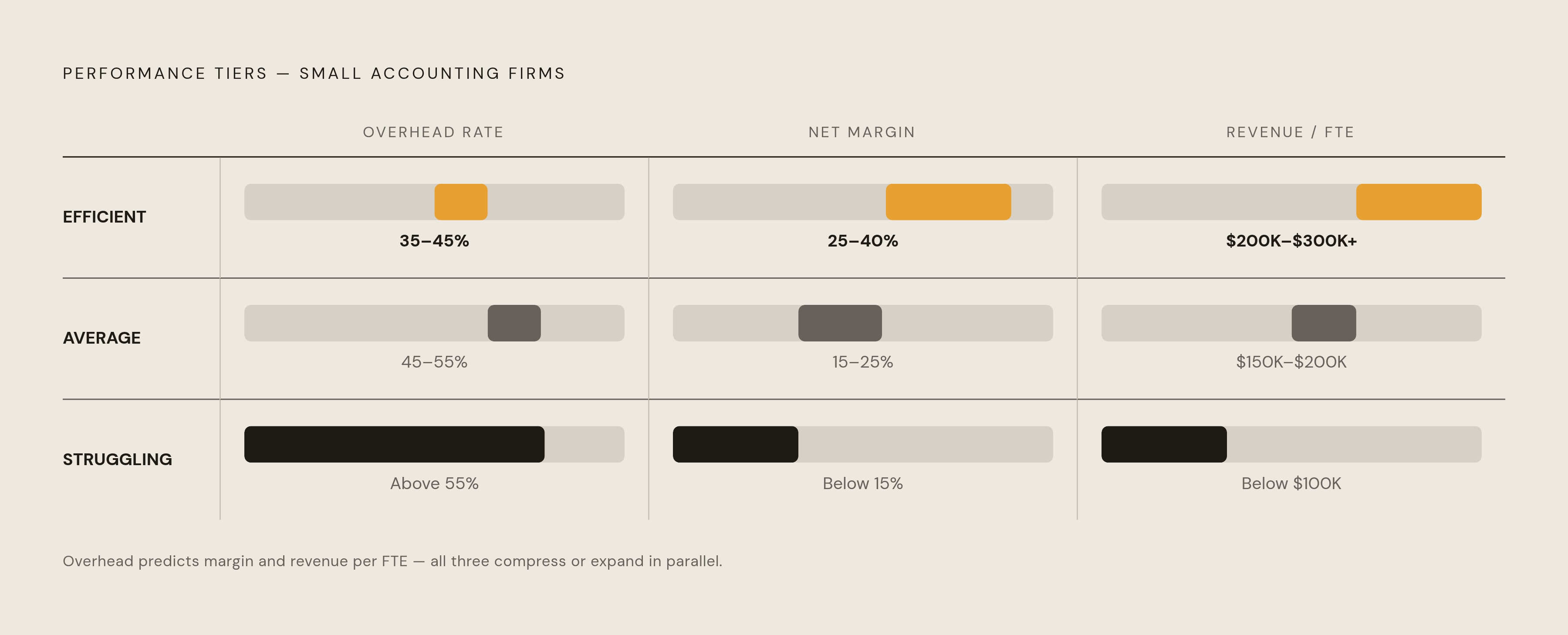
An efficient small accounting firm and a struggling one, measured on this single ratio, land far enough apart that the gap can decide whether the firm survives. Efficient firms hold overhead to 35-45% of revenue. Average firms run 45-55%. Firms above 55% fall into inefficient territory.
| Tier | Overhead rate | Net margin | Revenue per FTE | |---|---|---|---| | Efficient | 35-45% | 25-40% | $200,000-$300,000+ | | Average | 45-55% | 15-25% | $150,000-$200,000 | | Struggling | Above 55% | Below 15% | Below $100,000 |
The 35-45% band is not a number pulled from theory. Overhead discipline and owner profitability move together in that band.
Net margin tracks the same pattern. Struggling firms sit below 15% net margin, average firms run 15-25%, and high performers reach 25-40%. Overhead rate and net profit margin compress or expand in parallel, so a rising or falling overhead rate signals where margin will land before the margin number itself appears.
The 2-to-20-employee band carries the most exposure in this whole picture. They have not reached the scale needed to spread those fixed costs efficiently. Margins typically compress through this band, then recover as a firm approaches 20 people.
Revenue per employee offers a parallel check on the same problem. Good performance is between $150,000 and $200,000 per FTE. Firms below $100,000 per employee carry an efficiency or pricing problem that the overhead number alone might not reveal.
A firm's overhead rate only reads as accurate if its line items are categorized consistently.
The four forces that push overhead above the efficient band in 2026
Overhead climbs faster than revenue at most small practices, and the cause rarely traces back to carelessness. Four structural forces each add cost while revenue grows more slowly, and most firms carry all four at once without the operational data to see which one does the most damage.
Real estate is the top factor. Offices remain leased at the floor plans and term lengths set for a headcount and attendance pattern that ended in 2020. Smaller graduate cohorts mean lower physical attendance even during peak season, but lease obligations have not shrunk to match the lower occupancy.
Talent cost moves the wrong direction too. More than 300,000 US accountants and auditors left the profession between 2020 and 2022. Firms hire AI-capable seniors and advisory specialists and pay premium rates for them, even as entry-level intake keeps shrinking. The wage bill climbs.
Client pricing pressure on compliance work adds a fourth force. Clients now price compliance work as a commoditized process. Clients who once accepted that tax prep and audit required qualified billable hours know AI is involved in the work, and they price accordingly, compressing revenue per engagement even though the work still consumes staff time.
The third force deserves the most attention, because it is the one a firm can act on directly. Without automation, scheduling, document collection, data entry, invoice processing, and month-end reconciliation all consume time that should go to billable or advisory work. This overhead inflates most quietly as a share of revenue because it appears in staff time spent on manual workflows that no line item tracks.
Real estate terms, talent market conditions, and client pricing psychology sit largely outside what a small firm can change in the near term. Administrative drag inside core workflows sits entirely within a firm's control, and it is the lever the rest of this piece focuses on. Each force alone is manageable. The real problem for firms above 55% overhead is that all four usually operate at once, and fee increases rarely close the gap: most firms planning fee increases in 2026 are targeting increases below the rate of cost inflation.
Which workflows inflate administrative overhead fastest
Administrative overhead does not spread evenly across a firm's operations. It concentrates in a small number of high-volume, human-intensive workflows where manual handling has compounded unchecked, and those same workflows are where AI-driven compression produces the fastest measurable return.
Month-end close and reconciliation is one of them. Manual data entry and categorization during close extends timelines and consumes senior staff time that would otherwise be billable. The Free Minded Accounting Group reduced its annual cleanup engagements from weeks to days after adopting Digits' Autonomous General Ledger, with the gains coming specifically from removing manual data entry and automating categorization and reconciliation.
Document collection and client onboarding carry a similar cost, even though the drag is harder to see. The cost hides inside utilization: time that could be billable goes instead to administrative coordination.
Prospect qualification and intake show what happens when this workflow runs unstructured.
Tax return preparation on standard returns inflates overhead on a seasonal cycle. The drag is seasonal, but it runs severe enough to force overtime or to cap capacity and revenue at the same time.
These four workflows share a common thread. Each one runs at high frequency and follows rules consistent enough that most of the decisions inside it do not require professional judgment. They require consistent execution instead, and consistent execution is exactly where human handling runs most expensive and most error-prone.
The operational pattern behind the 35-45% benchmark
Firms holding overhead to the 35-45% band share a recognizable pattern: they manage administrative capacity as a variable, not a fixed cost to absorb, and they concentrate human attention on work that requires professional judgment while automating or systematizing everything else.
Utilization data drives space and headcount decisions. If a firm still runs on pre-2020 floor plans and headcount assumptions, it tends to run above 55% overhead too.
Compliance delivery has shifted toward automation paired with recurring fee structures. Firms running CAS recurring models tend to hold their overhead steady.
Efficient firms also pick one high-friction workflow and run a structured pilot before they scale anything further. The practitioner consensus for small firms: choose one high-volume workflow, whether accounts payable, monthly reporting, or document requests, run a 30-to-60-day automation pilot, and measure results before expanding. This sequencing avoids the more common failure mode, which is buying tools and dropping them onto processes built for humans to run by hand.
The tool and the workflow change together, not in sequence. Deployment and measurable ROI are not the same thing, and firms that buy automation tools and layer them onto existing processes unchanged capture only a fraction of the available gain. Firms that compress overhead successfully redesign the human steps in the workflow at the same time they bring the tool in.
That redesign opens a door past cost-cutting. When firms free senior time from administrative drag, they gain room for advisory work, which carries better margins and is where revenue growth concentrates across the profession. Advisory work has grown as a share of firm revenue over the past decade and a half, and firms buried in admin cannot chase that shift even when they want to.
How small firms compress administrative overhead workflow by workflow
The path from above-55% overhead to the efficient band runs through a sequence of compressions, not one single initiative.
Identify the highest-volume, most rule-bound workflow first. The Journal of Accountancy's CAS practice guidance recommends choosing one high-friction workflow and running a 30-to-60-day AI automation pilot on it. Starting with the workflow that carries the highest transaction volume and the most predictable decision rules produces the fastest measurable reduction in overhead.
Accounts payable and invoice processing is the typical entry point, and the clearest documented case comes from Countsy's deployment of Vic.ai. For firms carrying similar AP volumes, this workflow tends to deliver the fastest overhead reduction available.
Close and reconciliation works as the second lever. For a small firm, tasks that never needed senior judgment consume senior time most expensively during the close workflow.
The capacity gain from these first two levers compounds in a specific way. A professional services firm took on more clients without adding headcount by sending the capacity it freed up to client acquisition.
Prospect qualification and intake forms a third lever, and a less obvious one. Intake does not usually get classified as administrative cost, but partner time spent on unqualified prospect calls counts as real overhead against the revenue line.
An honest objection sits inside this argument: only a minority of finance teams with AI solutions deployed report clear, measurable ROI, because deployment is outpacing workflow redesign at most firms.
The build-or-buy decision for closing the overhead gap
A firm owner closing the gap between a current overhead rate and the efficient benchmark faces a choice of implementation path, and that choice matters as much as the choice of workflow. Hiring full-time carries costs and timelines that tend to worsen overhead before it improves.
A full-time AI hire carries significant total compensation and a multi-month time-to-fill. For a firm already running above 55% overhead, adding a senior technical hire to payroll before any productivity gain arrives worsens overhead measurably in Year 1.
Off-the-shelf tools sit at the other end of the spectrum. Median annual AI tool spend per adopting small business runs in the thousands of dollars, and payback for accounting automation tools is achievable within months. This is the right starting point for a single-workflow pilot, and the firms with documented results, Countsy, The Free Minded Accounting Group, and Agate CPA, all started with purpose-built tools.
An embedded partner occupies the middle ground, and it works differently from either path. It is not a tool vendor shipping software and walking away, and it is not a consultant delivering a report and moving on. SANSA runs a three-stage model built on this logic: diagnose in two weeks, build, then stay embedded. That model is built specifically for firms between 5 and 500 employees, the range that cannot absorb a six-figure consulting engagement or a six-month hiring cycle.
The documented cases point to a compounding path. First-workflow compression frees up capacity, and firms redeploy it to client acquisition or advisory work. That work grows revenue, and when revenue grows, it improves the overhead ratio even before a second workflow gets touched. Firms that reach the 35-45% benchmark and hold it are the ones that build this compounding sequence, rather than running a single pilot and stopping there.
A practical diagnostic for where your firm sits
Knowing the efficient benchmark only helps once a firm owner can locate their own number against it and name the workflow to fix first. The diagnostic runs simpler than most owners expect: it locates the one or two workflows where overhead concentrates before it spreads across the firm.
Start by calculating the overhead rate directly: pull total expenses, subtract professional and administrative salaries, and divide the remainder by total revenue. A result above 45% puts a firm in average-to-inefficient territory, where the remaining steps apply. A result above 55% makes the case for workflow compression urgent.
Next, find the highest-volume, most rule-bound workflow in the firm. Look for the place where staff time goes to tasks that do not require professional judgment: AP processing, close and reconciliation, document collection, intake routing. This is almost always the right place to start, and the documented cases confirm it works.
Run a 30-to-60-day off-the-shelf pilot on that workflow before building anything custom. A pilot that produces no measurable time reduction within 60 days signals a need to change the tool or the workflow design, not a reason to abandon the approach.
Measure what changes in the overhead rate itself, not just in hours saved. Deployment and ROI are not automatically the same thing, and firms that capture real gains are the ones tracking whether freed staff time moves to billable or advisory work rather than getting absorbed by new administrative tasks. Revenue per employee before and after the pilot tells that story more reliably than hours logged.
After the first win, ask which workflow would produce the largest additional capacity gain if compressed next, and whether that capacity is heading toward higher-margin work or sliding back into the administrative baseline.
The overhead ratio is an operational variable that responds directly to workflow decisions, and the distance between 35% and 55% overhead separates a firm that can take on new clients and new service lines from one that stays perpetually at capacity without growing. The ceiling on what a small firm could do was never talent or ambition. It was administrative drag compounding unchecked in the wrong workflows, and that is now a problem firms can name, measure, and fix.