Wage Inflation Pressure on SMB Operational Roles
Small businesses can't afford the automation fix, so wage pressure is freezing growth instead.
Wages for operational roles are climbing faster than pay across the rest of the economy, and for small businesses, that's not a line-item problem. It's turning into a hard ceiling on how much work the business can actually take on. This piece breaks down why that's happening, what it costs to fix with AI versus a new hire, and how owners can respond without eating the margin hit or freezing growth plans.
Operational wage growth versus overall pay for SMBs
Payscale's Labor Market and Wage Trend Report pulls from 10.2 million salary records across more than 4,500 organizations. Overall wage growth landed at 3.5% for the quarter, against inflation running at 3.9%. Anyone in a flat-pay role already lost ground in real terms before operations even entered the picture.
Operations roles beat that pace anyway: 4.5% growth in Q2 2026. That gap is concentrated demand in supply chain, manufacturing, and logistics, where employers are fighting over a shrinking pool of people who can actually do the job.
Looking at individual roles sharpens the picture. Ironworker Foreman pay jumped 18%. Equipment Maintenance Technician also rose 18%. A logistics and supply chain supervisory role climbed 15%. These are hands-on, on-site jobs, the kind where someone has to physically show up and know what they're doing. That pressure won't ease on its own. A foreman can't be outsourced to a lower-wage country, and no chatbot is standing in for one on the warehouse floor.
Rising operational wages becoming a capacity ceiling, not just a cost line
Cost and capacity are different problems, and they don't get solved the same way. Cost is margin compression: the business pays more for the same output, and profit shrinks. Capacity is the harder one. It means the business physically cannot serve more clients, take on more volume, or launch a new service line, because it can't afford to add the headcount that growth requires.
Once wages outpace revenue growth, a small business lands in one of three spots. It pays market rate and absorbs the hit, which works until the hit gets too big to swallow. Or it leaves the role understaffed, which caps volume and usually drags service quality down with it. Or it quietly shelves the growth plan that depended on that role existing at all, turning a cost problem into a strategic stall.
That third outcome is the one owners underestimate most, and it's the one that does the most damage. A cost problem appears on a P&L, visible and at least theoretically manageable. A stalled growth plan has no line item. It just doesn't happen, and nobody circles a number to explain why.
The ceiling appears fastest wherever a single operational role sits on the critical path. The logistics coordinator touches every outbound shipment, the account manager personally owns every client relationship, and the back-office processor is the only one who actually understands the invoicing system end to end. When that seat gets expensive or hard to fill, growth slows to whatever pace that one person can sustain. There's no slack anywhere else to borrow from.
The out-of-reach "just hire an AI engineer" response for most SMBs
Facing wage pressure, the obvious instinct is to automate the problem away. Bringing an AI engineer in-house is the loudest version of that instinct, and the price tag rules it out for most small businesses before the conversation even gets going.
Median pay for an AI engineer in the US runs $173,482, with the 90th percentile reaching $269,611. Robert Half's Salary Guide puts the mid-band for an AI/ML Engineer at $170,750, close enough to confirm that first number isn't some outlier.
Benefits, payroll taxes, equipment, and management overhead push the real figure up fast. Levels.fyi data puts the fully loaded cost of a single in-house senior AI hire at $242,507 on average, and for a senior hire specifically, total compensation clears $300,000 in year one once benefits, payroll taxes, and overhead get layered on. None of that buys a single line of code that changes how the business runs.
Then there's the wait. Senior engineering roles in specialized technical areas take three to six months to fill. Call it three months of recruiting and interviewing before a single workflow changes, followed by a full year of payroll regardless of what ships. For a business running 15 or 20 employees, that math doesn't come close to clearing the bar, and pretending it might is how owners waste a hiring cycle finding that out the hard way.
Where SMB AI adoption stalls right now
Small businesses are adopting AI tools at a pace that would've looked unbelievable three years ago. US SMB adoption has grown sharply in recent years, well past early-adopter territory at this point.
The US Chamber of Commerce's Empowering Small Business Report backs that up from a different angle: 58% of small businesses now self-identify as generative AI users, up from 40% the year before. The Small Business & Entrepreneurship Council's 2026 Small Business Tech Use Survey adds the detail that actually matters here: a large share of small business employers have invested in AI tools, many running several separate tools in their stack.
Five tools is the tell. Adoption is wide, but it's spread thin. Most SMBs are sprinkling AI across a handful of point solutions instead of putting real weight behind the one or two systems that would break a bottleneck open, and that scattershot approach is why so many of them can't point to a return.
Confidence has gotten ahead of proof, too. The Upwork Research Institute research found a strong majority of SMB leaders feel very confident handing high-stakes tasks to AI agents, and one in three consider AI agents mission-critical to strategy. Yet ROI uncertainty ranks as a leading barrier to adoption, trailing only data security and compliance concerns. Belief in the technology has outrun the ability to say what it's actually returning, and that gap is where budgets quietly leak.
The cost math: what AI deployment runs versus what a new operational hire costs
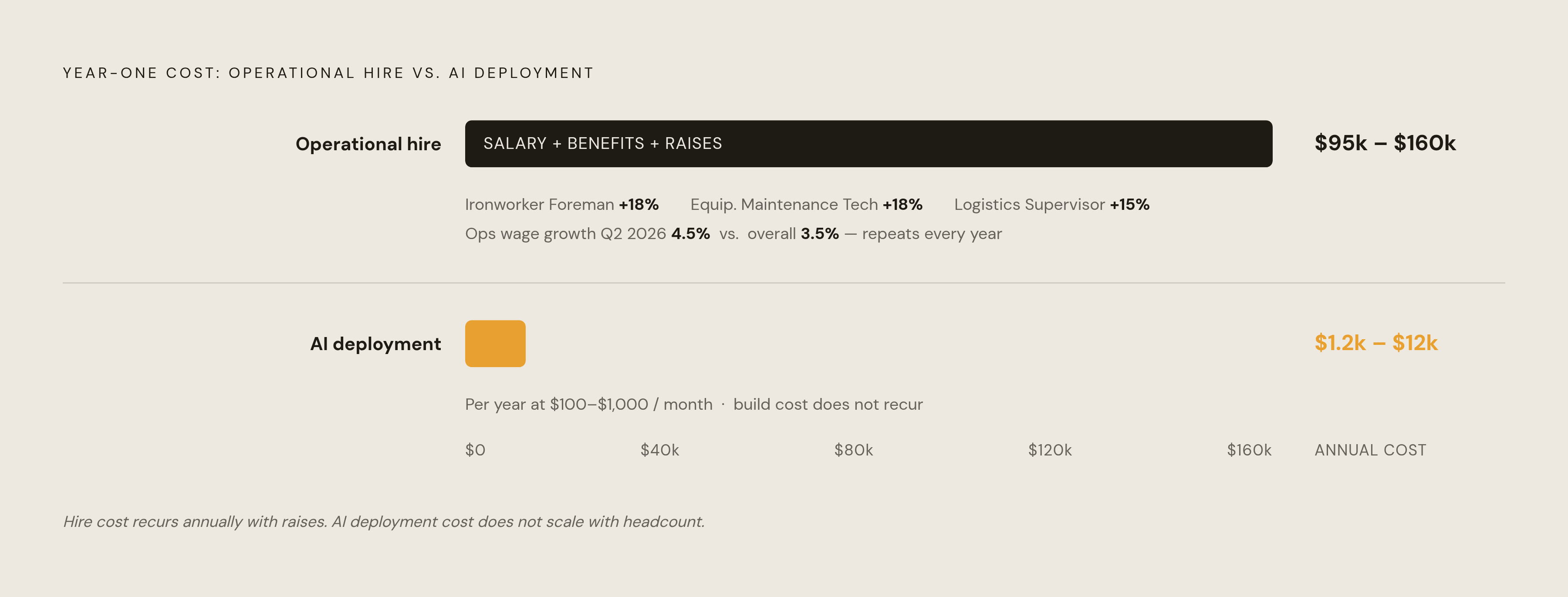
Lining the two numbers up shows the gap isn't subtle. A mid-level operational hire, fully loaded with taxes, benefits, and overhead, lands well into six figures in year one. AI deployment lives in a different range.
Off-the-shelf AI tools typically run SMBs in the hundreds to low thousands of dollars a month. Custom agents built around a specific workflow cost more upfront, but that's a one-time build, not a salary that repeats every year with raises stacked on top of it.
Prices are moving the right direction too. Entry-level AI costs have fallen meaningfully in recent years, as model infrastructure gets cheaper and more vendors compete for the same customers.
None of that means AI replaces a person, and treating it that way is the mistake that sinks most deployments. Research into AI automation economics has found that for many tasks AI is technically capable of handling, a human remains the cheaper option once deployment costs are factored in. Judgment calls, client escalations, relationship management, real strategic decisions: those still need a person behind them. AI's value appears in the structured, repeatable slice of a job, never the whole job. Chasing the whole job is the fastest way to burn a deployment budget on the wrong 23%.
ROI timelines when AI targets an operational bottleneck directly
Industry surveys consistently report strong average returns on AI investment within the first year or two of production deployment, though results vary widely across companies of different sizes. Enterprise survey data sharpens the picture: a large share of companies report their most advanced AI initiatives met or beat ROI targets, with a notable portion seeing returns well above expectations.
Small business data tells a similar story at smaller scale. Surveys of small business owners consistently find that a meaningful share report revenue increases after adopting AI tools, alongside self-reported gains in efficiency.
Payback gets sharper still when AI targets one specific bottleneck instead of chasing general productivity. Customer service automation can meaningfully cut support handling time, often paying back within months. Administrative automation can save a significant share of time spent on overhead tasks, with similarly short payback periods. Sales and lead qualification automation can drive a meaningful lift in conversion rate.
None of those numbers are vague productivity claims. Each one points at a single workflow with a single bottleneck, and the payback clock starts the day the system goes live, not months later once someone finally finishes onboarding.
SMB responses to wage pressure without absorbing it or stalling
Before spending a dollar, an owner needs to answer three questions, in order. Skipping the order is where most AI budgets go to die.
First: which operational role or workflow is the actual throughput constraint? Not the most annoying task, not the one that gets complained about most in a Monday meeting. The one where adding capacity, human or otherwise, unlocks growth most directly.
Second: how much of that role is structured, repeatable work that doesn't need judgment, and how much genuinely does? A logistics coordinator's job might be mostly data entry and status updates, with a smaller slice handling the exception when a shipment gets stuck at customs. AI can take the larger share. It can't take the exception-handling 30%, and pretending otherwise is how a rollout collapses under its own promises.
Third: run the actual first-year comparison. Another hire at current market wages, fully loaded, against an embedded AI system built for the structured layer of that same role. Given the numbers above, that comparison usually isn't close, and owners who skip it end up hiring their way into the same ceiling they were trying to avoid.
Operational roles are moving faster than the job descriptions and pay bands built to track them, and the same lag occurs when AI gets deployed without locating the real bottleneck first. Generic tooling, bought because a competitor has it or a vendor gave a good pitch, doesn't move anything. It just adds a sixth tool to a stack that already has five sitting idle.
There's a real difference between removing a ceiling and adding efficiency at the margin. Removing a ceiling means embedding AI directly into the workflow that's capping output today. Efficiency at the margin means layering a tool onto work that was never the constraint to begin with, and that kind of deployment feels productive while changing almost nothing.
Done right, the sequence compounds. The first AI system frees the existing team to handle more volume, or take on a service line that wasn't possible before. That new revenue funds the next system, and capability keeps growing without headcount scaling in lockstep with output. That's the whole point: the business stops hiring its way through every unit of growth, one expensive operational role at a time.