Small Freight Broker Survival in a Market Favoring Scale
Rising rates and tightening capacity are squeezing small brokers harder than the big players.

The freight brokerage market has lost about one in five brokerages since 2022, and the ones still standing tend to be bigger and better funded than the ones that closed. That matters because the competitive field a small broker faces today is harder, structurally, than the one it entered even two or three years ago. This wasn't a single bad quarter. It was a sustained grind: thousands of brokerages shut down across 2023 and 2024, and active motor carrier numbers fell through an 18.3% decline over two years, measured through April 2025. Five states, California, Texas, Florida, Georgia, and Illinois, accounted for roughly half of all net broker closures nationwide. That concentration tells its own story: the pressure hit hardest in the busiest, most competitive freight corridors, the exact lanes where small brokers used to compete on hustle and local knowledge. The brokers who made it through weren't simply lucky. They were running leaner, better-capitalized operations in a market that stopped tolerating anything else.
Why 2026's partial recovery does not relieve the pressure on small brokers
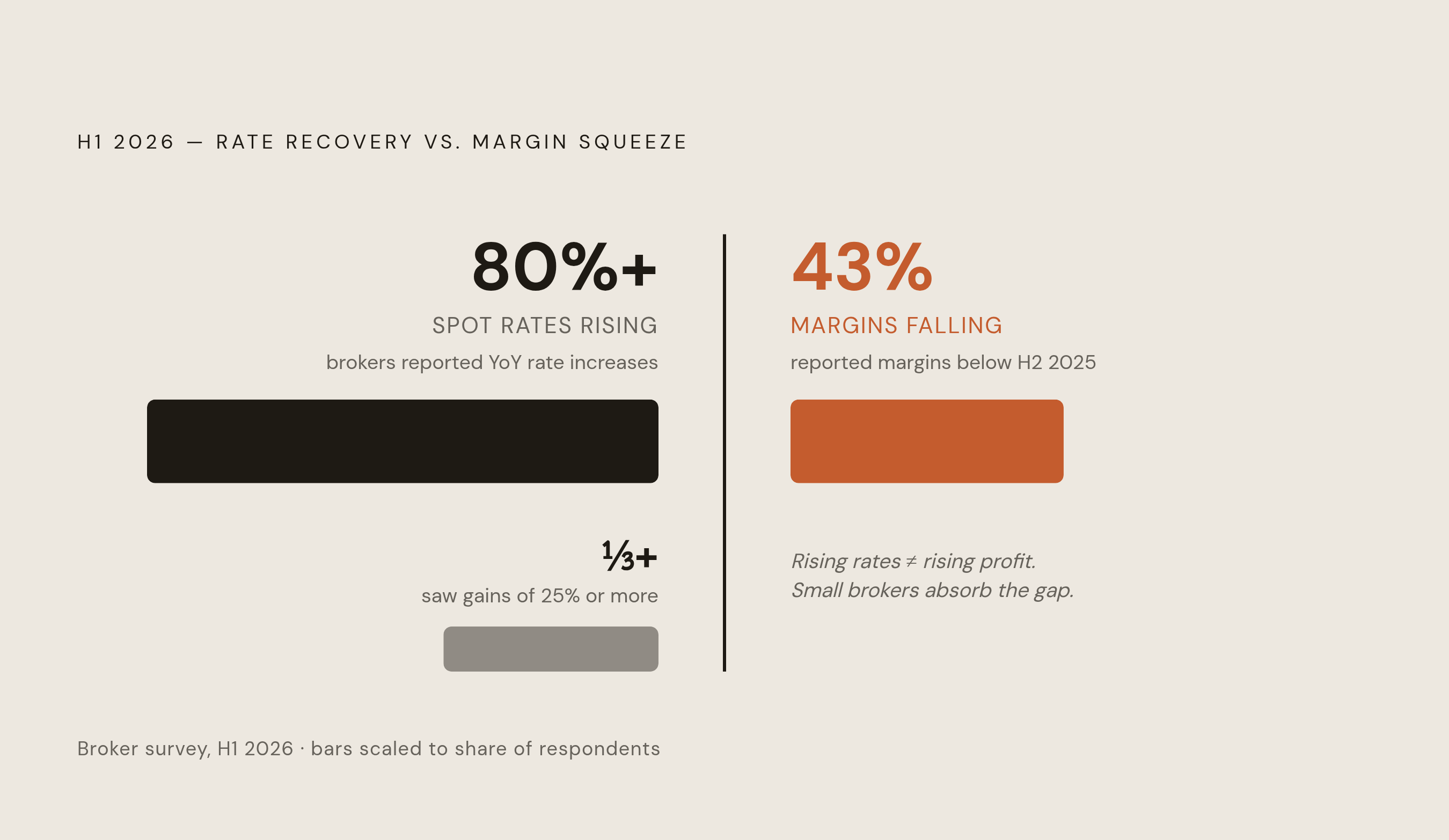
A market turning upward sounds like relief, but if you're a small broker in 2026, this turn is making things harder, not easier. Rates are climbing, margins are shrinking, and that combination squeezes the brokers who have the least room to absorb it. More than 80% of brokers reported spot rates rose year-over-year in the first half of 2026, with over a third of those seeing gains of 25% or more. At the same time, 43% said margins were lower than in the second half of 2025. Rates and margins are moving in opposite directions because capacity is tightening faster than shipping volume is growing. When rates rise without a real surge in demand behind them, large asset carriers with trucks sitting available start accepting loads directly, at the higher rate, and brokers get cut out of the transaction. That's the exact dynamic playing out right now. On top of that, most brokers expect capacity to keep tightening over the next three to six months, and 86% already say finding capacity is harder than it used to be. For a small broker without a deep bench of carrier relationships, a tightening capacity market turns into a load-coverage crisis fast. A broker who can't source a truck doesn't just lose that one load. The shipper remembers who failed them, and the relationship goes with it. Brokers with their own trailer fleets hold a real structural edge here, and small non-asset brokers can't replicate it just by working harder. The only counter available to them is speed and precision in how they operate, because the market recovery itself is tilted toward brokers who already have scale.
The cash flow trap that kills operationally sound brokers before bad decisions do
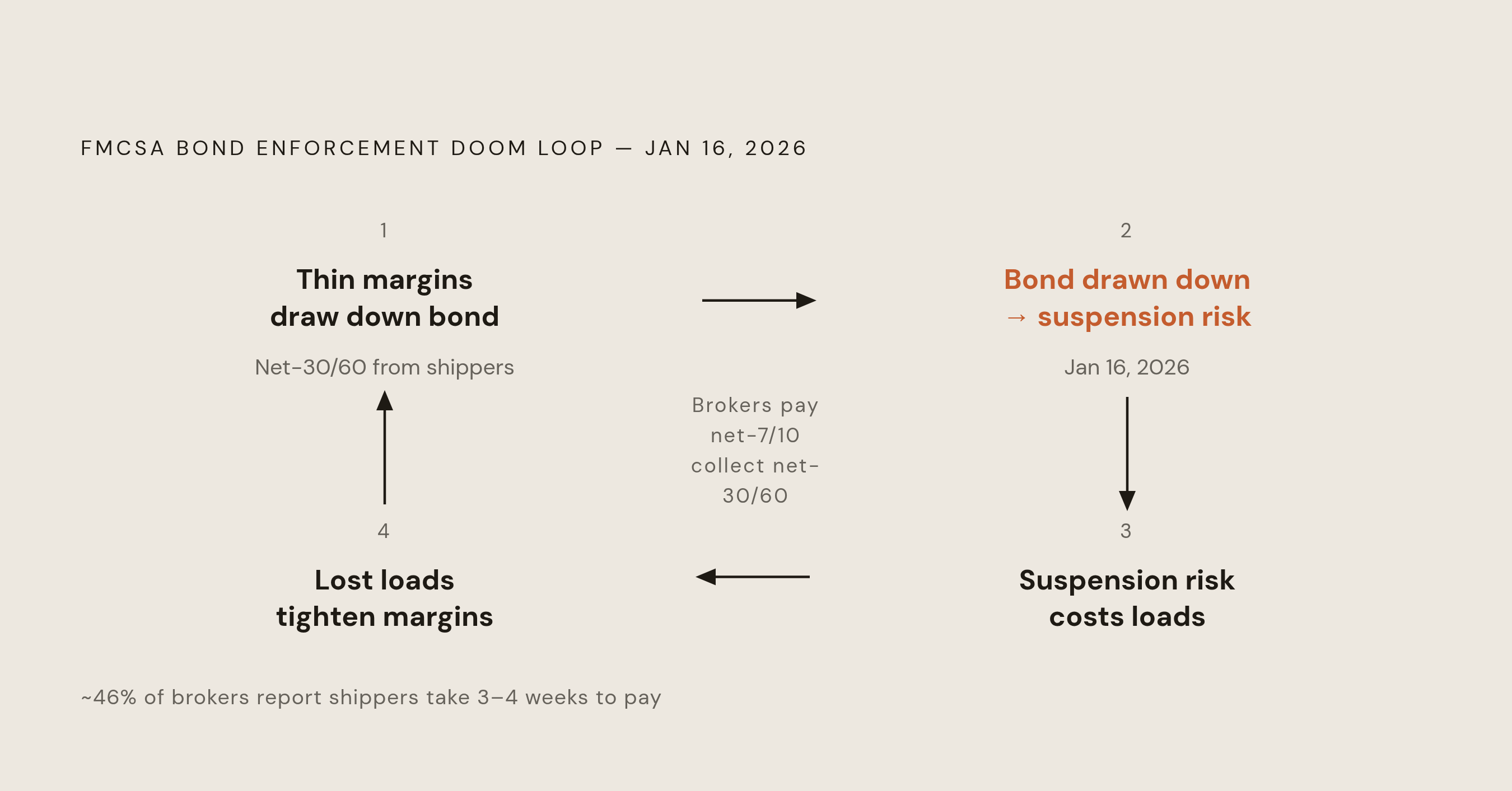
The most dangerous threat you face as a small freight broker in 2026 is the timing mismatch between when carriers get paid and when shippers pay the broker. Brokers typically pay carriers on net-7 or net-10 terms, but shippers pay the broker back on net-30 or net-60. Every load booked under those terms means the broker has to fund the gap out of pocket, and that gap compounds with volume. Close to half of brokers report that shippers take three to four weeks to pay invoices, and a large additional share take a month or longer. That timing mismatch is the baseline condition of running a brokerage, not an occasional headache, and it means the cash cycle has to be planned for, not reacted to. The stakes around that gap changed sharply this year. FMCSA bond enforcement took effect January 16, 2026, and brokers who had been quietly drawing down their surety bonds to cover operating shortfalls now face automatic suspension risk. A cash flow problem that used to just be uncomfortable can now cost a broker the license to operate. Detention fees make the squeeze worse: most brokers simply absorb detention costs rather than fight shippers over them, because chasing the dispute costs more in time and goodwill than the fee is worth. That's revenue earned and never collected, and it drains margin one load at a time. Put the pieces together: thin margins lead to a drawn-down bond, the drawn-down bond creates suspension risk, suspension risk costs loads, and losing loads tightens margins further. It feeds itself. A broker who hasn't stress-tested bond adequacy, days sales outstanding, and margin profile together, as one connected picture rather than three separate numbers, is running blind straight into that sequence.
What Scale Buys Large Brokers
Large brokers are using scale to strip cost out of their operations through automation, and that shift opens gaps that a sharp small broker can fill. C.H. Robinson has put more than 30 generative-AI agents to work across its brokerage operation, handling over 3 million shipping tasks, while headcount in the truckload division fell and adjusted operating margin climbed. That's what scale buys: a cost structure that keeps getting lighter as volume grows. But scale built for volume isn't built for the exception. As capacity tightens through 2026, mid-sized shippers who can't afford a full-time logistics staff need a partner who can find a truck on short notice and adapt when a lane breaks down. Systems built to process the median load at huge volume aren't tuned for that kind of responsiveness. Brokers that lock in carrier relationships, tighten their internal workflows, and build real visibility into available capacity before the back half of 2026 will be positioned exactly where the market is about to need them: the moment routing guides start failing at scale, which is precisely when a shipper picks up the phone and calls a broker they trust, not a support queue. But will fast-automating giants out-respond everyone too? Automation at scale is optimized for throughput on the typical load, not for the unusual lane, the compliance-sensitive shipment, or the same-day emergency, and those are the situations where a median-tuned system underserves the shipper every time.
Quoting speed as the first place operational discipline shows up in won loads
Quote response time is the single operational variable tied most directly to whether a broker wins the load, and closing that gap has nothing to do with size. It comes down to workflow discipline and the right tools. Walk through what actually happens when a quote request lands: an email or portal request comes in, someone has to pull the right rate for the lane, check it against current market conditions, send a confirmation back, and only then does the load get booked. Every step in that chain takes time, and every minute added is a minute a competing broker can use to win the business first. Automation is the fastest route to profitability in 2026, and the baseline for a competitive tech stack now is eliminating manual work across quoting, booking, billing, and customer communication. A small broker that closes this gap is competing on the thing that actually decides who gets the load: who answered first, with an accurate number.
Carrier relationships as managed infrastructure, not informal contact lists
In a capacity market this tight, a small broker's network of carrier relationships functions as a strategic asset, not a convenience. Most small brokers still manage that network informally, through memory, habit, and whoever happens to answer the phone, and that kind of system breaks down exactly when the broker needs it most. With 86% of brokers already reporting that capacity is harder to find than before, and most expecting it to tighten further over the next three to six months, a broker who can't cover a load doesn't just lose that shipment. The shipper relationship goes with it. Compliance has become part of this picture too. The Supreme Court's recent ruling on broker liability is reshaping how brokers have to evaluate carriers before booking them, and a notable share of brokers now expect it to push real investment into carrier evaluation tools. Tracking a carrier's safety and compliance record is how a broker manages its own legal exposure. Parade's CoDriver, integrated with McLeod Software's PowerBroker TMS, shows early adopters cutting manual call and email work sharply while increasing loads handled per person per month, because the follow-up that used to get forgotten now happens automatically. Parade embedded CoDriver directly inside Turvo's TMS in April 2025, and early users there report the same pattern: far less manual work, more capacity captured, and more loads booked per rep. The practical discipline here is straightforward: carrier onboarding speed, compliance documentation, and lane preference history need to live in a system that the whole team can access, not inside one dispatcher's memory. Because the day that dispatcher takes a vacation or leaves the company, that knowledge walks out the door with them.
The TMS as an operational foundation, not a booking tool
Most small brokers use their transportation management system the way they'd use a filing cabinet: a place to log loads after the fact. Brokers who make it through this consolidation treat the TMS differently, as the infrastructure every other workflow in the business runs on top of. Teams move faster, make fewer errors, and operate with less day-to-day stress when they're working inside a system actually built for freight brokerage. The TMS belongs in business strategy conversations, not just in daily operations. How deeply a broker integrates automation into that system changes how fast it pays off. Brokers who build an AI agent directly into their TMS see payback in roughly 60 to 120 days. Brokers who run the same tool as a separate add-on, disconnected from the TMS, wait considerably longer to see any return, because running automation on top of a disconnected system roughly doubles the time it takes to pay for itself. The brokers most exposed as capacity tightens are the ones still sourcing carriers manually or managing it all on spreadsheets. The problem with spreadsheets is that they can't surface the patterns a connected TMS builds automatically over time: which carriers reliably cover which lanes, which shippers pay on time and which don't. A handful of numbers separate operational improvement that's real from improvement that's just a feeling: loads per employee per week, average time to cover a load, quoted margin against realized margin by account, days sales outstanding, and the percentage of invoices that need manual intervention before they get paid. If you don't track those five numbers, you can't tell whether an operational change actually worked or whether it just felt better.
Why the AI-Versus-Hiring Calculation Resolves Differently for Small Brokers
The instinct when margins tighten is to ask whether to hire another person or buy another tool, and most owners assume hiring is the safer bet because a person can handle whatever comes up. For a small brokerage, that assumption gets the math backwards. A new hire takes weeks to ramp up, draws a salary regardless of load volume that week, and still has to be trained on carrier relationships and lane history that live in someone else's head. An automation tool integrated directly into the TMS starts paying back in 60 to 120 days, scales with volume instead of sitting idle in a slow week, and captures the exact tasks, quoting, manual carrier outreach, invoice follow-up, that eat the hours a small team doesn't have to spare. That doesn't mean small brokers stop hiring; the order of operations changes: close the operational gaps that scale used to solve automatically first, then hire into a business that's actually built to support the person coming in. A brokerage that hires before it fixes its quoting speed, its carrier infrastructure, and its cash cycle is just adding payroll on top of the same structural problems. One that fixes those gaps first gives any new hire a system built to make them productive from day one, instead of another person trying to hold the business together by memory and hustle alone.