Service Line Expansion as a Competitive Lever for Automated SMBs
Automating operational bottlenecks frees capacity for new service lines without hiring.
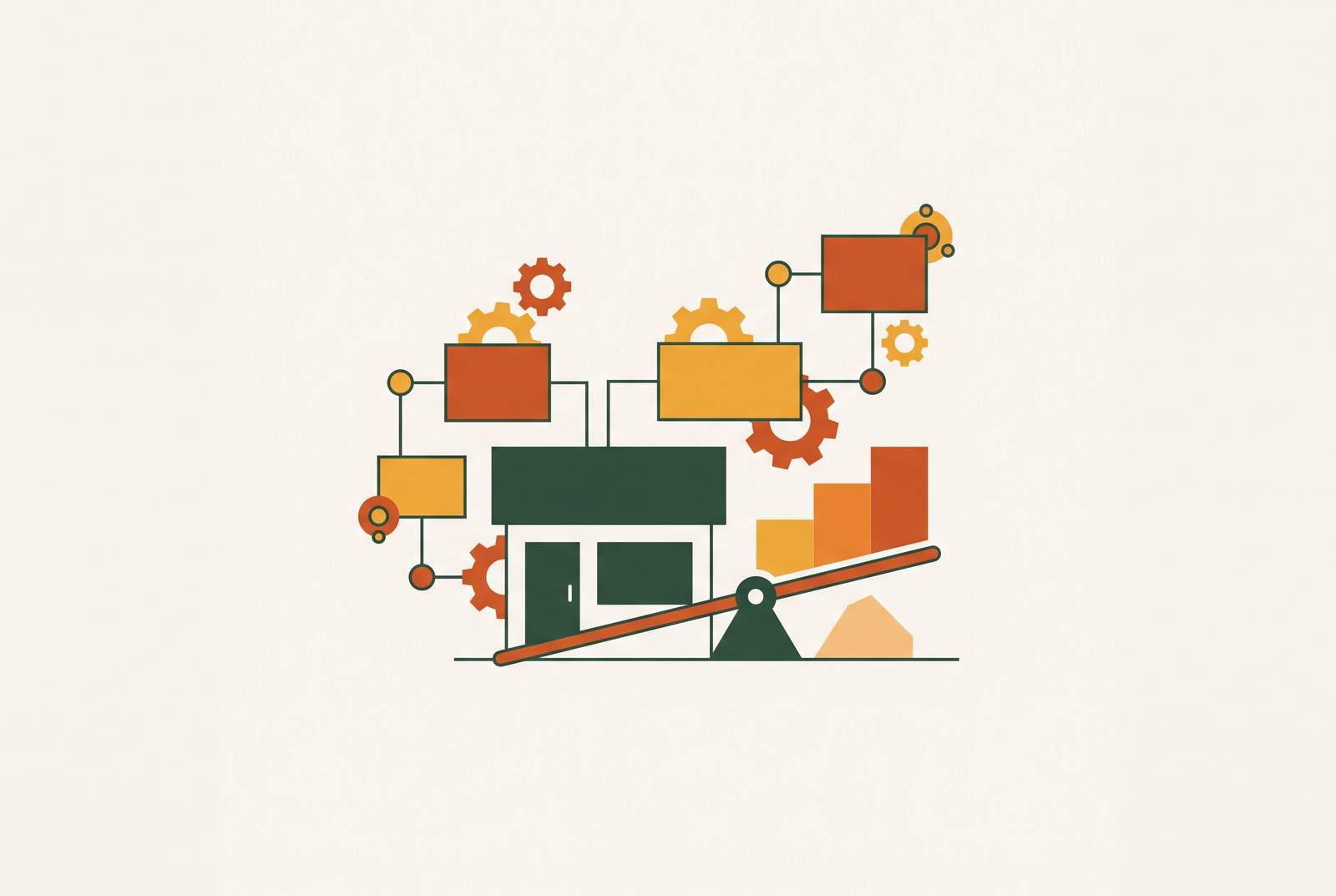
A small accounting firm turns down a new advisory client because every hour in the week is already spoken for, even though the partners have the skill to serve them. That's the real subject of this piece: for small and mid-sized businesses, the barrier to a new service line is rarely talent or ambition. It's operational bandwidth, and automation that targets the right bottleneck changes what a team can take on without changing its headcount.
The ceiling SMBs hit before their ambition
An owner of a ten-to-fifty-person firm knows the feeling well. A client asks about a service the business doesn't offer yet, and the honest answer is "we could, eventually." The hire itself usually waits until enough revenue shows up to justify the salary. So the new offering sits on a list, waiting for proof that may never arrive, because the team is too busy running the business it already has to build the business it wants.
This ceiling is structural. In accounting firms, insurance agencies, logistics brokerages, and general service businesses, the daily load, quoting, onboarding, data entry, scheduling, follow-up, fills every available hour before anyone gets to the work that would grow the firm. Adding a new service line under those conditions means more coordination, and more coordination means another body on payroll. For a ten-to-fifty-person company, that calculation rarely pencils out.
What makes this ceiling easy to miss is that it doesn't look like failure. Revenue is steady. Clients are served. The team is working hard and doing good work. The constraint only becomes visible the moment someone tries to add something new and discovers there's no slack left to add it with. A LinkedIn report on small business growth found that most U.S. small businesses already use AI for narrow tasks, writing emails, summarizing notes, that kind of thing. Far fewer have moved from occasional experimentation to running their operations on it. The gap between trying a tool and rebuilding a workflow around it is exactly where this ceiling holds.
What "removing the ceiling" means in operational terms
The difference that matters is architectural. AI that assists a person who is still doing the job, drafting an email faster, summarizing a document, saves a few minutes here and there. AI built into the actual bottleneck, the step that caps how much work the team can move through, changes the ceiling itself.
A window unit and central air cool a building in fundamentally different ways. A window unit cools the room it's sitting in. It helps, but the rest of the house still runs hot, and someone still has to move it around to get relief where it's needed. Central air is built into the structure of the building. It changes the baseline condition of every room at once, without anyone touching a dial.
Automation layered on top of an unchanged process works like the window unit. It makes one task faster for one person. Automation built into the workflow that owns the bottleneck, the quoting engine, the intake process, the data entry pipeline, changes the baseline capacity of the whole team. When that hour-intensive coordination layer is handled by a system instead of a person, the same five-person team can move materially more volume without hiring anyone. The constraint that used to cap throughput is gone.
This is the shift that separates businesses using AI to save a few hours a week from businesses that change what they're able to offer. One is a productivity gain. The other is a new ceiling, set much higher than the old one.
Why freed capacity converts to new service lines
Freed time doesn't automatically become a new product. The bottleneck removed is the same one that was blocking the new offering in the first place, and that's what turns freed time into a new product. A bottleneck gets automated, delivery capacity opens up, a new offering becomes something the team can actually staff, and revenue follows because the team can now say yes to work it used to turn away.
Consider a freight broker whose team spends its afternoons manually matching loads to carriers. That work consumes the hours that would otherwise go toward quoting new lane types or building a tracking service for existing clients. Nobody is sitting idle. There's simply no room left in the day. Automate the load-matching, and the same team, with the same headcount, now has the hours to build that tracking layer and sell it. The new line was never a staffing problem waiting on a new hire. It was a capacity problem waiting on the old bottleneck to be removed.
An insurance broker faces a version of the same constraint. When a team spends most of its working hours on manual data entry, policy details, renewal dates, client updates, it has no room to take on a new carrier relationship or launch a new policy class, no matter how many prospects are asking for it. Remove the entry burden with a system that handles it directly, so the capacity to serve that new carrier relationship exists without adding a single employee.
The obvious objection deserves a straight answer: freed hours don't sell themselves. Someone still has to scope the new service, build the pricing, and close the client. That's exactly the case for automating the operational bottleneck specifically rather than some peripheral task that only looks productive. When the delivery constraint is gone, what's left for the team to spend its newly freed hours on is judgment, relationships, and sales, the parts of the business that were never candidates for automation in the first place and that actually build a new line.
Pax8's SMB AI Pulse Report found that SMBs using AI are far more likely to say they're ahead of competitors on technology than non-users. That gap reflects more than faster task completion. It reflects a real difference in what each kind of business is capable of delivering.
The functions where automation most reliably opens expansion capacity
Not every automated task frees up expansion capacity. The ones that do share a pattern: high-volume, rules-based coordination work that touches every client or every transaction, the kind of work that scales linearly with headcount until it's automated, at which point it stops scaling with headcount.
Data entry and cross-system synchronization sit at the top of the list. When intake, onboarding, and the movement of data between systems run without manual handling, the team's attention shifts from processing paperwork to making judgment calls, the prerequisite for taking on more complex or higher-margin engagements. An accounting firm that no longer has staff keying in transaction data has staff available to review that data and advise on it instead.
Customer intake and triage matter just as much. Automating first-contact qualification, routing inquiries to the right person, and handling initial responses means a small team can absorb inquiry volume that used to require a dedicated coordinator. That throughput increase makes a new service line serviceable.
Reporting and analytics free up a different kind of capacity. When data aggregation and the reports built from it no longer require someone pulling numbers manually, the team gains visibility into its own operations fast enough to make decisions about new offerings. That visibility can become a service in its own right, sold to clients who don't have it themselves.
Quote and proposal generation deserves particular attention in insurance, freight, and professional services, where the quoting step often caps how many prospects a small team can pursue in a given week. Automate that step, and the number of opportunities the team can chase expands directly, without adding a quoting specialist to the payroll.
JPMorgan Chase Institute's analysis of AI spending among small businesses found that generative AI accounts for 65% of AI service spending in construction in 2025, with similarly heavy concentrations in transportation and warehousing, health care, and professional services. Those are the sectors where data coordination work is heaviest, and where removing that coordination load frees the most capacity.
Automation versus hiring: the economics of expansion
Growth through hiring follows a familiar and constraining pattern. A new service line needs a new hire to deliver it, that hire draws a salary from day one, and margins compress until volume catches up to the cost. Plenty of SMBs know their clients would buy a given service and still don't launch it, because the math on the hire doesn't work until revenue is already there to support it, a condition that can take months or years to materialize.
Growth through automation runs on a different equation. When a bottleneck is removed and a new service line becomes deliverable as a result, the marginal cost of that expansion is the cost of the automation itself, not the recurring cost of a salary. That's a structurally different kind of investment. One scales with a fixed, often one-time cost. The other scales with headcount indefinitely.
None of this argues against hiring. It argues for spending hiring budget differently. Automation handles the operational work, the entry, the matching, the routing, and hiring gets reserved for growth work: relationship-building, business development, the specialized judgment calls that no system should be making. That allocation means a firm's hiring budget goes toward roles that compound its capability over time rather than roles that just keep pace with processing volume.
Pax8's research found that AI-adopting SMBs are more than twice as likely to have increased their technology spending compared to non-adopters. That pattern points to something beyond cost-cutting. The businesses pulling ahead on competitive advantage are treating AI spend as an investment in growth, not a line item aimed at trimming expenses.
How the deployment timeline determines whether expansion happens
Two businesses can automate the same bottleneck and land in entirely different places a year later. What separates a business that actually expands from one running a proof-of-concept that never ships comes down almost entirely to how the engagement is structured from the first week.
Engagements built around lengthy discovery phases, dense scoping documents, and staged pilots tend to stall before anything reaches production. By the time the pilot wraps, the team has already adapted back to its old process, and the window in which a new system would have changed behavior has closed. The appetite for change doesn't last forever, and a slow rollout spends that appetite on paperwork.
The alternative is to identify the single highest-leverage bottleneck inside the first two weeks and build a working production system around it immediately. That gives the team something concrete to use while the organizational energy for change is still there. A working system in production by the end of the first month functions as a turning point for the whole initiative: the team can see, in real operational terms, what capacity has actually opened up, and start scoping a new service line against that real headroom.
LinkedIn's research on small business AI identifies the critical transition as the move from experimentation to adoption. Most businesses haven't made that move yet. Whether a given engagement gets a business there in thirty days or lets the moment pass is a function of how the work is sequenced, not how sophisticated the technology is.
The compounding path from first system to new service line
The first production system does more than return a handful of saved hours. It changes what a team believes is possible for itself, and that shift in belief is what makes scoping the next system, and eventually the next service line, a realistic conversation.
Month one typically produces a working automation of the highest-leverage bottleneck, along with real data on what capacity that automation has freed. Months two and three build on that data: a roadmap for where the freed capacity goes, whether that's a new offering, a new client segment, or a new delivery capability the firm couldn't have staffed six months earlier.
Each system that removes one constraint tends to reveal the next one. An accounting firm might move from automated data entry to automated reporting, and from there to an advisory service line it never had the staff to launch before. A freight broker might move from automated load-matching to a carrier management offering built on the capacity that automation freed. An insurance broker might move from automated policy intake to a commercial lines practice it previously had no room to pursue. Each step builds on the operational intelligence gained from the last one.
Pax8's Q2 2026 SMB AI Pulse Report found that SMBs using AI report significantly more confidence about business growth than those that don't. That confidence tracks a real pattern: compounding automation builds not just freed hours but a clearer sense of what the business is capable of becoming. The ceiling these firms ran into was never a shortage of talent or ambition. It was the absence of systems built to remove the operational constraints standing between them and the work they were already capable of doing.