Why Enterprise AI Implementations Fail When Ported to SMBs
Enterprise AI fails in small businesses because it ignores their missing data, staff, and budgets.

Small businesses can get technical work done without hiring a full-time developer by using embedded engineering help to solve one clear bottleneck, build a production-ready system, and keep it working after launch. Enterprise AI implementations fail when ported to SMBs because they assume data, staff, workflows, and budgets that usually are not there. The alternative is not a smaller software subscription, but an implementation model built around those missing foundations.
Why enterprise AI was built for infrastructure SMBs don't have
Enterprise AI deployments assume that much of the groundwork is already done. Centralized data pipelines supply the inputs, an IT department owns integration, and documented workflows describe what the system must do. Budget covers the disruption of changing how people work. The model starts on an existing foundation. Its job is to add capability to an organization that already has the means to put that capability into use.
Most SMBs approach the same tools from a different starting point. Their data lives in spreadsheets and disconnected apps, while workflows live in the owner’s head or in team habits. The person choosing the tool often has another full-time responsibility, such as operations or accounting. There may be no separate implementation budget at all. Neither side has necessarily made a bad decision, but the deployment assumes resources the business does not have. A tool can work as designed while the system around it never becomes usable.
How high adoption rates mask an equally high failure rate
A large majority of small businesses now use AI in some form, and many report measurable revenue increases. Those results can coexist with shallow use. Access to a tool does not show whether it has become part of a core workflow, and only a small fraction of SMBs have embedded AI that deeply. Adoption measures entry. A business can use AI often and still do the coordination and integration work behind it by hand.
IBM’s 2025 CEO Study found that only about a quarter of AI initiatives delivered expected ROI. That finding covers businesses broadly and exposes the distance between launching an initiative and obtaining its promised return. The gap is especially difficult for smaller firms because they lack the resources enterprise deployments assume. Businesses therefore need the conditions to turn an AI purchase into a working operation.
The four structural conditions enterprise AI requires that SMBs rarely meet
Data readiness is the first condition enterprises assume. Their deployments expect inputs that have been cleaned, standardized, and structured before a model uses them. SMBs often keep customer records in several spreadsheets and split transaction data between point-of-sale and accounting tools, with no data governance policy. AI cannot make those inputs consistent on its own. Layering it over inconsistent inputs can amplify the inconsistency across more work and undermine the trustworthiness of the output.
Enterprises also count on technical ownership as the second condition. A dedicated person is responsible for making the system work, rather than fitting that responsibility around sales, accounting, or operations. In an SMB, one person often does all those jobs. The initiative competes with everything else they do. Without dedicated ownership, integration, troubleshooting, and improvement have no protected place in the working week, even when the business has chosen a suitable tool.
Enterprises count on documented workflows as the third condition. The implementation starts with a description of the process, including the exceptions that affect how work gets done. An SMB may instead rely on informal habits and decisions that only the owner understands. Those exceptions are part of the process too. If they remain unwritten, the implementation has no clear account of the work it is meant to automate, leaving a gap between the apparent process and the real one.
The fourth condition is a budget for implementation and time for change management. Enterprise plans include integration, user training, and the weeks of disruption before a system stabilizes. SMBs are often quoted a subscription instead. That leaves the work around the tool unfunded. The consequence is a deployment that looks affordable at purchase but has no allocated resources for getting it into daily use.
Why the pilot-to-production gap is where most SMB implementations die
A proof-of-concept can show that AI is useful without showing that the business can use the system. It impresses leadership, consumes budget, and appears ready for a wider rollout. Then production exposes requirements that were never scoped, including integration, authentication, compliance, and user training. The demo answered only whether the technology could perform a task.
A property manager coordinating 30+ vendors and spending a significant part of each week on that work has an identifiable capacity constraint. That is a more useful starting point than a general desire for AI-driven efficiency. It names the work and its burden. The project can then be judged against a business outcome.
The reverse failure starts with a broad purchase. Tools are rolled out across the business with no clear problem to solve, and subscriptions go unused. Without a success metric, there is no basis for evaluating ROI, improving the system, or justifying further investment. Deployment alone changes very little about the work. Treating AI as an IT handoff misses the business process that must change for the investment to produce a return.
What the forward-deployed engineer model costs and why SMBs can't afford the enterprise version of it
Enterprises address this gap by embedding a technical specialist in the operation. The forward-deployed engineer handles integration, troubleshooting, and tuning over time while learning how the client’s work gets done. This is not a remote help desk. The engineer makes the technology fit the work, including details that a software demo or a training session cannot settle. The model recognizes that useful AI depends on more than access to a model.
The obstacle for SMBs is the cost structure. At enterprise rates, engineering alone can exceed what a small business can justify annually, before travel, overhead, and vendor margin. The brief gives no single price for that work, and one figure would hide how much the scope can vary. A business without a dedicated technical budget cannot simply adopt an engagement designed for one.
What SMBs often receive instead is pre-packaged software, limited customization, remote support, and training sessions. Those services serve a purpose, but they are not equivalent to someone solving problems inside the workflow. Short embedded engagements can leave another gap. If knowledge transfer is incomplete, the internal team cannot maintain or extend what was built. Each significant change then requires the vendor to return, turning a temporary engagement into a recurring dependency.
How can a small business get technical capacity without hiring a full-time developer?
An SMB-appropriate implementation model needs the same connection between engineering and operations, but with narrower scope and a different definition of completion. It begins with one high-leverage bottleneck, one measurable outcome, and one accountable owner. Tool selection follows that diagnosis. Stanford Digital Economy Lab’s review of successful AI deployments found that results depended on how the business was set up, including sponsorship and process readiness. The owner must therefore take responsibility for what the business gains as well as for getting the software into use.
IBM’s study found that a majority of CEOs see integrated data architecture as critical for cross-functional collaboration, while a large majority see proprietary data as key to generative AI value. An SMB can begin useful work without first setting up a data program for the whole company. The immediate task is much more specific. The inputs within the chosen workflow need to be consistent and structured enough for the system to use reliably.
The build should then use rule-based workflows for predictable operations and AI where unstructured information or judgment is required. Bounded tasks such as lead enrichment, meeting transcription, and support deflection for documented query types are more verifiable than a chain of agents passing work between themselves. Every handoff adds a reliability concern. Multi-agent orchestration is still experimental, and people need to watch it closely when it serves customers or does work that revenue depends on. After launch, someone must keep managing integrations, exceptions, and changes to the workflow.
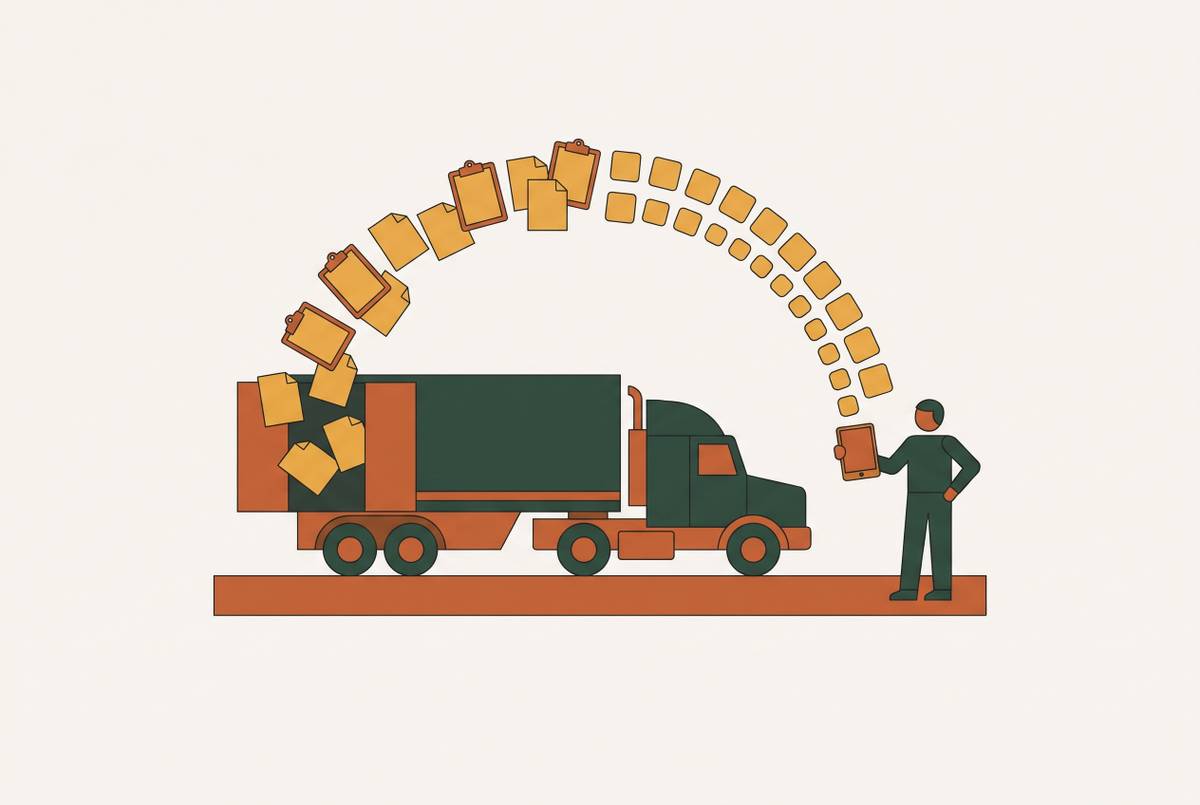
SANSA applies this model through a three-stage engagement. A short diagnostic identifies the highest-leverage bottleneck, a production-ready build addresses it, and the team stays embedded as the system develops. Its examples include a dramatic reduction in manual data entry for a wholesale insurance broker and 160+ hours a month recovered for a paper freight company. Both were done without six-figure consulting contracts or months spent hiring. These are examples of a scoped alternative to adding full-time technical staff.
Why "AI instead of hiring" is the wrong frame and what the right trade-off actually looks like
The choice is not simply software or another employee. A subscription gives the business access to a tool, embedded engineering help covers implementation and technical work over time, and hiring brings in a person who can take on work that needs judgment. These options solve different constraints. Treating AI only as a headcount substitute encourages businesses to underinvest in the integration and management that make it useful. Businesses need to distinguish work that needs automation, work that needs technical ownership, and work that still needs a person’s judgment.
Intuit QuickBooks’ 2026 AI Impact Report found that small businesses using AI were much more likely to say they had hired more people than fewer people. The report drew on tens of thousands of small business surveys. That finding challenges the simple replacement story without proving what any individual business should do. Role redesign is the more useful frame. A company that planned to hire two support coordinators may instead hire one person to supervise automations, review exceptions, and improve workflows.
There is a genuine trade-off in that redesign. Removing simpler tasks can also remove the work through which junior employees learn to exercise judgment. The response is to redesign the learning loop while continuing to automate. At the same time, embedded systems can let a five-person team quote faster, offer a service line it could not staff before, or make decisions that previously required an unaffordable specialist. SANSA’s positioning rests on that expansion of capability. Access to supporting systems was the constraint.
The sequence that separates SMB implementations that compound from those that stall
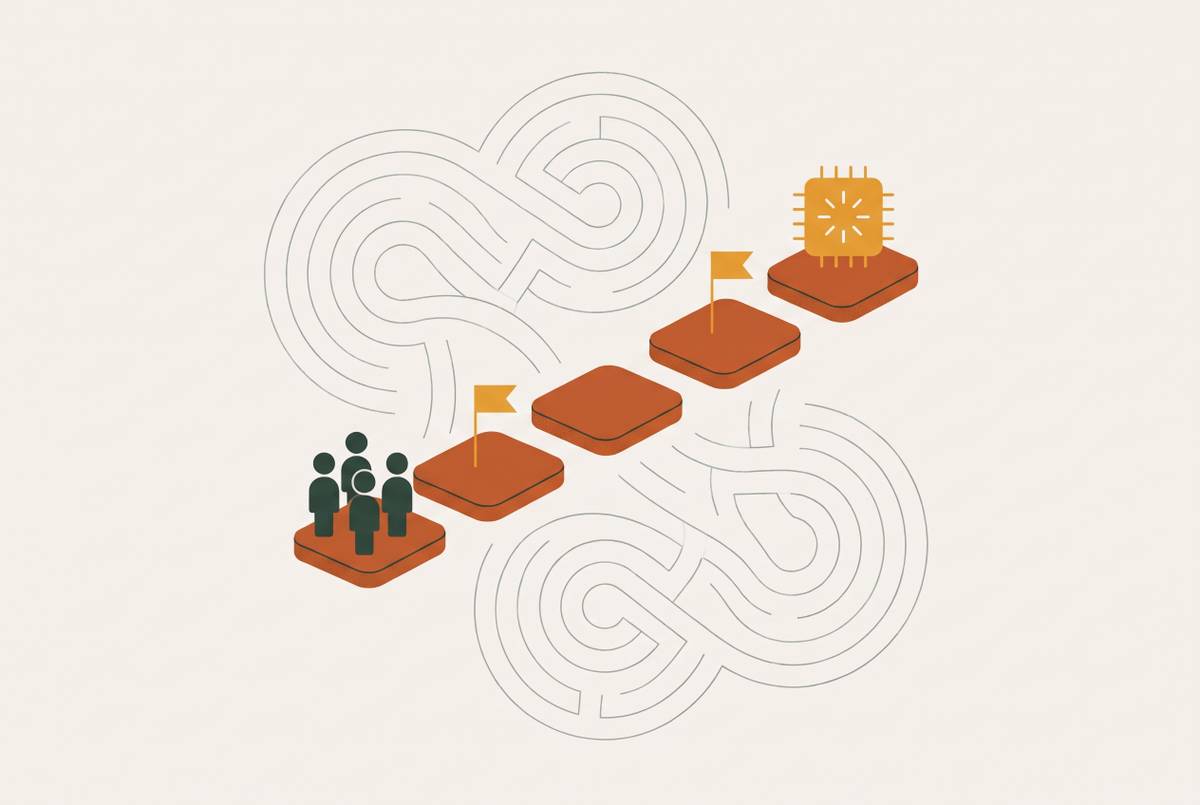
The practical sequence begins by naming the workflow where time or capacity is the binding constraint. A team in that position should define an outcome it can measure before selecting a tool. If the problem is too vague to measure, implementation is not ready to start. Scope comes before the delivery clock starts. A 30-day benchmark is achievable for a scoped lead-response workflow that connects form submission to an AI agent that qualifies, responds, and schedules, but that window depends on setting the boundary first.
The next step is to clean the data within that boundary, then build one function around one metric and one timebox. This preparation is limited to the data within the chosen workflow. The inputs need to be complete and consistent enough for the chosen task. Deploying across the business with one 30-minute introduction and no success metric leaves the central implementation questions unanswered.
Launch then becomes the start of ongoing management. Someone stays close enough to catch edge cases, fix integrations, and add to the system as the business changes. Time for change management belongs in the plan as well, because adoption depends on people changing their work. The next capability follows from a working first deployment. Once routine coordination no longer consumes the team’s time, the business can use that capacity to respond faster or take on work it previously could not support, with an established owner and a system that can be extended.