How Trucking SMBs Eliminate Manual Data Entry Without Adding Headcount
Automating document intake first cuts errors and triples dispatcher capacity.
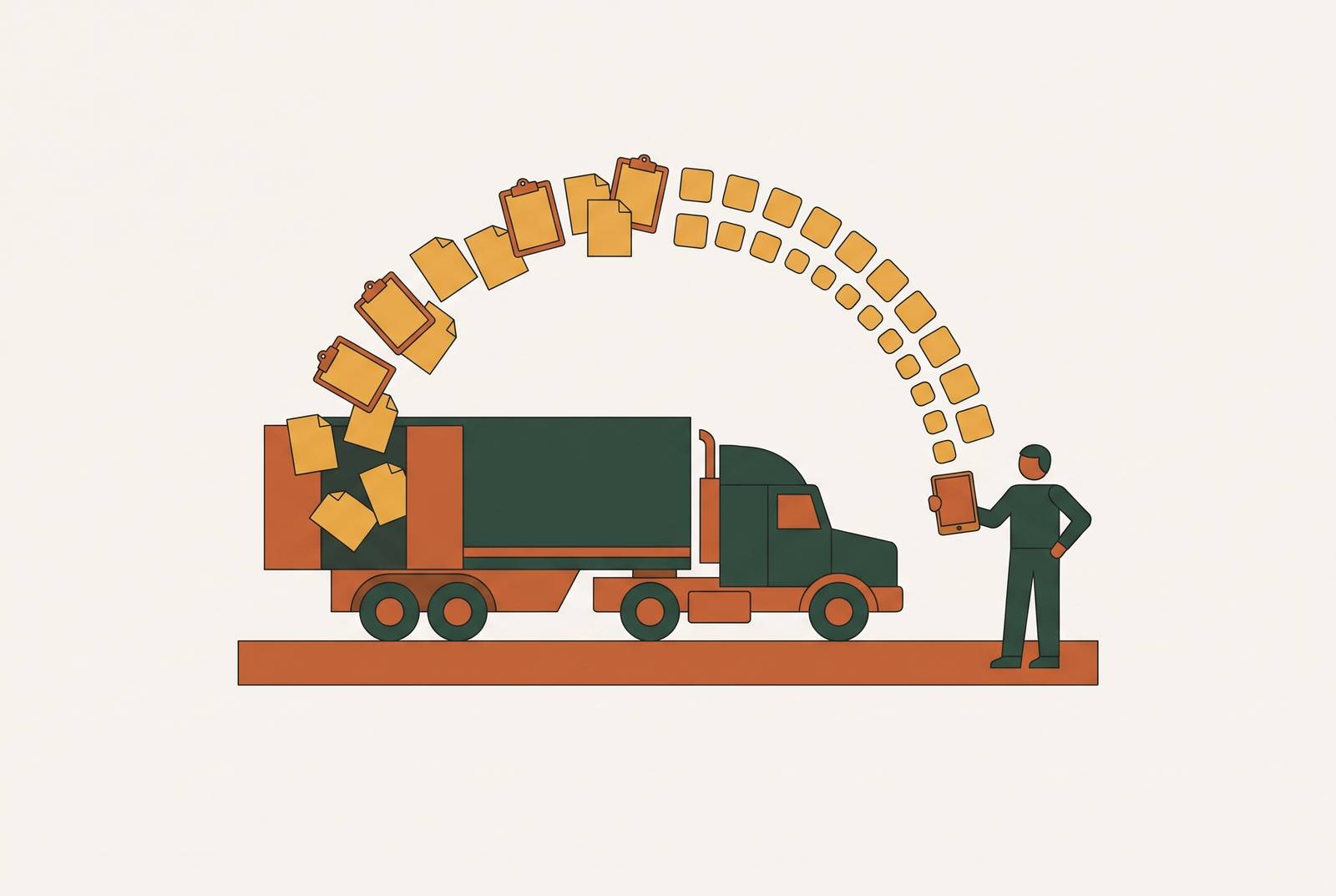
Trucking SMBs eliminate manual data entry without adding headcount by automating the load record in order, starting with document intake, then status updates, then billing. AI automation for freight and logistics SMBs works best when it removes re-keying at the source. Each stage gives the next cleaner data, so the same team can handle more loads and invoice sooner.
Why manual data entry is trucking's most expensive workflow problem
Every time someone retypes a rate confirmation, BOL or POD, another error can enter the load record. That error does not stay in dispatch. A miskeyed rate or commodity code can later cause a billing dispute, a rejected factoring invoice or an accessorial fight. Revenova’s Danielle Chaffin describes the connection directly. “Billing errors, accessorial disputes, late invoicing … those originate at the point of load creation and quoting, when unstructured data gets manually re-keyed and errors enter the system”.
For a small carrier, these handoffs also limit how much work the existing staff can process. The same team doing the work for five trucks by hand cannot handle fifteen without more people or less care at each handoff. A transportation management system, or TMS, does not automatically remove that constraint just because it stores the records. BeyondTrucks CEO Hans Galland puts the distinction plainly. “Classic TMSs are systems of record. They're not systems of action”. These systems still need a way to pass information through the work without making someone enter it again.
Why the sequence of what you automate first determines whether it works
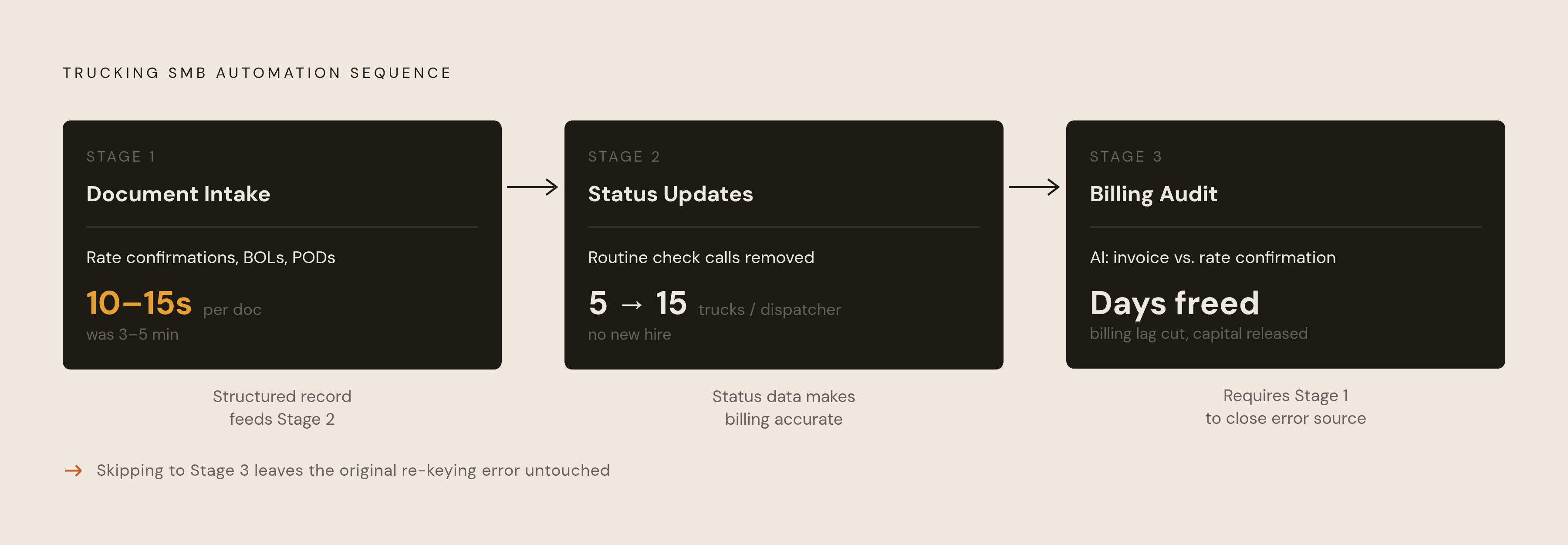
Automating billing before fixing intake leaves the original error source untouched. An invoice agent may work faster, but it still depends on the rate, documents and delivery information it receives. The useful order follows that dependency, with document intake first, status updates and check calls second, and billing third. Intake puts load data into a structured record, status automation keeps it up to date, and billing turns the finished record into an invoice.
Before that work starts, the TMS needs one clean record for each load. The rate confirmation, BOL, POD, carrier identifiers and accessorials belong with the same load, rather than being scattered across disconnected records. This is a bounded cleanup. Without it, an agent can update the wrong load or work from a rate that someone renegotiated by phone. The claim that the team will clean up its data after automation reverses the dependency.
Magnus Technologies CEO Matt Cartwright states the starting point clearly. “The first thing you have to do is define a problem… define a process that has inefficiency”. For an SMB choosing tools, that means naming the handoff that fails and looking past a broad promise of AI productivity. There is little to improve in a process that already works well. A handoff that keeps going wrong gives automation a clear job, if the record it works from is usable.
Stage one: document intake, where the biggest error reduction happens fastest
Document intake takes out the step where someone types in data by hand and errors first enter the load record. Datatruck co-founder Bek Ergashev gives a concrete comparison for the work. “Before, it took about three to five minutes. Today it takes about 10 to 15 seconds”. McLeod Software similarly reduced email-based order processing from five minutes or more to a fraction of that time. These are repeatable tasks across incoming loads. Spending less time on each document therefore frees up time throughout the day, beyond what an occasional administrative job would save.
The gain is not just faster typing. AI document processing extracts information from rate confirmations, BOLs and PODs without requiring a person to re-key each field. It can also flag discrepancies before they reach invoicing, including an incomplete or mismatched POD that could cause a factoring company to reject the invoice. Ergashev connects document quality directly to payment acceptance. “If your POD is not qualitative enough… factoring companies may reject your invoice. Today, this routine task is eliminated”. Catching that problem at intake keeps it from becoming a later billing interruption.
Carrier Logistics uses AI to extract BOL data and create shipments automatically. In multi-stop LTL work, getting the data earlier lets optimization run sooner, so there is less risk of missing windows.
Highway’s Q2 2026 Freight Fraud Index classified roughly half of all fraud vectors as communication-based, including compromised inboxes, spoofed emails and impersonation calls. The shared inbox is therefore also a fraud entry point. Discrepancy flagging provides a screen, though it is not proof that every incoming message is genuine. Once intake produces a structured load record, the next system has something reliable to track, including the load’s identity and the information needed to connect updates to it.
Stage two: status updates and check calls, where dispatcher capacity is actually recovered
Clean load records make it possible to remove routine check calls from the dispatcher’s day. Datatruck’s Ergashev describes a tripling of per-dispatcher throughput, expressed as a move from five trucks to fifteen without a hire. That is a different operating capacity. Document intake shortens each transaction, while status automation takes over repeated work that otherwise follows the dispatcher from one load to the next.
Tai Software’s track-and-trace voice agent contacts drivers, logs updates and adjusts shipment status without human intervention, operating around the clock. The broader workflow connects a location update to an appointment window, updates the TMS and messages the customer. Telematics feeds make that comparison more reliable than another round of manual entry. Samsara and Motive publish location and hours-of-service APIs, while project44, FourKites, Descartes MacroPoint and Trucker Tools expose tracking through APIs or file feeds.
The handoff to a person remains essential. Loads with no signal or those running late need human attention, and a breakdown is not just another status message. The purpose of automation is to separate routine progress reporting from situations that need judgment. That distinction lets dispatchers spend more time on the loads that have actually gone wrong.
Ergashev says people still need to make commercial decisions. “I believe that AI is not ready yet to talk to brokers and negotiate the loads”. BeyondTrucks offers a useful example of the assistive model, allowing dispatchers to enter an exception in plain language, such as “avoid this metro during a snowstorm”, and translating it into updated optimization constraints. The person supplies the judgment, and the system applies it. As routine updates become reliable, billing can work from current delivery information instead of waiting for staff to reconstruct what happened.
Stage three: billing and invoice automation, where the cash-flow gain compounds
An invoice cannot go out cleanly until the POD is attached, the rate is confirmed and accessorials are documented. When people do those steps by hand, carriers can wait days or weeks after delivery before they send an invoice. A mismatch with the rate confirmation can then create another delay. Automating only the final invoice does not remove the missing document or wrong rate that held it up.
With clean intake and reliable delivery data, an AI audit agent can compare the carrier invoice with the rate confirmation and flag discrepancies. It can then resolve them automatically or route them to a human. The distinction is important for disputed charges. Automation can perform the comparison without making every disagreement a machine decision, leaving staff to handle the cases that need explanation or negotiation.
C.H. Robinson reported using generative AI agents to complete more than three million shipping-related tasks, removing repetitive manual work and freeing staff for higher-value activities. That is evidence of the broader workflow operating at scale. An SMB’s financial gain comes from its own billing lag. Cutting several days between delivery and invoicing frees up working capital that would otherwise be tied up during the wait, if the cleaner, earlier invoice leads to payment.
The upstream work is what makes that possible. Document intake cuts errors when data is entered, status automation keeps delivery data reliable, and invoice audit checks the bill against the agreed rate. These are linked controls. When they work together, invoice processing no longer has to grow in direct proportion to manual staffing. The company can bill a larger volume of completed work without first building a larger billing department.
What AI still cannot do in trucking back offices, and why that matters for SMBs
AI does not remove the need for people who understand the load, the customer and the commercial relationship. Broker negotiation, breakdown response and exceptions remain human work. The same applies when billing discrepancies require judgment. Ergashev identifies trust as another limit to autonomous negotiation, saying, “I think the next is… when the broker side will start trusting AI”. Until that trust exists, the useful division of labor is assistance.
Calling a tool AI does not prove that it can adapt. AVRL’s Olesen states the standard as “AI should be self-learning. It should be pretrained. It should be implemented and able to learn by itself”. SMBs evaluating vendors should therefore test whether a system adapts or merely executes fixed rules. They should also distinguish that question from data readiness, because inconsistent commodity coding, missing load history and absent ELD integration are problems a product label cannot settle.
How can a small trucking company put AI automation into production without a six-month project?
A 15- or 50-person carrier has little reason to keep an AI integration team on staff. Yet moving an agent from a working concept into production requires integration expertise, data pipeline work and judgment about when to escalate to a person. An embedded AI engagement gives the business access to that work without waiting for a full-time hire to become productive or turning the project into a six-figure consulting exercise.
The deployment discipline is to diagnose the bottleneck first and keep that diagnosis bounded. A two-week diagnosis preserves the rest of a 30-day deployment window for building and embedding the system. The diagnosis should locate the source of downstream damage across intake, status and billing, while checking whether the upstream records are ready. A billing complaint may still point back to document intake as the correct first build.
Datatruck and McLeod show how to save time on documents and order-processing, Tai handles routine tracking messages, and the telematics providers offer feeds that status automation can use. A carrier choosing among them should judge the fit against the handoff it needs to remove, its TMS connections and its human escalation needs. The technology examples show that these tasks can be automated, while the production result depends on how well the pieces fit the operation.
SANSA is an option to evaluate for an embedded engagement around a defined freight workflow. SANSA’s homepage describes a Paper Freight Company case in which comparing freight rates by hand took 160+ hours per month. That figure describes the workload before automation. Its relevance is the bounded task, which gives the engagement a specific piece of work to address with AI.
The first deployment should also make the next one easier. A team that previously had to turn away more loads can take them on, while the capacity recovered creates room for a faster quote, a new service line or a market it could not previously reach.