The Real AI Deployment Timeline for a 50-Person Company When You Skip the Enterprise Playbook
Skip the enterprise playbook and deploy a single workflow in 30 days to unlock capacity.
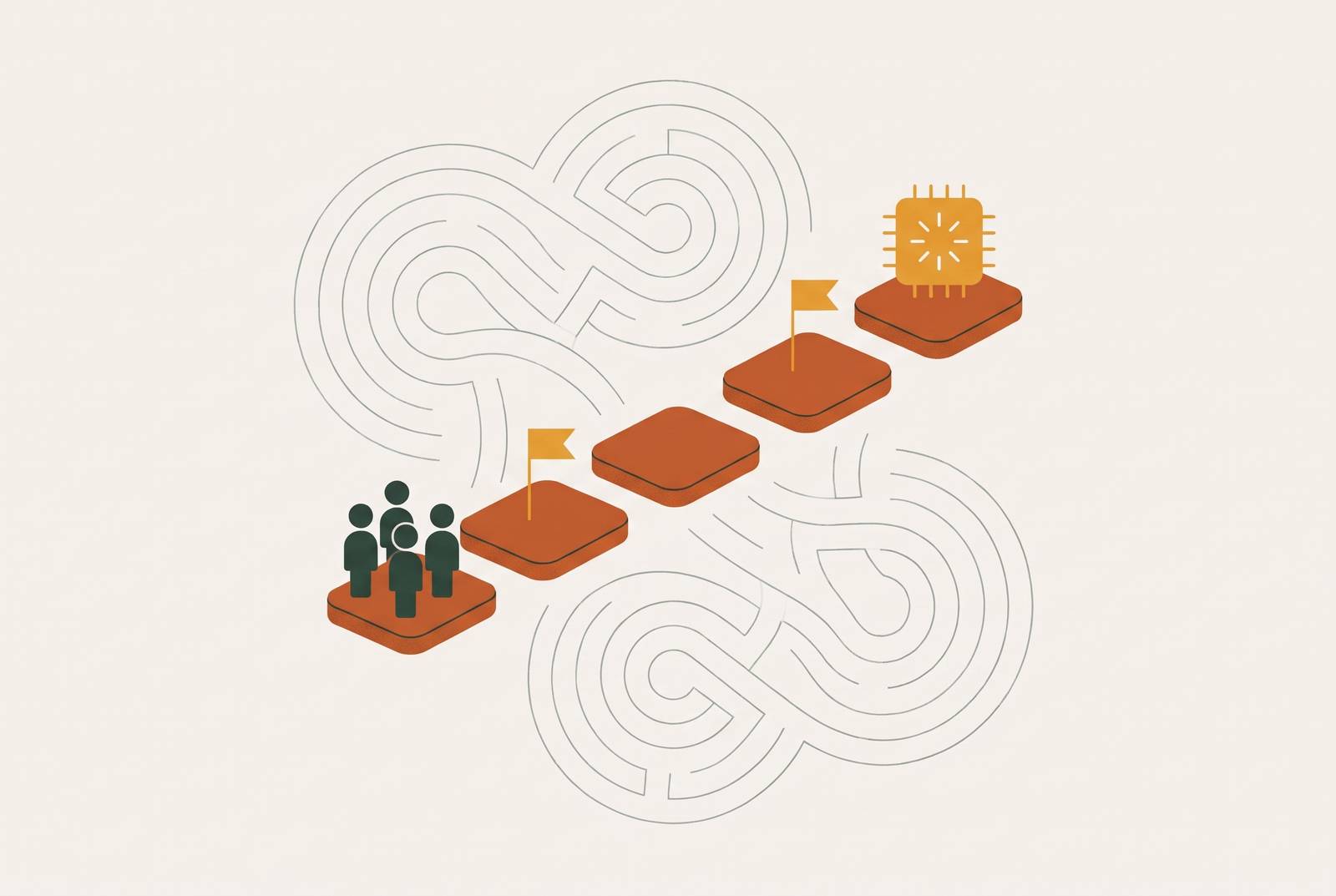
A 50-person company can get a production AI workflow running in 30 days when it targets one operational bottleneck, names one owner, and measures the current process before building.
Why the enterprise AI deployment model fails when you shrink it to 50 people
The enterprise playbook assumes people and time that a 50-person company does not have. Multi-stakeholder committees, phased pilots, months-long discovery, and RFP cycles are designed to manage risk across large organizations with many interdependencies. But a smaller company has no spare committee, dedicated IT procurement team, or six-month runway for postponing decisions while the process runs.
The cost is more than the consulting bill. Every meeting takes people away from their work, and each approval stage has to wait until they are free. A process intended to reduce risk can therefore create a different risk, which is that the deployment consumes the capacity it was supposed to release. Even with a cheaper tool, the company still has to wait for decisions.
Even when that process produces a launch, broad access to generic tools can produce high adoption with low transformation. Individuals save time, but the savings stay on their desks rather than becoming more revenue, lower costs, or greater capacity. Smaller companies also tend to have deployment advantages in their fewer legacy systems, fewer layers of rules, and workflows that are easier to follow. The enterprise playbook actively works against them by adding coordination where a direct decision could have been enough.
What the bottleneck-first approach replaces and why it compresses the timeline
The bottleneck-first approach replaces separate rounds of discovery, alignment, pilot, and rollout with a question about where work stops moving. It asks where the team must wait, intervene manually, hire, or turn work away because a process cannot keep up. The target is one workflow whose friction restricts the business’s capacity.
One workflow has one owner, one set of inputs, and one measurable output, so questions about data, sign-off, and success have a defined place to land. The team still needs to design, test, and oversee the work. The team can make those choices for one workflow and get it running without first having to agree on them for a wide range of possible uses.
The construction company spending a full FTE’s worth of hours on bid preparation illustrates the distinction. “AI for construction” leaves the project open-ended, while bid preparation identifies the work absorbing capacity. The loan officer example also keeps the work within a repeatable email-review-draft sequence. In both cases, the company can start before it has worked out its whole AI strategy. Each gives the deployment a clear object.
That is why a narrow workflow is not automatically a good candidate. A task can be easy to automate without being the task that holds the business back. The bottleneck qualifier ties the build to a business consequence. With that boundary established, a month becomes a plausible delivery window because the team knows what belongs inside the project and what does not.
How long does a 30-day AI deployment take, week by week?
Week 1 is for choosing and locking the process. The team documents how long it takes, who touches it, and its current error or delay rate, then names one person accountable for the result. Without a clean baseline, the final week cannot produce a defensible before-and-after comparison, however impressive the system looks.
The commercial real estate lending firm example gives that boundary a concrete shape. Its workflow covers one connected sequence of email review, rate sheet comparison, a draft response, and a calendar hold. It gives the team one proof point to establish before expansion, with a result that can be compared against the original process.
Week 2 is for redesigning the flow on paper. The team defines where human judgment must stay, including approval gates and exception handling, and identifies the systems of record involved, such as CRM, billing, helpdesk, or email. Tools follow those decisions. Microsoft 365 Copilot and Google Workspace Gemini provide built-in AI across their app suites, while Zapier and Make provide cross-system automation connections.
Week 3 is for building the thinnest production path that can run against real inputs. Output volume and error rate need to be visible from the start, so metering belongs in this build. The immediate target remains bid preparation, even if the design exposes other work that could eventually benefit.
Week 4 is for running actual volume through the system and comparing the results with the baseline. The decision is explicit, whether to scale, iterate, or kill. A four-week experiment that does not work costs a fraction of a six-month enterprise pilot that does not work, and it leaves the company with a decision.
Where the timeline breaks down and what actually causes it
Scope creep is the first risk, especially while the team is designing the flow on paper. Mapping one process brings nearby problems to light, and adding them to the build can seem to make sense. Each addition changes the project’s integration burden, however, and can push it beyond what one owner can manage clearly. A broader deployment is a different kind of project. It is not simply the same month-long build with a few more tasks attached.
Missing or dirty baseline data can cause the build to fail in a different way. The team can finish the build on time but get to week 4 without knowing whether it has made anything better. Without a starting point it can trust, the team has no firm basis for an ROI claim to the CFO or a decision to expand.
The handoff can undermine a technically successful launch. A consultant or vendor delivers the workflow and leaves, then the team meets edge cases the documentation did not cover. Staff add checks by hand to make up for this, so the team never gets the full gain it expected. The system is delivered but not fully trusted. That loss can remain invisible on the project budget while the business runs a parallel manual process for months.
Governance is a fourth concern. An AI agent standards initiative names distinct agent identity, runtime security monitoring, and supply chain integrity as issues that the team needs to plan for when it deploys the system. Even with a narrow scope, the team still has to meet those obligations. It gives the team a smaller governance surface than a broad deployment, so the required controls can be considered against a defined workflow.
Why staying embedded after launch is where the compounding actually starts
An embedded model keeps the builder close to the work after launch so the team has support for edge cases the documentation did not cover. That proximity exposes decisions that never made it into the process document and allows the workflow to be tuned as the builder observes those decisions in the work. Edge cases often contain the most risk and value, so treating them as afterthoughts leaves the system weakest where judgment counts most.
This changes what completion means after week 4. The first live workflow becomes something to improve against actual work, rather than an artifact passed to the team with instructions. Its baseline then provides the evidence for a second deployment aimed at the next bottleneck. The first result funds a clearer decision. Over 12 months, three to five production use cases can generate combined capacity gains equivalent to one to two additional FTEs without hiring.
SANSA follows this pattern with a two-week diagnosis, a production-ready system built around the opportunity that could make the biggest difference, and an embedded relationship that lasts beyond the first win. Its insurance broker example shows a large drop in the amount of manual data entry. Its freight company example centers on hundreds of hours a month freed from the work.
Getting a system live is an initial milestone, while reclaiming capacity depends on whether people can rely on it during real work. Staying embedded connects those two outcomes. It also gives the next investment a firmer basis than enthusiasm about the first tool.
What the hire-vs-automate decision actually looks like at the bottleneck
Once the constraint is visible, the consequential decision is often whether to hire or automate. The answer depends on the contents of the queue. Repetitive, rules-based, measurable work presents a different problem from work that requires trust, creativity, or complex judgment. Treating both as a need for more staff hides the choice the company has to make.
The practical rule is to automate the repetitive work first and hire for judgment-heavy work. Those actions are compatible, and their order changes what the new hire will spend time doing. Freed capacity can make room for more skilled work. The aggregate picture among AI-adopting SMBs is more hiring, so the useful frame is sequencing.
The cost comparison needs the same discipline. AI should not be priced against a skilled employee as though their entire contribution consists of tasks a system can handle. The relevant comparison is with the repetitive work absorbing that person’s day and blocking throughput. Narrowing the comparison makes it more honest. It also separates time released from money saved, since a reduction in task hours does not automatically reduce payroll.
The customer service AI agent case identifies the measures that belong in this decision, including implementation cost, monthly operating cost, weekly hours saved, additional monthly revenue, and payback period. Those measures belong in the week-1 baseline conversation. The decision then becomes whether automation removes the defined constraint faster, and what human work remains once it does.
How to read your own operation for the first bottleneck worth automating
Start the diagnostic by listing the five workflows where work most often piles up, slows down, or needs someone to step in by hand before it can move forward. Score each against volume, structure, and ownership. A candidate needs all three to be a sound starting point, regardless of how painful or visible it feels.
Volume asks whether the task repeats often enough for a small saving to accumulate. A workflow that runs twice a month offers a different return from one that runs many times a day. Frequency alone is not sufficient, though. Structure asks whether the inputs are alike enough to build a system around or need fresh judgment each time.
Highly variable, judgment-dependent inputs require a human in the loop and can push the deployment into an emerging-use-case tier with a three-to-six-month timeline. That makes the workflow a poor fit for the first 30-day deployment. Ownership supplies the final test, which is whether one person can make decisions about the workflow end-to-end without recreating the alignment overhead the model is meant to avoid.
Choose the workflow that scores highest across all three criteria. SANSA’s two-week diagnosis is the professional version of this same process, aimed at finding the highest-leverage opportunity before building around it. Completing it leaves the company ready to start week 1 of the calendar with a candidate to lock, an owner to name, and a baseline to record.